Study Guide
13. Identifying the goods
13.3. Online HS and national tariff classification tools
Classifiers may also consult government-maintained online tariff resources, many of which now include explanatory notes, classification guidance, and access to national tariff measures. These tools can help confirm understanding and provide context, but they should be used only as an aid; the classifier must still base the final assessment on the actual goods in their condition as imported.
These tools matter today because, in an age of increasing digitalization of international trade, many Customs administrations and Ministries of Economy and Trade now provide readily accessible and easy-to-navigate online tariff platforms as a public service. Common features include:
|
01 Searchable HS databases Look up Harmonized System codes by keyword, description, or product category. |
02 National tariff schedules View duty rates and tariff structures applicable in a specific country. |
03 Explanatory notes Access official guidance that clarifies how headings and subheadings apply. |
|
04 Classification guides Worked examples of how common goods have been classified by authorities. |
05 Binding rulings access Search prior decisions such as EU Binding Tariff Information(BTI) and US CROSS rulings issued on past importations. |
06 AI-assisted search In some cases, machine-learning search functions help locate likely classifications. |
These tools are increasingly used by traders and logistics staff to understand tariff structures and explore possible classifications. The European Union's TARIC platform is one widely used example.
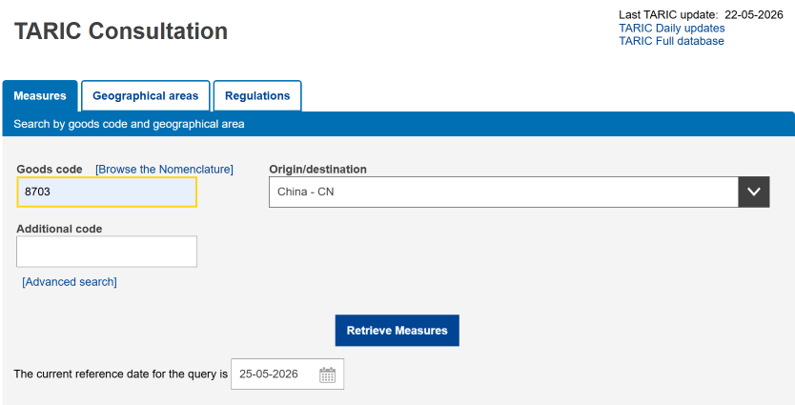
European Union – TARIC Online Tariff
Online tools can help users:
- navigate headings and subheadings
- compare national tariff treatments
- understand duty rates and national measures
- view examples of previously classified goods
- generate preliminary classification ideas
|
Note: AI tools Artificial intelligence tools are increasingly being developed to assist with tariff classification. These systems typically analyze product descriptions, technical specifications, or historical classification data to suggest possible HS codes. While such tools can be useful for initial orientation, their maturity and reliability vary significantly across providers. Most AI systems are still dependent on the quality of the input data, and many struggle with ambiguous descriptions, multi-material goods, or items requiring technical interpretation under the General Rules of Interpretation. AI classification tools may therefore provide a helpful indication or time‑saving starting point, but they are no substitute for a human classifier who retains ultimate responsibility for correctly applying the HS rules and following due process on each occasion. |
|
|
Example: A shipment arrives described only as “plastic fittings.” Using a national or supra‑national online tariff tool, for example, the EU’s TARIC to compare headings and legal notes, or the US CROSS ruling database to review how similar goods have been classified, the classifier can see the types of information Customs has relied upon in previous cases. This helps them ask the right questions and narrow down the correct classification. |
|
Note: Online tools are aids, not authorities. They support classification, but must always be used alongside the HS structure, the Interpretation Rules, and the physical characteristics of the goods themselves and the condition in which they are imported. |