Study Guide
The need for Risk Management in International Transactions
All international commercial transactions require careful management of risks and costs among the parties involved — principally the Seller and the Buyer. However, modern trade involves many service providers, each with its own interests to protect, particularly when unforeseen circumstances arise.
Typical international trade transaction example
The following steps outline a typical simple international trade transaction, illustrating the parties involved and the risks at each stage.
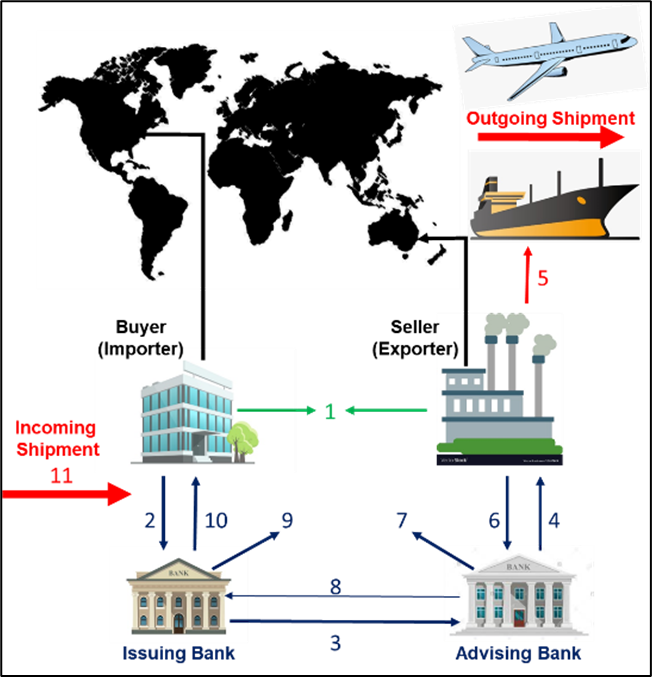
- Seller and Buyer conclude a sales contract, with method of payment usually by letter of credit (documentary credit).
- Buyer applies to issuing bank, usually in Buyer’s country, for letter of credit in favour of Seller (beneficiary).
- The issuing bank requests a correspondent bank, usually in the Seller’s country, to advise and typically confirm the credit.
- The advising bank, usually in Seller’s country, forwards letter of credit to Seller informing about the terms and conditions of credit.
- If credit terms and conditions conform to sales contract, the Seller prepares goods and documentation and arranges delivery of goods to carrier.
- The Seller presents documents evidencing the shipment and draft (bill of exchange) to paying, accepting or negotiating bank named in the credit (the advising bank usually), or any bank willing to negotiate under the terms of credit.
- The bank examines the documents and draft for compliance with credit terms. If satisfied, it pays, accepts, or negotiates.
- If this is not the issuing bank, it forwards the documents and draft to the issuing bank.
- The issuing bank examines the documents for compliance. If satisfied, the Seller’s draft is honoured.
- Documents released to the Buyer after payment or on other terms agreed between the bank and the Buyer.
The Buyer surrenders bill of lading to carrier (in case of ocean freight) in exchange for the goods or the delivery order.
(Source: Export Council of Australia, 2022)
|
Note As this process highlights, even the simplest international transaction can involve more than six key parties and upwards of 50 people — most of whom the Buyer and Seller will never meet. |
The following hypothetical illustrates the kinds of risk that can emerge:
|
💡Hypothetical scenario – Risk Management in International Transactions A freight forwarder is asked to use their own “in-house” insurance policy for the carriage of goods. The Buyer assumes that all is in order; signs the policy and does not check its scope. A claim occurs outside the scope of the policy. How important is the client to the freight forwarder? Is it worth putting pressure on the insurance broker, or will they suffer the loss of a client? What if one of the banks involved in the payment process closes its doors? The Buyer and Seller don’t use a proper term of sale and make assumptions on both sides. The logistics provider makes its own assumptions in good faith and moves the freight accordingly. The Seller (or Buyer) ends up with an unexpected bill after the carriage of the goods has occurred. Who will pay the bill? |