Study Guide
Key Documents for Air Carriage
In air transport, there is one main type of carriage contract: the Air Waybill. The Air Waybill serves as a receipt for the goods and as evidence of the contract of carriage.
It is generally not negotiable and does not function as a document of title. This is because goods transported by air usually arrive before the documents, making a negotiable document unnecessary.
In some cases, a negotiable Air Waybill may be issued if the parties specifically request it.
A contract of carriage may be made between the consignor and the carrier, or between an air freight forwarder and the carrier. The forwarder may act as agent for the cargo owner or as a contracting carrier in its own right. Both the contracting carrier and the actual carrier are subject to the Guadalajara Convention 1961.
|
Note Unlike a bill of lading, an air waybill is normally made out by the consignor (sometimes completed by the carrier on the consignor’s behalf) and given to the carrier with the goods. The carrier verifies the information by signing the appropriate copy. |
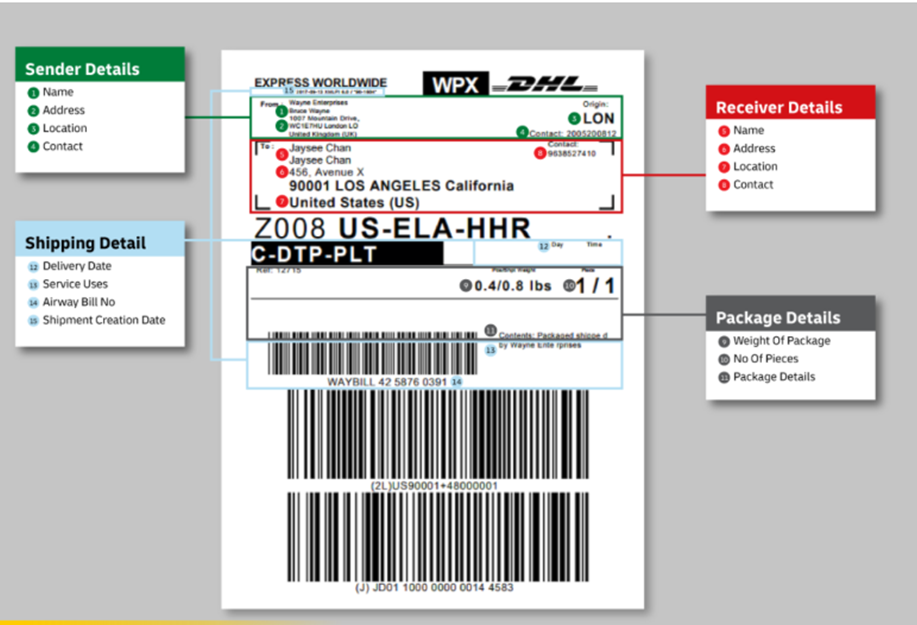
Source: DHL Express Air Waybill Explained
Freight forwarders acting as consolidators may issue Air Waybills (AWBs) in their own name as carriers. In this role, they operate in a similar way to Non-Vessel Operating Common Carriers (NVOCCs) in sea transport.
By grouping multiple consignments together, forwarders can access lower freight rates offered by carriers for larger shipments. This consolidation process is similar to the groupage function used in container shipping.
Consolidators may also provide supporting services at both origin and destination. These can include:
- warehouse handling at the point of departure
- notification of the consignee on arrival
- customs clearance
- insurance arrangements
- door to door delivery
When goods are consolidated, they are typically shipped under a single Air Waybill known as a Master Air Waybill (MAWB), with a cargo manifest listing all consignments attached. The freight forwarder then issues a separate Air Waybill to each shipper, known as a House Air Waybill (HAWB).
As noted, the exporter or consignor often appoints a freight forwarder or consolidator to arrange the transport of goods. The consignor provides a Shipper’s Letter of Instructions, which authorizes the forwarding agent to complete and sign documents, including the Air Waybill, on the consignor’s behalf.
In this situation, the Air Waybill must confirm that the goods have been accepted for carriage. It must be signed or authenticated by the carrier or an agent acting on its behalf. The signature must clearly identify the carrier. If an agent signs or authenticates the document, the name of the carrier and the agent’s authority to act on the carrier’s behalf must be stated.