Study Guide
2. Rules of Origin
2.3. Regional Trade Agreements
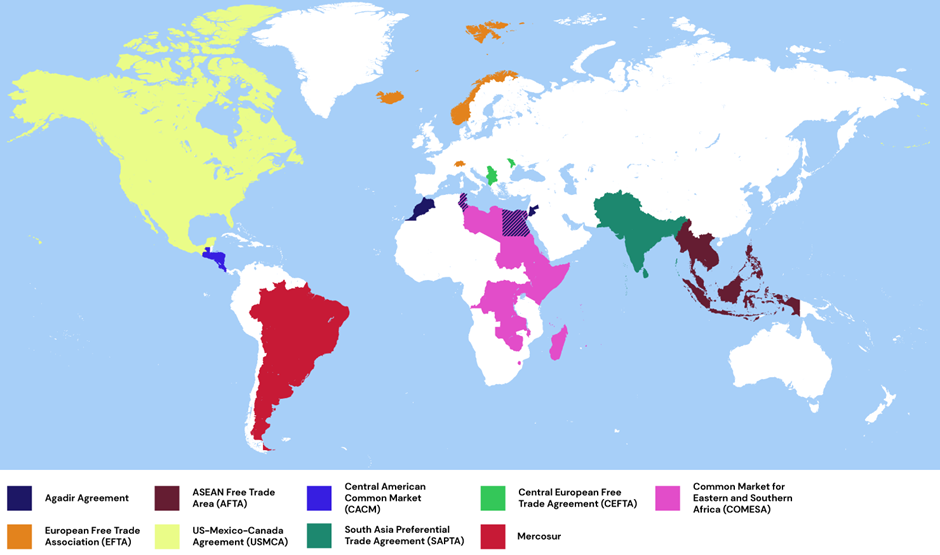
Some of the plurilateral agreements between states or blocs in the same geographic region include:
|
Agreement |
Member states |
||
|
Morocco, Tunisia, Egypt, Jordan |
|||
|
Brunei Darussalam, Cambodia, Indonesia, Lao People’s Democratic Republic, Malaysia, Myanmar, Philippines, Singapore, Thailand, Vietnam |
|||
|
Costa Rica, El Salvador, Guatemala, Honduras, Nicaragua |
|||
|
Albania, Bosnia and Herzegovina, Kosovo, Moldova, Montenegro, North Macedonia, Serbia. Bulgaria, Croatia and Romania’s memberships terminated on EU accession. |
|||
|
Burundi, Comoros, Democratic Republic of Congo, Djibouti, Egypt, Eswatini, Eritrea, Ethiopia, Kenya, Libya, Madagascar, Malawi, Mauritius, Rwanda, Seychelles, Somalia, Republic of Sudan, Tunisia, Uganda, Zambia, Zimbabwe |
|||
|
Iceland, Norway, Switzerland, Liechtenstein |
|||
|
United States-Mexico-Canada Agreement (USMCA) *previously North American Free Trade Agreement (NAFTA) |
Canada, the U.S., Mexico |
||
|
|
Afghanistan, Bangladesh, Bhutan, India, Maldives, Nepal, Pakistan, Sri Lanka |
||
|
|
MERCOSUR |
Argentina, Bolivia, Brazil, Paraguay, Uruguay, Venezuela (suspended). Chile, Colombia, Ecuador, Guyana, Peru and Suriname are associate members; Mexico has observer status. |
|
A full list is available at the WTO website: https://rtais.wto.org/UI/PublicMaintainRTAHome.aspx.
The three tables below show bilateral free trade agreements concluded by Australia, China, and the United States. They illustrate how the bilateral approach has expanded alongside the regional one, and why Certificates of Origin remain central to international trade; they provide the key evidence of entitlement to preferential access to markets.
Australia has bilateral agreements with:
|
Australia has bilateral agreements with: |
|
|
New Zealand |
Indonesia |
|
Singapore |
Hong Kong |
|
United States |
Peru |
|
Thailand |
China |
|
Chile |
Japan |
|
Malaysia |
Korea |
|
India |
United Kingdom |
|
United Arab Emirates |
|
|
The People's Republic of China has bilateral agreements with: |
|
|
Costa Rica |
Chile |
|
Hong Kong |
Macao |
|
Singapore |
New Zealand |
|
Pakistan |
Peru |
|
Australia |
Indonesia |
|
Japan |
South Korea |
|
USA |
Thailand |
|
Iceland |
Switzerland |
|
The United States of America (USA) has bilateral agreements with the following countries and blocs: |
|
|
Australia |
Chile |
|
Bahrain |
Colombia |
|
Singapore |
Israel |
|
Jordan |
Peru |
|
Morocco |
Oman |
|
South Korea |
Dominican Republic/CAFTA |
Most free trade agreements allow members to keep their national tariffs. Rules of Origin are critical for without it, goods from outside the free trade area could be imported into the member with the lowest external tariff and then re-exported to another member as if they qualified for preference.
Well managed origin rules also encourage regional trade in raw materials and intermediate products, because producers prefer to use inputs sourced within the area so their goods qualify for preferential status and gain maximum market access. If the origin process is too expensive or complex to document, businesses may prefer to keep paying the external tariff. This can undermine regional trade.
As GATT rounds continue to reduce Customs duty rates, rules of origin (rather than tariffs themselves) may become the main method of offering some protection to industries within free trade areas, whether formal or informal.
An Oxford academic paper on Rules of Origin identified four ‘Laws’ on the operation and impact of preference within free trade areas:
|
01 Hidden protection ‘Law 1: RoO can insulate an industry from the consequences of an FTA and it can provide hidden protection for intermediate inputs used by it. It may well be that the ability to insulate an industry makes FTAs easier to pass than Customs Unions. Agents who stand to lose from an FTA can undo its effects without, for the most part, even being seen as doing so! For example, in the US-Canada Free Trade Area (FTA), the production of aged cheese from fresh milk does not confer origin. This in effect prevents free trade of cheese in the FTA.’ |
02 Precise form matters ‘Law 2: The precise form of the RoO matters. Lawyers and trade negotiators have clearly understood this for a long time. This is evident in the importance placed on the details of the RoO negotiated. For example, great importance was placed on the treatment of interest costs by Honda when content requirements were being defined for the FTA between the US and Canada.’ |
|
03 Time horizon matters ‘Law 3: The time period matters. Responses to RoO take time. Short-run partial equilibrium effects can differ greatly from long-run, general equilibrium ones. For example, in the short run the response to RoO may be primarily in terms of trade flows, while in the long run it may take the form of investment flows. Hence, it is vital to specify the time frame for analysis and to incorporate the major linkages across sectors and options available to firms.’ |
04 Too much can backfire ‘Law 4: You can have too much of a good thing. Having more restrictive RoO may result in higher, not lower imports! This point is quite subtle and provides a warning to policymakers and potential users that RoO may well backfire!’ |