Study Guide
5. Rules of Origin under the Revised Kyoto Convention
5.3. What do they look like?
There is no prescribed form for a certificate or declaration by the manufacturer. It should, however, describe the goods and indicate that, in accordance with the Customs Act or whichever applicable legislation, the goods are eligible for preference. The name of the person signing the certificate or declaration should also be clearly stated.
A sample form is shown in Annex 1 to Specific Annex K (Reading 3) and actual samples are shown in Figure 4 and Figure 5 below.
How do you obtain a Certificate of Origin?
Australia deals with two types of certificates of origin:
|
Certificate type |
What it certifies |
|
Certificate of Australian Origin |
The location within Australia where the goods were grown, produced or manufactured |
|
Certified Declaration of Origin |
Goods manufactured in countries outside of Australia |
In Australia, a Certificate of Origin can be obtained from a Chamber of Commerce by completing a Declaration of Origin and providing the relevant export documentation. A Declaration of Origin is an affidavit signed by the exporter or their representative certifying the country of growth, production or manufacture of the exported goods. Copies of the following documents must also be provided:
|
01 Commercial invoice Required for every application. |
02 Bill of lading Required for sea freight shipments. |
|
03 House airway bill Required for airfreight shipments. |
04 Letter of credit Required only if applicable to the transaction. |
Some examples of goods that require Certificates of Origin include chemicals, garments, jewelry, meat, pharmaceuticals, rice, sugar, textiles, wool, and wheat.
As Chambers of Commerce are often one of the principal issuing authorities for Certificates of Origin, the ICC provides the following information for its members on its website: ICC Certificates of Origin.
What is a Certificate of Origin?
A Certificate of Origin (CO) is a document attesting that goods in a particular export shipment are wholly obtained or produced or manufactured or processed in a particular country (country of origin). Virtually every country in the world considers the origin of imported goods when determining what duty will be assessed on the goods or, in some cases, whether the goods may be legally imported at all.
There are two types of certificates.
|
Non-Preferential C.O. |
Preferential C.O. |
|
The “ordinary” certificate. Issued by Chambers of Commerce. Certifies the country of origin of a particular product. |
A certificate that enables products to enjoy tariff reduction or exemption when exported to countries extending these privileges. |
|
✘ Does not qualify the product for any preferential treatment. |
✔ Qualifies the product for tariff reduction or exemption. |
|
Used for general country-of-origin documentation, customs records, and commercial purposes. |
Used under schemes such as GSP and Commonwealth Preference Certificate. |
Certificates of origin may be needed to comply with Letters of Credit, foreign Customs requirements, or a buyer’s request.
Unlike the ATA Carnet, there is no international chain among chambers of commerce for the issuance of certificates of origin.
In most countries, Chambers of Commerce are the key agent in the delivery of Certificates of Origin. In some countries, this privilege may also be extended to other industry groups. The role of Chambers of Commerce in delivering Certificates of Origin can be traced back to the 1923 Geneva Convention relating to the Simplification of Customs Formalities (Article 11), eventually updated by the Kyoto Convention.
Under the Convention, signatory governments were obliged to make the process and procedures as simple as possible for companies requiring Certificates of Origin. The State may also allow these certificates to be issued by other organizations “which possess the necessary authority and offer the necessary guarantees” to the State. Due to the widespread network of the Chamber of Commerce community in nearly all countries and its respected reputation in serving the business community, Chambers of Commerce are recognized as the authority to issue a Certificate of Origin.
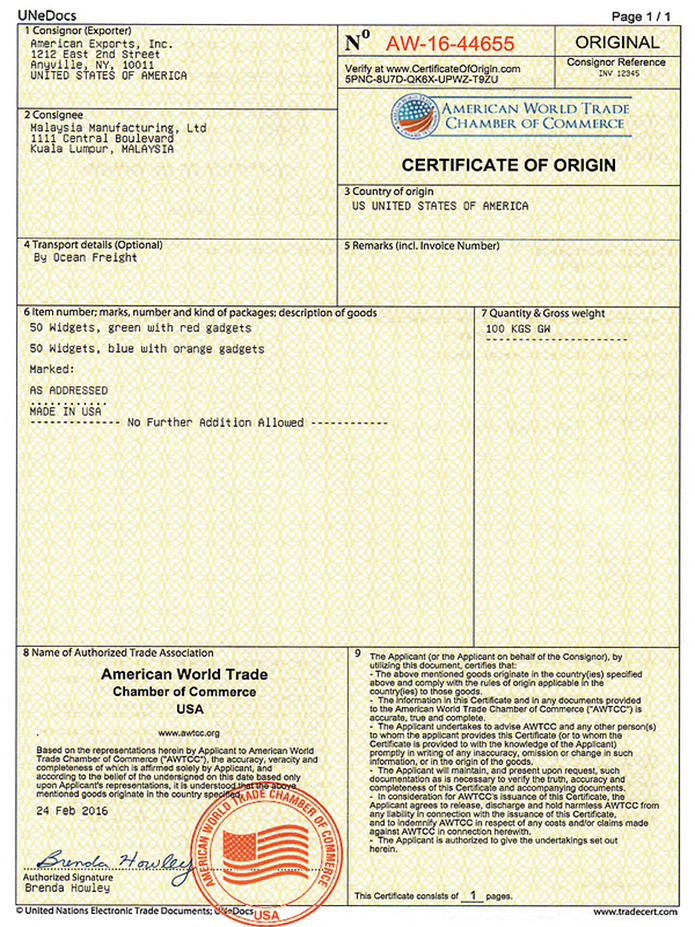
Figure 4: Certificate of Origin
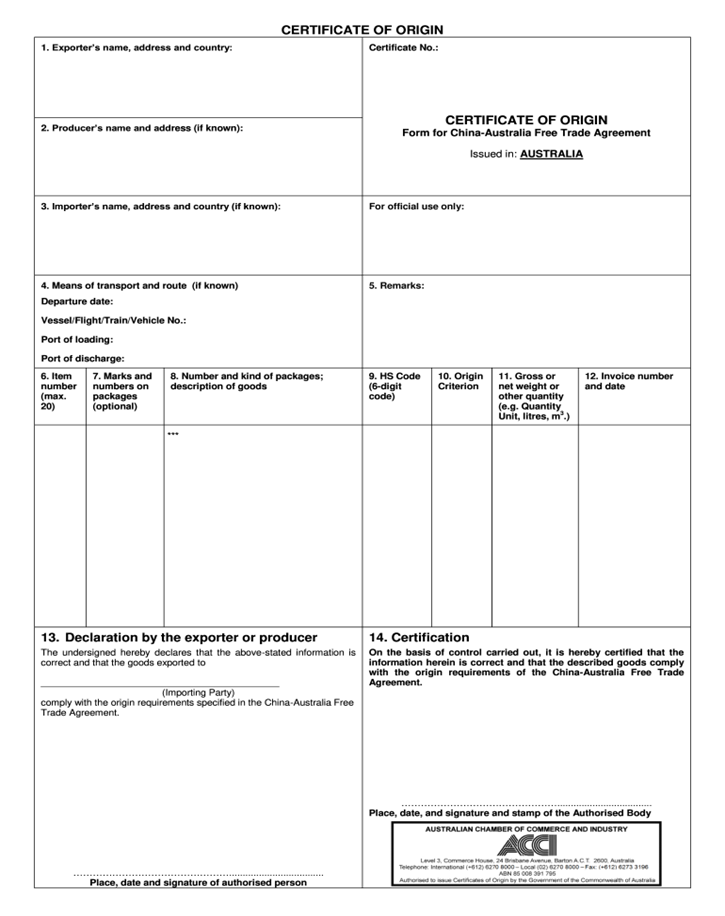
Figure 5: China-Australia Certificate of Origin
Compliance verification
In many countries, Customs operates in a self-assessment environment, where information provided to it is treated in the first instance as true and correct. Underpinning this self-assessment environment are risk management strategies to identify cargo that may require further attention, and a number of compliance management tools including real-time checking of entries and post-entry audits.
Customs’ compliance monitoring may take place at the time of entry, or after the goods are delivered into home consumption. Customs may require an importer to produce supporting information to confirm that the criteria for eligibility for preference rates of duty have been met. This information should be requested from the overseas manufacturer.
If Customs subsequently finds that the goods do not meet the relevant terms and conditions to qualify for preferential treatment, they will demand any duty short-paid and may impose penalties. Additional action may be taken where fraud is involved, including prosecution.