Study Guide
5. Harmonized System Committee (HSC)
5.3. 3. Continuous updating of the HS
Unlike its predecessor, the HS has a built-in system of continual amendment. Goods that are traded change constantly, whether as the result of varying demand or as the result of the progress of technology. A product classification nomenclature is of use only if its structure — the headings, subheadings and legal notes — keeps in step with technical progress.
Amendments can take two forms, depending on whether the scope of a heading needs to change.
Two ways to amend the HS
|
Amend Explanatory Notes only |
Amend the legal texts |
|
Aid to interpretation; the official interpretation of the HS. |
The legal texts themselves: headings, subheadings, and legal notes. |
|
Sometimes enough on its own to achieve the desired objective. |
Required where the scope of a heading or subheading needs to change. |
|
Does NOT alter the scope of the headings or subheadings concerned. |
DOES alter the scope of the headings or subheadings concerned. |
To keep pace with change, the HS runs on a five-year review cycle. Review cycles may look at the Nomenclature as a whole, or address particular sectors — heavy machinery, computer equipment, renewable energy power generation, rare earth elements and so on. The process is intensive, involving detailed submissions and consultation between the HSC and its sub-committees.
Since its inception the HS has undergone six major reviews. The Sixth Review was implemented on 1 January 2022. Work on the Seventh Review is currently underway, and it is scheduled for implementation on 1 January 2028. The cycle was extended from five to six years because of the COVID-19 pandemic.
HS 2028 amendments
The HS 2028 Review introduces significant structural changes across a wide range of product areas. Two themes stand out:
|
01 Public health visibility New and revised subheadings make critical health emergency supplies easier to identify in the nomenclature. |
02 Environment and circular economy Amendments aligned with the Basel, Rotterdam, and Stockholm (BRS) Conventions sharpen distinctions for hazardous waste and support sustainable materials management. |
Public health visibility
A major focus of this edition is the improvement of public health visibility within the nomenclature. New and revised subheadings enhance the identification of critical health emergency supplies, including ambulances, PPE (Personal Protective Equipment), ventilators, diagnostic devices, and other essential medical equipment.
|
|
Example: Vaccine structure overhaul
Splitting human vaccines into their own heading improves clarity and supports global supply-chain control and health-response mechanisms. |
Environment and circular economy
In addition to public health, HS 2028 places strong emphasis on environmental protection and the circular economy (i.e. an economic model that keeps materials and products in use for as long as possible through reuse, repair, recycling and reduced waste). Amendments aligned with the Basel, Rotterdam and Stockholm (BRS) Conventions introduce clearer distinctions for hazardous plastic and electronic waste, waste requiring prior informed consent, and other waste streams.
|
|
Example: e-waste under heading 85.49 New and revised subheadings under heading 85.49 now differentiate between electrical and electronic waste containing hazardous components and other e-waste, reflecting Basel Convention controls on transboundary and traceability movements of such materials. Further changes improve transparency for plastic products, including single use items, supporting pollution reduction policies and sustainable materials management. |
Correlation Tables Between HS Versions
Not all countries implement the same edition of the Harmonized System at the same time, owing to factors such as legislative cycles, IT system readiness and capacity constraints in some administrations, particularly in developing economies. When two trading partners use different HS versions (e.g., HS 2017 vs HS 2022), the same product may appear under different headings or subheadings. This can create confusion, inconsistent declarations, and misclassification risks.
What correlation tables do
The World Customs Organization (WCO) publishes official correlation tables for each HS revision cycle. They show:
|
01 Structural changes Where headings or subheadings have been split, merged, deleted, or renumbered. |
02 Code correspondence How a code in an older HS edition corresponds to a code in the new edition. |
03 Change type Whether changes are structural (affecting classification) or editorial (no change in scope). |
Correlation tables are advisory, not legally binding, but they are essential tools for ensuring continuity and accuracy during transition periods.
|
|
Example 1: Drone (HS 2017 → HS 2022) A Jamaican exporter ships a consumer drone (unmanned aerial vehicle) to Dominica. Both states are CARICOM members, but while the CARICOM Common External Tariff (CET) is officially based on HS 2022, several member states, including Dominica, have not yet transitioned from HS 2017. Exporter A (Jamaica — HS 2022) Jamaica uses HS 2022. The drone is correctly classified as 8806.22 (unmanned aircraft with a maximum take-off weight exceeding 250 g but not exceeding 7 kg). This code appears on the commercial invoice, airway bill, and CARICOM certificate of origin. Importer B (Dominica — HS 2017) Dominica still uses HS 2017. Heading 88.06 does not exist in that edition, so the same drone must be classified under a code that was available at the time. Two options are defensible: 8802.20 (aeroplanes and other aircraft, unladen weight not exceeding 2,000 kg), or 8525.80 (television cameras, digital cameras and video camera recorders), if the drone’s camera function is considered primary. The correct choice depends on how Dominica’s customs authority interprets the product’s essential character. Where importers may get caught out
Quick comparison
The real issue here is HS edition misalignment, not an error by either party. WCO correlation tables allow the importer to identify the correct HS 2017 successor code and resolve the mismatch at clearance. |
||||||||||||
|
|
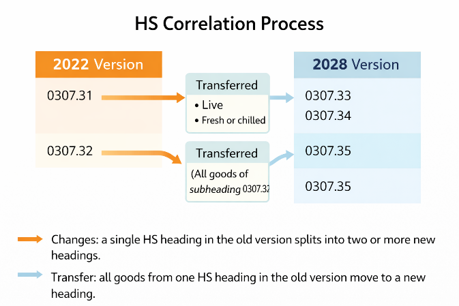
Example 2: Mussels (HS 2022 → HS 2028) Under HS 2022, subheading 0307.31 covers mussels (Mytilus spp., Perna spp.) that are live, fresh or chilled, while 0307.32 covers frozen mussels. In HS 2028, these are reorganized:
This shows how a single subheading in one HS edition can split into multiple new subheadings in the next, reflecting finer distinctions in product condition.
This example shows how HS 2022 subheadings for mussels (live, fresh/chilled, frozen) are reorganized in HS 2028. Subheading 0307.31 (live, fresh or chilled) splits into two new subheadings (0307.33 and 0307.34), while subheading 0307.32 (frozen) transfers entirely to 0307.35. This illustrates how correlation tables track splits, transfers and structural changes between HS editions. |
|
Key point Correlation tables help explain why a supplier’s HS code may differ from the importing country’s tariff and why DHL staff must always classify using the HS version in force in the country of importation. |