Study Guide
| Site: | Centre for Customs and Excise Studies |
| Course: | DHL International Customs Program 2026: Cohort 2 |
| Book: | Study Guide |
| Printed by: | Guest user |
| Date: | Friday, 16 October 2026, 11:10 PM |
Table of contents
- 1. Introduction
- 2. What is an International Trade Transaction?
- 3. International Commercial Terms (Incoterms®)
- 4. The Contract of Sale
- 5. International Carriage of Goods
- 5.1. International Carriage of Goods by Sea
- 5.2. Comparing the different Convention regimes
- 5.3. Contract of Carriage – The Bill of Lading
- 5.4. Sea Waybills
- 5.5. Voyage Charterparties
- 5.6. Marine Insurance
- 5.7. Case Study: Commercial Practice in Action
- 5.8. International Carriage of Goods by Air
- 5.9. Legal Framework for Carriage by Air
- 5.10. Key Documents for Air Carriage
- 5.11. Carriage of goods by multimodal transport
- 5.12. Universal Postal Union Standards
- 5.13. CN22 Form
- 5.14. CN23 Form
- 5.15. Electronic Advance Data (EAD)
Introduction
This module introduces participants to international trade processes — specifically, what is involved in a typical international commercial transaction, and the key commercial documents used in that process.
International trade has two main dimensions: a commercial side and a regulatory or government side. The regulatory side — including Customs administration of bilateral, regional, and multilateral agreements — is covered in later modules. This module focuses on the commercial aspects and their underlying legal framework, covering the following topics:
• What is an International Trade Transaction?
• Incoterms®
• The Contract of Sale
• International Carriage of Goods
This module introduces financing and insurance but does not cover them in detail, focusing instead on the overall transaction process and the international movement of goods.
What is an International Trade Transaction?
|
Learning Objectives
|
At its simplest, an international trade transaction is generally understood as a transaction between parties located in different countries. However, in practice, the definition is more complex.
One approach defines an international sale based on whether goods are transported from one country to another. A more widely accepted approach, reflected in international conventions, defines it based on the location of the parties’ places of business.
An international sale also involves decisions on payment method, insurance, and carriage. Because there is a time gap between export and delivery, a key legal issue is determining when ownership of the goods passes from the seller to the buyer.
Contracts for the international sale of goods have characteristics not found in domestic contracts, arising from several factors:
· Formation at a distance: Most contracts are concluded with parties in the same room. International contracts of sale are often generated and negotiated electronically across the globe, sometimes between parties with no prior relationship.
· Interdependence of contracts: International contracts of sale are closely linked to — and often dependent on — contracts for carriage, insurance, and financing.
· Regulatory compliance: Parties must comply with government controls on the movement of goods across borders, including import and export controls, customs duties, and health inspection requirements.
Any transaction generates documents that provide evidence of what the parties have agreed to and record their respective rights and responsibilities. While a contract of sale is central to any commercial transaction, there is no international law requiring traders to use one for every transaction. As a result, some transactions proceed based on verbal or only partially documented agreements.
International transactions involve significantly more parties than domestic ones, and the parties involved will vary depending on transaction complexity and supply chain logistics. Consider the following examples
- An importer may source a product from an export agent in a third country who does not manufacture anything. If ocean freight is unavailable from the usual port of loading, for example, due to seasonal conditions, alternative transport arrangements must be made, often with non-standard service providers.
- An exporter may sell directly to an importer or through an intermediary, such as an export house or confirming house. In these cases, the intermediary may act as an agent, earning a commission, or as a principal, earning a profit on the sale. The exporter may also operate through other arrangements, including an appointed agent, a branch office, a sole distribution agreement, a licensing agreement, a franchising agreement, or a joint venture.
These examples highlight that international trade can be straightforward — with the seller also acting as manufacturer and the buyer as end user — or highly complex, with sellers and buyers sourcing from multiple countries.
Disputes often arise from poor planning. The urgency to complete a transaction can override the preparation required beforehand. Given the complexity of international trade, parties must consider the risk of disputes and the law that will govern them.
Ultimately, the seller does not want to ship goods to a foreign country without payment, while the buyer does not want to pay without assurance that the goods will arrive safely and in the agreed condition. Neither party wants to bear the risk of loss while the goods are in transit.
An additional complexity in modern trade is containerization. Sellers typically deliver goods to an inland freight forwarder rather than directly to a ship or an airport. The goods may then travel by road, rail, sea, or air, often alongside goods from other transactions. In this ‘multimodal’ arrangement, the goods are under the control of a freight forwarder who may, in turn, hold contracts with multiple carriers.
In practice, it is usually clear whether a contract of sale is international, based on the location of the parties and the transport arrangements. However, the rights and obligations of the parties depend on the agreed place of delivery, mode of transport, and method of payment.
Two key legal differences arise when an international element is present:
· Choice of law: Which legal system governs the transaction? For example, if a German manufacturer exports goods to India, does European law or Indian law apply?
· Increased risk: Cross-border trade and investment carry risks that domestic transactions do not.
e
The Importance of Documents in an International Trade Transaction
An international trade transaction involves both the physical movement of goods and the exchange of documents. Courts have long recognized that these transactions depend as much on documents as on the goods themselves. Exporters must therefore provide the correct documents and goods.
Key documents used in international commercial transactions:
- The contract of sale
- The bill of lading, air waybill, or other transport document
- Payment-related documents (particularly the documentary credit and bill of exchange or bank draft)
- Insurance document (policy, certificate, or note)
Paper documents can be forged, altered, or misrepresented. An importer may receive documents that appear valid but do not match the goods delivered and may be unable to stop or reverse payment.
To reduce this risk, importers verify the identity of counterparties and may require documentation, such as an inspection certificate or a certificate of origin.
For exporters, the documentary system creates different risks. Delivery of the goods does not excuse errors in the documents. While an exporter may meet the terms of the contract, they may still be unable to receive payment if they fail to meet documentary requirements.
Both parties can reduce risk by ensuring, before entering into an international contract of sale, that they understand their documentary obligations and any applicable restrictions. These may include insurance requirements in countries that mandate the use of national insurance schemes (currently over 60 countries worldwide, as well as import and export documentation requirements that vary by country.
The need for Risk Management in International Transactions
All international commercial transactions require careful management of risks and costs among the parties involved — principally the Seller and the Buyer. However, modern trade involves many service providers, each with its own interests to protect, particularly when unforeseen circumstances arise.
Typical international trade transaction example
The following steps outline a typical simple international trade transaction, illustrating the parties involved and the risks at each stage.
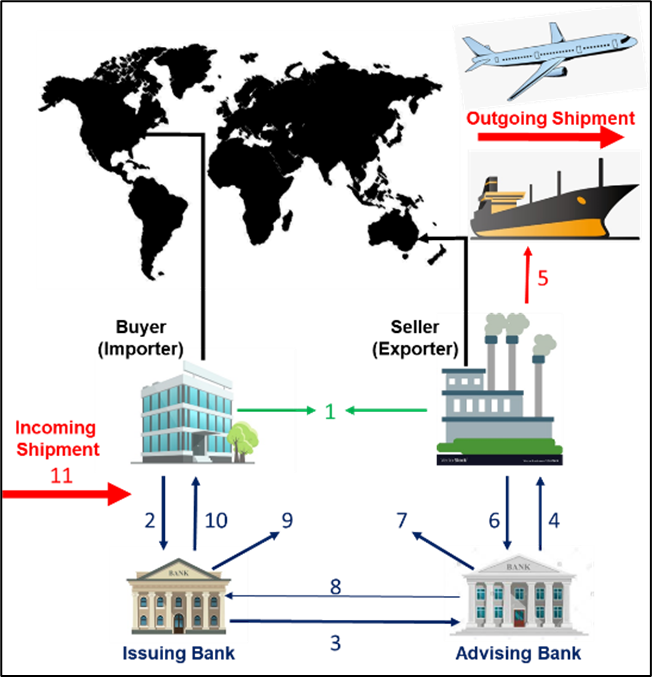
- Seller and Buyer conclude a sales contract, with method of payment usually by letter of credit (documentary credit).
- Buyer applies to issuing bank, usually in Buyer’s country, for letter of credit in favour of Seller (beneficiary).
- The issuing bank requests a correspondent bank, usually in the Seller’s country, to advise and typically confirm the credit.
- The advising bank, usually in Seller’s country, forwards letter of credit to Seller informing about the terms and conditions of credit.
- If credit terms and conditions conform to sales contract, the Seller prepares goods and documentation and arranges delivery of goods to carrier.
- The Seller presents documents evidencing the shipment and draft (bill of exchange) to paying, accepting or negotiating bank named in the credit (the advising bank usually), or any bank willing to negotiate under the terms of credit.
- The bank examines the documents and draft for compliance with credit terms. If satisfied, it pays, accepts, or negotiates.
- If this is not the issuing bank, it forwards the documents and draft to the issuing bank.
- The issuing bank examines the documents for compliance. If satisfied, the Seller’s draft is honoured.
- Documents released to the Buyer after payment or on other terms agreed between the bank and the Buyer.
The Buyer surrenders bill of lading to carrier (in case of ocean freight) in exchange for the goods or the delivery order.
(Source: Export Council of Australia, 2022)
|
Note As this process highlights, even the simplest international transaction can involve more than six key parties and upwards of 50 people — most of whom the Buyer and Seller will never meet. |
The following hypothetical illustrates the kinds of risk that can emerge:
|
💡Hypothetical scenario – Risk Management in International Transactions A freight forwarder is asked to use their own “in-house” insurance policy for the carriage of goods. The Buyer assumes that all is in order; signs the policy and does not check its scope. A claim occurs outside the scope of the policy. How important is the client to the freight forwarder? Is it worth putting pressure on the insurance broker, or will they suffer the loss of a client? What if one of the banks involved in the payment process closes its doors? The Buyer and Seller don’t use a proper term of sale and make assumptions on both sides. The logistics provider makes its own assumptions in good faith and moves the freight accordingly. The Seller (or Buyer) ends up with an unexpected bill after the carriage of the goods has occurred. Who will pay the bill? |
International Legal Framework for Commercial Transactions
In the nineteenth century, international commercial transactions were largely governed by commercial usage and bilateral commercial treaties — commonly known as ‘Friendship, Commerce and Navigation’ (FCN) Treaties. These treaties addressed trade and shipping rights and, as corporations became more significant, introduced the concept of ‘national treatment’, whereby legal persons of one state were treated no less favorably in the other state than their domestic equivalents.
More recently, FCN treaties have been largely replaced by bilateral and multilateral agreements that focus on market access and trade liberalization. This shift followed the establishment of the United Nations and the corresponding increase in international economic cooperation.
The key multilateral treaty for international commercial transactions is the United Nations Convention on Contracts for the International Sale of Goods 1980 (also known as the ‘Vienna Sales Convention’ or ‘CISG’). Other important multilateral treaties govern the carriage of goods, including the United Nations Convention on the Carriage of Goods by Sea 1978 (the Hamburg Rules).
|
Note The parties to a contract are free to choose their preferred governing law, whether that of one of the parties, a third country, or the CISG itself. |
Commercial custom and trade usage remain important sources of international commercial law and have been codified by the International Chamber of Commerce (ICC). The ICC’s rules are codified commercial usage: they have no binding force on their own but can be incorporated into any contract, at which point they become binding as terms of that contract. These rules, known as ‘Incoterms®’, are explained later.
The law governing international commercial transactions is therefore a combination of conventions, treaties, domestic legislation, and commercial practice. The two principal international bodies that shape international trade law are:
- The United Nations Commission on International Trade Law (UNCITRAL)
- The World Trade Organization (WTO)
The United Nations Convention on Contracts for the International Sale of Goods (CISG)
Because we are talking about an international sales transaction there can be three different legal regimes that come into play:
- The domestic law of either the buyer or the seller, with the contract governed by the law of the jurisdiction where it was concluded.
- An international convention applicable to one or both parties.
- The rules that apply where one party is not a signatory to the relevant international convention.
Article 1.1 of the CISG states that it applies between parties whose places of business are in different States. This means the CISG may apply even where goods are collected by a foreign buyer in the seller’s country, or where the goods move only within the seller’s country — provided the parties’ places of business are in different States.
The CISG is not mandatory. It is intended to assist where parties have not addressed a matter in their contract, serving a ‘gap-filling’ function. Its purpose is to provide an internationally acceptable set of rules that reduces difficulties arising from differences in national sales law. Because it functions as a model law, it has no legal effect of itself; it takes effect only where a country enacts it into law or adopts it in some other way. The CISG has been adopted as the law of 76 countries, including Australia, Canada, China, France, Germany, Italy, Japan, New Zealand, Singapore, the Russian Federation, and the United States.
One issue the CISG does not address is when ownership of the goods passes from the seller to the buyer. This was not possible to agree at the time of negotiation and must instead be determined by reference to the contract itself or applicable national law.
International Commercial Terms (Incoterms®)
|
Learning Objectives
|
Possibly the most important clause in an international contract of sale is the one that defines the agreed trade terms between the seller and the buyer. These terms establish three things for each party:
- Which responsibilities apply to the seller, the buyer, and their respective service providers?
- How risks are divided between seller and buyer
- How costs are divided between seller and buyer
|
Note At every point in the supply chain, legal responsibility for the goods rests with either the seller or the buyer. Responsibility covers carriage, risk, and costs. |
International Supply Chain
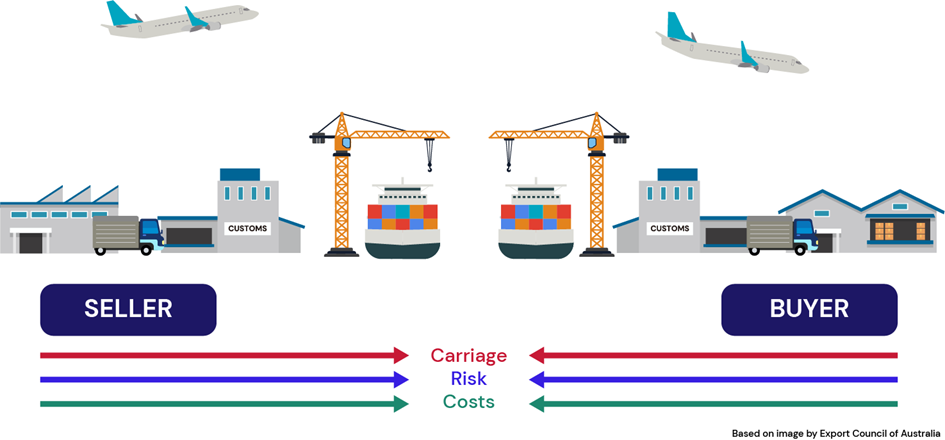
In commodity trade, standard contract forms have developed to meet the specific requirements of different goods — oil, timber, grain — each with distinct handling, shipping, and payment conditions. These are often performed under charterparties[1], with detailed provisions for loading, unloading, inspection, and payment. Manufactured goods follow similar conventions, with parties either using industry-standard terms or negotiating bespoke contracts.
Because the CISG applies only between parties in different States, an international sale usually involves goods crossing at least one border. It is therefore necessary to clearly define how functions, costs, and risks are allocated between the buyer and the seller.
The key questions are:
- Who arranges carriage?
- Who handles customs formalities?
- Who bears the risk if goods are lost or damaged in transit?
These issues are addressed by trade terms. The most widely used are those developed by the International Chamber of Commerce, known as Incoterms® — a standardized shorthand that divides responsibility clearly between seller and buyer.
Incoterms® were first introduced in 1936. The current version, Incoterms® 2020, took effect in January 2020. There are 11 terms, organized into four Groups and two categories based on obligations, risk, and costs. The table below lists all 11 terms by Group and mode of transport.
|
Group |
Term |
Description |
Mode of Transport |
|
E |
EXW |
Ex Works – named place of delivery (e.g. factory or warehouse) |
Any |
|
F |
FCA |
Free Carrier At – named place of delivery (e.g. seller’s premises or ‘other place’) |
Any |
|
FAS |
Free Alongside Ship – named seaport of loading |
Sea or Inland Waterway |
|
|
FOB |
Free On Board – naming the seaport of loading and vessel |
Sea or Inland Waterway |
|
|
C |
CFR |
Cost and Freight – naming the seaport of discharge/destination |
Sea or Inland Waterway |
|
CIF |
Cost, Insurance and Freight – naming the seaport of discharge/destination |
Sea or Inland Waterway |
|
|
CPT |
Carriage Paid To – naming the place of handover at destination |
Any |
|
|
CIP |
Carriage & Insurance Paid to – naming the place as in CPT |
Any |
|
|
D |
DAP |
Delivered At Place – naming the place of destination |
Any |
|
DPU |
Delivered at Place Unloaded – naming the place of destination |
Any |
|
|
DDP |
Delivered Duty Paid – naming a place of handover at destination |
Any |
Source: International Chamber of Commerce 2025
|
Incoterms® are concerned with the possession of goods, not ownership, title, or property. At any given point in the supply chain, the party in possession of the goods may not be the party that owns them. Traders must understand this distinction and manage their business accordingly. |
[1] In a charter party a shipper in effect charters a ship to carry the cargo to its destination. The cargo or portions of it are sold and re-sold during transit and may be off-loaded at different ports. Parties to such transactions are trading on the basis of the sale of documents representing the goods – the bill of lading.
Incoterms® as a determination of delivery
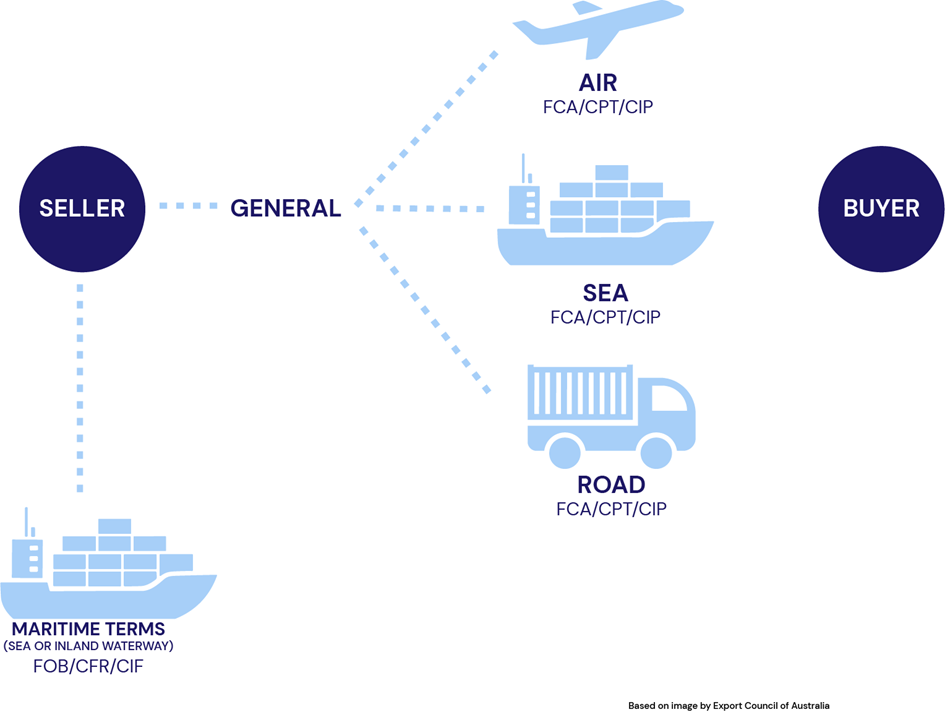
The terms agreed by the seller and buyer define the exact point at which risks and responsibilities pass from one party to the other — in other words, which steps in moving the goods from Point A to Point B are the seller's obligation, and which are the buyers. The same applies to the costs incurred in moving or administering the movement of cargo up to the agreed point. Separate terms apply to general transport and to maritime transport.
|
Note The point of handover is always a physical location. As a general rule:
|
Incoterms® function as abbreviations or shorthand — a series of expressions intended to state each party's obligations clearly and to minimize the potential for disputes.
Incoterms® should be expressly incorporated into the contract of sale and should include the words "Incoterms® 2020" after the trade abbreviation — for example, "FOB Singapore (Incoterms® 2020)". The named place attached to the Incoterm is critical. It will:
- identify either the place or port where goods are considered 'delivered' by the seller to the buyer, or
- identify the place of 'delivery', or
- identify the place or port to which the seller must arrange carriage (the destination) or, in the case of D-rules, both.
Incoterms® are also relevant to customs valuation, which is addressed in a separate module. In most countries, customs duties are levied on a Cost, Insurance and Freight (CIF) basis, meaning that overseas freight and insurance costs are included in the customs value. Where a contract is on Free on Board (FOB) terms, additions must be made to the contract price before a transaction value can be determined.
|
Note Incoterms® cannot address every circumstance and must always be used in conjunction with other trade instruments, including the contract of sale. One significant exclusion is the issue of ownership: Incoterms® govern possession, not ownership. |
The Incoterms® Rules cover obligations in a set of ten paired articles, numbered A1/B1 through A10/B10. Articles A set out the seller's obligations; the B articles set out the buyer's obligations.
|
Articles |
Incoterm Rule |
|
A1/B1 |
General Obligations |
|
A2/B2 |
Delivery/Taking Delivery |
|
A3/B3 |
Transfer of Risk |
|
A4/B4 |
Carriage |
|
A5/B5 |
Insurance |
|
A6/B6 |
Delivery/Transport Document |
|
A7/B7 |
Export/Import Clearance |
|
A8/B8 |
Checking/packing/marking |
|
A9/B9 |
Allocation of costs |
|
A10/B10 |
Notices |
As an illustration of how these articles operate, consider Article A2/B2 on Delivery. Comparing the rules for DAP and DPU demonstrates the difference in seller’s obligations:
- DAP (Delivered at Place) The seller must deliver the goods by placing them at the disposal of the buyer on the arriving means of transport, ready for unloading at the named place of destination. Delivery is deemed to occur when the goods are placed at the buyer’s disposal, on the agreed date or within the agreed period.
- DPU (Delivered at Place Unloaded) The seller must unload the goods from the arriving means of transport and then place them at the disposal of the buyer at the named place of destination, on the agreed date or within the agreed period.
Reading these two articles side by side, the key distinction is clear: under DAP, delivery occurs on the arriving means of transport; under DPU, the seller is also responsible for unloading. (UK Customs Academy, 2020.)
Incoterms® as a determination of Insurance Cover
The terms of sale are recorded on commercial sales invoices and define the rights and responsibilities of each party. Ownership of goods and the risk of loss or damage can be transferred between the buyer and the seller at different stages of the export transaction. In any insurance claim, the agreed trade terms will determine which party is responsible and which party may benefit.
The most common terms for container shipments are EXW, FCA, CPT, and CIP. The table below defines each in the context of insurance liability.
|
Term |
Definition |
Insurance Policy Type |
|
EXW |
Ex Works (also known as ex-warehouse) – the buyer is responsible for loss or damage to the goods when the seller makes them available at the works or warehouse. |
The buyer should insure the goods from the seller's works (warehouse) to their own warehouse. |
|
FCA |
Free Carrier (named place) – reflecting modern transport methods (e.g. multi-modal), risk transfers from seller to buyer when the goods are delivered to the carrier at their nominated consolidation point, if LCL, wharf or other location if FCL. |
As risk transfers at the nominated point (not the ship's rail), insurance arrangements must follow this transfer of ownership. |
|
CPT |
Carriage Paid To (named place) – the seller delivers the goods to the carrier nominated by the seller at an agreed place. |
This rule has two critical points: risk passes and costs transfer at different places. Both the place of delivery (where risk passes to the buyer) and the named place of destination must be clearly identified in the contract. Insurance policies must reflect this. |
|
CIP |
Carriage and Insurance Paid – similar to FCA but the seller must also arrange freight and marine insurance against loss or damage during carriage. |
The seller should insure the goods from the seller's warehouse to the buyer's nominated location consistent with Institute of Cargo Clauses (A). |
As a general rule, sellers should seek to insure as much of the carriage process as possible. If a buyer fails to insure adequately and payment under a documentary letter of credit or other contract of sale is not made, the seller may be left with goods in a foreign country or on the high seas with no insurance coverage.
In practice, sellers should quote on CIP terms and arrange insurance locally or alternatively arrange seller’s contingency insurance. An added benefit is the claims reporting service available from local marine insurers, which allows sellers to better manage their risk.
Incoterms® 2020
Incoterms® 2020 replaced Incoterms® 2010. The principal changes were:
- Clarification of scope: Explicit confirmation that Incoterms® do not deal with transfer of property, title, or ownership; are not in themselves a contract of sale; and do not determine the law applicable to the contract.
- Different insurance levels for CIF and CIP: Under CIF, the default cover is Institute of Cargo Clauses (C), which covers specified risks. Under CIP, the seller must now obtain cover compliant with Institute of Cargo Clauses (A), which covers all risks subject to listed exclusions. Both parties retain the option to agree to a higher or lower level of cover.
- Own transport: Clarification that a seller under a D-rule, or a buyer under an FCA-rule, may use their own transport.
- DAT renamed DPU: The term DAT was renamed DPU to reflect that the place of destination may be any place, not only a terminal.
- Reordering: DAP was placed before DPU in the sequence of terms.
- Security requirements: Security-related requirements were incorporated within carriage obligations and costs.
|
Note There was no change to the two categories of transport modes. |
Incoterms® 2020 – Consolidated Responsibility Reference
The table below summarises how charges (C) and risk (R) are allocated between Seller and Buyer across all 11 Incoterms® 2020 rules. EXW represents the minimum obligation for the seller; DDP represents the maximum. As you move left to right, responsibility progressively transfers from buyer to seller. Note that for CPT and CIF, charges and risk pass at different points — the seller pays for main transport but risk transfers to the buyer once goods are handed to the first carrier.
|
S = Seller (blue) B = Buyer (red) S* = The Buyer is responsible for transport costs in their own country following arrival at the named ‘place’ C = Charges R = Risk |
|
Export Process
|
MULTIMODAL |
SEA & INLAND WATERWAY ONLY |
||||||||||||||||||||
|
EXW |
FCA |
CPT |
CIP |
DAP |
DPU |
DDP |
FAS |
FOB |
CFR |
CIF |
||||||||||||
|
C |
R |
C |
R |
C |
R |
C |
R |
C |
R |
C |
R |
C |
R |
C |
R |
C |
R |
C |
R |
C |
R |
|
|
Packaging |
S |
S |
S |
S |
S |
S |
S |
S |
S |
S |
S |
S |
S |
S |
S |
S |
S |
S |
S |
S |
S |
S |
|
Pre-carriage |
B |
B |
S |
S |
S |
S |
S |
S |
S |
S |
S |
S |
S |
S |
S |
S |
S |
S |
S |
S |
S |
S |
|
Export customs |
B |
B |
S |
S |
S |
S |
S |
S |
S |
S |
S |
S |
S |
S |
S |
S |
S |
S |
S |
S |
S |
S |
|
Loading / handling |
B |
B |
B |
B |
S |
S |
S |
S |
S |
S |
S |
S |
S |
S |
B |
B |
S |
S |
S |
S |
S |
S |
|
Main transportation |
B |
B |
B |
B |
S |
B |
S |
B |
S |
S |
S* |
S* |
S |
S |
B |
B |
B |
B |
S |
B |
S |
B |
|
Transportation insurance |
B |
B |
B |
B |
B |
B |
S |
B |
S |
S |
S |
S |
S |
S |
B |
B |
B |
B |
B |
B |
S |
B |
|
Unloading |
B |
B |
B |
B |
B |
B |
B |
B |
B |
B |
S |
S |
S |
S |
B |
B |
B |
B |
B |
B |
B |
B |
|
Import customs |
B |
B |
B |
B |
B |
B |
B |
B |
B |
B |
B |
B |
S |
S |
B |
B |
B |
B |
B |
B |
B |
B |
|
Post-carriage |
B |
B |
B |
B |
B |
B |
B |
B |
B |
B |
B |
B |
S |
S |
B |
B |
B |
B |
B |
B |
B |
B |
Source: ICC, 2019
Incoterms® 2020 - Rules for Any Modes of Transport |
|
Term |
Delivery point |
Who pays transport |
Who bears risk |
Export |
Import |
|
EXW |
seller premises |
buyer |
buyer (early) |
buyer |
buyer |
|
FCA |
carrier |
buyer |
buyer (at carrier) |
seller |
buyer |
|
CPT |
carrier |
seller |
buyer (early) |
seller |
buyer |
|
CIP |
carrier |
seller |
buyer (early) |
seller |
buyer |
|
DAP |
destination |
seller |
buyer (at arrival) |
seller |
buyer |
|
DPU |
destination (unloaded) |
seller |
buyer (after unloading) |
seller |
buyer |
|
DDP |
destination |
seller |
seller (almost all) |
seller |
seller |
|
EXW Ex Works The buyer does (almost) everything. |
|
🚢 All Transport Modes |
|
"Ex Works" means the seller delivers when the goods are placed at the disposal of the buyer at the seller's premises or at another named place (such as works, factory, or warehouse). The seller has no obligation to load the goods onto any collecting vehicle or to clear them for export. The parties should specify as precisely as possible the point within the named place of delivery, as costs and risk to that point are for the seller's account. The buyer bears all costs and risks from the agreed point onwards. A buyer purchasing on EXW terms for the purpose of export should be aware that the seller is only required to provide assistance obtaining export clearance — the seller is not obliged to organize it. Buyers who cannot obtain export clearance directly or indirectly are advised not to use EXW. The buyer also has limited obligations to provide the seller with export-related information, though the seller may need such information for taxation or reporting purposes (ICC 2025). |
|
⚠ Risk Transfer: Risk passes to the buyer the moment goods are made available at the seller's premises — before they are even loaded. |
|
FCA Free Carrier Seller delivers to your carrier — then you take it from there. |
|
🚢 All Transport Modes |
|
"Free Carrier" means the seller delivers the goods to the carrier or another person nominated by the buyer at the seller's premises or at another named place. Risk passes to the buyer at that point. If delivery is to occur at the seller's premises, the address of those premises must be stated as the named place of delivery. If delivery is to occur elsewhere, a specific alternative place must be identified. FCA requires the seller to clear the goods for export. |
|
⚠ Risk Transfer: Risk passes at the named delivery point when goods are handed to the carrier nominated by the buyer. |
|
CPT Carriage Paid To Seller contracts and pays for freight — but risk moves earlier. |
|
🚢 All Transport Modes |
|
"Carriage Paid to" means the seller delivers the goods to the carrier or another person nominated by the seller at an agreed place, and contracts and pays for carriage to bring the goods to the named place of destination. This rule has two critical points, because risk passes and costs transfer at different places. The parties must identify in the contract both the place of delivery (where risk passes to the buyer) and the named destination (where the seller must contract for carriage). If multiple carriers are used and no specific point of delivery is agreed, risk passes when the goods are delivered to the first carrier at a point of the seller's choosing. If the parties wish risk to pass at a later stage — for example, at an ocean port or airport — they must specify this in their contract. CPT requires the seller to clear the goods for export. |
|
⚠ Risk Transfer: Risk transfers to the buyer when goods are delivered to the FIRST carrier — not when they arrive at the destination. |
|
CIP Carriage & Insurance Paid To Like CPT, but the seller also insures the goods for the buyer. |
|
🚢 All Transport Modes |
|
"Carriage and Insurance Paid to" means the seller delivers the goods to the carrier or another nominated person at an agreed place, and contracts and pays for carriage to the named destination. The seller also contracts for insurance cover against the buyer's risk of loss of, or damage to, the goods during carriage. Under Incoterms® 2020, the seller under CIP must obtain insurance equivalent to Institute of Cargo Clauses (A), which provides cover against all risks subject to listed exclusions. If the buyer requires additional protection, it must either negotiate this expressly with the seller or arrange its own supplementary cover. CIP requires the seller to clear the goods for export. |
|
⚠ Risk Transfer: Risk passes at the first carrier, same as CPT — but the buyer benefits from the seller's insurance obligation. |
|
DAP Delivered at Place Seller brings the goods to your door — you handle unloading and import. |
|
🚢 All Transport Modes |
|
"Delivered at Place" means the seller delivers when the goods are placed at the disposal of the buyer on the arriving means of transport, ready for unloading at the named place of destination. The seller bears all risks involved in bringing the goods to that place. The parties should specify the point within the agreed destination as precisely as possible, as risks to that point are borne by the seller. If the seller incurs unloading costs under its contract of carriage, those costs cannot be recovered from the buyer unless otherwise agreed. DAP requires the seller to clear the goods for export, but the seller has no obligation to clear the goods for import, pay import duty, or carry out import customs formalities. Where the seller is to undertake import clearance, DDP should be used instead. |
|
⚠ Risk Transfer: Risk transfers to the buyer when goods are placed at their disposal on the arriving transport at the named destination — but before unloading. |
|
DPU Delivered at Place Unloaded The seller unloads. You handle import from there. |
|
🚢 All Transport Modes |
|
"Delivered at Place Unloaded" means the seller delivers when the goods, once unloaded from the arriving means of transport, are placed at the disposal of the buyer at the named place of destination. The term 'place' includes any location, whether covered or not — a quay, warehouse, container yard, or road, rail, or air cargo terminal. The seller bears all risks involved in bringing the goods to, and unloading them at, the named place. The parties should specify the 'place' as precisely as possible, and where possible identify a specific point within it, as risks to that point are borne by the seller. If the parties intend the seller to bear the costs and risks of transporting the goods from the terminal to another location, DAP or DDP should be used instead. DPU requires the buyer to clear the goods for import. |
|
⚠ Risk Transfer: Risk passes when the goods are unloaded and placed at the buyer's disposal at the named destination. |
|
DDP Delivered Duty Paid The seller takes responsibility for everything, end to end. |
|
🚢 All Transport Modes |
|
"Delivered Duty Paid" means the seller delivers the goods, cleared for import on the arriving means of transport, ready for unloading at the named place of destination. The seller bears all costs and risks involved in bringing the goods to destination and is obliged to clear the goods for both export and import, pay all export and import duties, and carry out all customs formalities. DDP represents the maximum obligation for the seller. If the seller cannot directly or indirectly obtain import clearance, the parties are advised not to use DDP. Where the buyer is to bear all risks and costs of import clearance, DAP should be used. Any VAT or other taxes payable on import are for the seller's account unless expressly agreed otherwise in the contract of sale. |
|
⚠ Risk Transfer: Risk remains with the seller all the way to the named destination — only passing to the buyer on delivery, ready for unloading. |
Incoterms® 2020 - Rules for Sea and Inland Waterway Transport Only |
|
FAS Free Alongside Ship Get the goods to the quay — the buyer boards from there. |
|
🚢 Sea & Inland Waterway Only |
|
"Free Alongside Ship" means the seller delivers when the goods are placed alongside the vessel nominated by the buyer at the named port of shipment — for example, on a quay or barge. Risk passes at that moment, and the buyer bears all costs from that point onwards. The parties should specify the loading point at the named port as precisely as possible, as costs and risk to that point are borne by the seller; handling charges may vary by port. The seller must either deliver the goods alongside the vessel or procure goods already so delivered. The reference to "procure" accommodates multiple sales down a chain ("string sales"), which are common in commodity trades. Where goods are containerized, it is standard practice for the seller to hand them to the carrier at a terminal rather than alongside the vessel. In such cases, FAS is not appropriate and FCA should be used instead. FAS requires the seller to clear the goods for export. |
|
⚠ Risk Transfer: Risk transfers when goods are placed alongside the vessel at the named port — before loading. |
|
FOB Free on Board Once it's on the ship, it's the buyer's risk. |
|
🚢 Sea & Inland Waterway Only |
|
"Free on Board" means the seller delivers the goods on board the vessel nominated by the buyer at the named port of shipment, or procures goods already so delivered. Risk passes when the goods are on board the vessel, and the buyer bears all costs from that moment. As with FAS, the reference to "procure" caters for string sales common in commodity trades. FOB is not appropriate where goods are handed to the carrier before being loaded on board — for example, containerized cargo delivered at a terminal. In such cases, FCA should be used. |
|
⚠ Risk Transfer: Risk passes when goods cross the ship's rail and are loaded on board at the port of shipment. |
|
CFR Cost & Freight Seller pays to get it there. But risk travels with the ship. |
|
🚢 Sea & Inland Waterway Only |
|
"Cost and Freight" means the seller delivers the goods on board the vessel (or procures goods already so delivered) and contracts and pays the costs and freight necessary to bring the goods to the named port of destination. Risk passes when the goods are on board the vessel. This rule has two critical points, because risk passes and costs transfer at different places. While the contract will always specify a destination port, it may not specify the port of shipment — which is where risk passes. If the port of shipment is material to the buyer, it should be identified as precisely as possible in the contract. CFR is not appropriate for containerized cargo delivered at a terminal; CPT should be used in those circumstances. CFR requires the seller to clear the goods for export. |
|
⚠ Risk Transfer: Risk passes at the port of shipment when goods are loaded on board — the buyer bears the risk for the entire sea voyage. |
|
CIF Cost, Insurance & Freight Seller pays freight and insures the cargo — buyer still carries the voyage risk. |
|
🚢 Sea & Inland Waterway Only |
|
"Cost, Insurance and Freight" means the seller delivers the goods on board the vessel (or procures goods already so delivered), contracts and pays the freight to the named port of destination, and contracts for insurance cover against the buyer's risk of loss or damage during carriage. Risk passes when the goods are on board the vessel. Under Incoterms® 2020, the seller under CIF must obtain insurance equivalent to Institute of Cargo Clauses (A), which provides all-risks cover subject to listed exclusions. If the buyer requires additional protection, it must negotiate this with the seller or arrange its own supplementary cover. The reference to "procure" in the delivery obligation accommodates string sales common in commodity trades. CIF is not appropriate where goods are handed to the carrier before being loaded on board — for example, containerized cargo at a terminal; CIP should be used in those circumstances. CIF requires the seller to clear the goods for export. |
|
⚠ Risk Transfer: Risk passes when goods are loaded on board at the port of shipment — the insurance is the buyer's protection, not a shift in risk. |
|
CIF Cost, Insurance & Freight Seller pays freight and insures the cargo — buyer still carries the voyage risk. |
|
🚢 Sea & Inland Waterway Only |
|
"Cost, Insurance and Freight" means the seller delivers the goods on board the vessel (or procures goods already so delivered), contracts and pays the freight to the named port of destination, and contracts for insurance cover against the buyer's risk of loss or damage during carriage. Risk passes when the goods are on board the vessel. Under Incoterms® 2020, the seller under CIF must obtain insurance equivalent to Institute of Cargo Clauses (A), which provides all-risks cover subject to listed exclusions. If the buyer requires additional protection, it must negotiate this with the seller or arrange its own supplementary cover. The reference to "procure" in the delivery obligation accommodates string sales common in commodity trades. CIF is not appropriate where goods are handed to the carrier before being loaded on board — for example, containerized cargo at a terminal; CIP should be used in those circumstances. CIF requires the seller to clear the goods for export. |
|
⚠ Risk Transfer: Risk passes when goods are loaded on board at the port of shipment — the insurance is the buyer's protection, not a shift in risk. |
Incoterms® in Practice
|
The Contract of Sale
|
Learning Objectives
|
International trade transactions involve numerous contracts, with the contract of sale at the center. It defines the parties’ rights and obligations, the goods involved, their quantity and quality, and the monetary consideration.
|
Note Key features of an international contract of sale include:
The contract must therefore address all these variables, including the applicable law and the forum for resolving disputes. |
Any international trade transaction will include a contract of sale in some form. At a minimum, it will identify both parties, describe the goods (including quality and quantity), and state the price. Many contracts are more detailed, addressing the mode and means of transport, insurance, conditions and warranties relating to the goods, and other obligations. Terms and conditions may appear on a purchase order, sales order, or invoice, and each party may seek to incorporate its own standard terms — creating a risk of inconsistency. Consequently, resolving which set of terms governs the contract can be complex and time-consuming.
As a general rule, any international contract of sale — however detailed — must operate under a governing law. That law will determine:
- the validity of the contract
- any obligations not expressly stated in the contract
- whether a contract has come into existence
- whether the contract has been terminated
- the remedies available for breach, in conjunction with the law of the forum where the dispute is heard
The Significance of the Contract of Sale
The contract of sale is the master contract in an international trade transaction. All other contractual arrangements that follow — for transport, insurance, and financing — should conform to its provisions. It is the most important document in an international sale of goods and is the starting point for managing risk:
- It is evidence of the agreement between Seller and Buyer.
- It records the agreed goods, time of delivery, and point(s) of delivery.
- It records the agreed payment method, amount, and terms.
From a logistics provider’s perspective, a correctly worded contract of sale provides the basic information needed to manage the movement of cargo safely and efficiently. All parties — buyer, seller, and service providers — have a direct interest in ensuring that as much accurate information as possible is captured in the contract.
Both parties have an equal interest in addressing each key element of the contract. A proactive service provider will always encourage clients to consider any element they appear to have omitted before the physical movement of cargo begins.
|
Note In practice, it is the buyer who prepares the contract. This is why it is referred to as a Contract of Sale (issued by the purchaser), rather than a Sales Advice (which would be issued by the seller). The buyer does so on behalf of both parties, reflecting the agreed conditions. |
Key Elements of an International Contract of Sale
|
Buyer / Seller / Manufacturer / End User |
The contract must clearly identify the parties: the buyer and seller. However, the seller may not be the manufacturer. An order placed on a seller in Hamburg, for example, may relate to goods manufactured in Madrid. This difference has a direct impact on the cost of movement and must be clarified before costs are calculated. If costs are based on Ex Works (EXW) terms — with the buyer bearing costs from the place of manufacture — and the actual location of the “works” differs from what was assumed, the variation in location can substantially increase collection costs and alter the overall price of the goods. Similarly, the buyer’s final delivery address may differ from its principal place of business if the goods are required by an end user at another location. This affects door-to-door insurance arrangements, for which the exact points of origin and destination must be declared to the insurer. It also affects the freight forwarder’s planning, since the function of freight forwarding is to move cargo from point A to point B, and knowing exactly where those two points are is essential to both cost and execution.
|
|
|
Method of movement (for example, Air/Sea/Road/Rail) |
In indicating the chosen mode of transport, buyers and sellers have several basic options: air freight, sea freight, parcel post, road freight, rail freight, or a combination. Even a single mode may involve sub-options: airfreight may be via a freight forwarder’s consolidation service or direct IATA. Sea freight options include Conference or Non-Conference services and further sub-divisions into full container load (FCL), less than container load with a carrier (LCL), groupage with a freight forwarder, or break-bulk. The characteristics of the cargo — including timing of production, transit cost, and any special requirements — will often narrow the choice of transport. The most common factors influencing this decision are: · The transport options available between origin and destination · The mass, volume, and any dimensional abnormalities of the cargo · The hazardous nature of the cargo · A comparison of transit costs across different modes · Special requirements during transit |
|
|
Quantity / Type / Style / Price |
This section forms the substantive body of the contract and should be as accurate and precise as possible without including unnecessary detail. It is directly relevant only to the buyer and seller; most freight forwarders would not be in a position to interpret trade-specific descriptions in this section. The specific tariff headings required for customs clearance (using the WCO Harmonized System) should be identified, and the seller must be instructed to include those headings on the eventual commercial invoice.. This will assist the buyer with customs clearance at the destination. |
|
|
Terms of purchase
|
This is addressed in detail in the Incoterms® section. The terms of purchase specify the precise point during cargo movement at which the seller transfers risk and responsibility to the buyer.
|
|
|
References and dates |
The contract should reflect only the key dates and the seller’s and buyer’s respective reference numbers. The common dates are: · The date the Contract of Sale was executed · The anticipated production or ‘handed to carrier’ date · The date the goods are required at the final destination |
|
|
Appointed forwarders or carrier(s) |
Identifying the appointed freight forwarder in the contract establishes a clear communication channel between buyer and seller and designates that forwarder as the authorized point of contact for information relating to the movement. To remove ambiguity, the forwarder should be nominated by:
|
|
|
Methods of international payment |
The contract should reference the agreed payment method. Detailed payment terms and procedures will be recorded separately in the documents governing the financial arrangement between the buyer, seller, and their respective financial institutions. |
|
|
Documentation |
The contract must identify which documents are to be provided to which party. This includes commercial documentation required for customs clearance at destination, as well as any specific certificates required for the product in question. |
|
|
Insurance requirements |
The contract must clearly define the insurance arrangements, including: · which party is responsible for arranging insurance (buyer or seller) · the type of cover required · the value to be insured Details of the insurance sub-contract would be evidenced separately. |
|
|
Packing requirements |
The manufacturer of the goods will typically pack them in accordance with the protective requirements of the product and their knowledge of domestic transit conditions.
|
|
|
Marks and numbers |
Marks and numbers serve one purpose in cargo movement: to associate the item of cargo with the correct documentation. Two specific considerations apply: · Product sensitivity: If the product is susceptible to theft — such as electrical household goods or consumer electronics — the marks and numbers should not indicate the contents. A coding system known only to the buyer and seller is recommended. For hazardous goods, international marking and labelling standards must be applied. · End use and re-marking: If the buyer has re-marking requirements for stock control purposes, the supplier should be instructed to mark packages accordingly. |
|
|
Other instructions
|
The contract of sale should be used to capture any additional requirements or instructions from either party that are specific to the transaction.
|
|
|
Arbitration |
International trade generally begins with the intent to honor the agreed terms. However, unforeseen factors, such as market fluctuations, logistical failures, or circumstances beyond the parties’ control, can lead to disputes. Litigation is concrete in its outcomes, but it is expensive and time-consuming. Arbitration is a more practical alternative: it is less costly than litigation, binding on the parties, and typically faster. |
|
|
Other Clauses |
Long-term or high-value contracts are particularly exposed to market volatility. It is prudent to include adaptation clauses that allow for adjustments to prices and supply terms in response to changing economic or commercial circumstances, enabling parties to maintain their commercial relationship without recourse to formal dispute resolution. A force majeure clause is also advisable. It excuses non-performance in the event of unforeseeable events such as earthquakes, wars, or other acts beyond the parties’ control. Because of the distances involved in international transactions, the choice of governing law and jurisdiction can be critically important. A properly drafted international contract of sale will address two questions:
|
International Carriage of Goods
|
Learning Objectives
|
|
Learning Objectives · Identify the main international conventions governing carriage of goods by sea and outline the liability framework each establishes. · Describe the key features of the air waybill and explain how it differs from a bill of lading. · Outline the purpose of multimodal transport arrangements and explain the role of UPU standards (CN22, CN23, EAD) in customs compliance. |
A key element of international trade is the carriage of goods from one country to another. Carriage may occur by sea, air, road, or rail. Each mode is governed by complex legal rules that determine the rights and liabilities of the party undertaking the movement — the carrier.
These rules are established both by common law (mercantile practice) and by international conventions incorporated into national law. Such laws impose mandatory requirements on carriers that cannot be excluded by contract.
International sales necessitate the transportation of goods by one or more modes. Incoterms® allocate responsibilities based on the mode or modes of transport. When carriage involves:
- Only one mode, it is called unimodal transport.
- When it involves two or more modes, it is called multimodal transport.
The distinction between unimodal and multimodal transport is important for two reasons. It reflects the complexity of the transaction, and it affects how responsibilities are allocated between the parties. Different transport modes may also be governed by different international conventions and customs requirements.
The size and nature of the cargo largely determine the mode of transport. Large bulk shipments are typically moved by sea, as it is more cost effective. When fast delivery is required, air transport may be used, although it is limited by size and cost.
International Carriage of Goods by Sea
Despite technological change, sea remains the primary mode of international carriage. Only around 4% of international consignments travel by air freight and approximately 13% by road or rail; the remainder travel by sea.
The nature and size of cargo determine both the transport mode and the contractual arrangement. Transporting coal, for example, may require the entire capacity of a large ship, involving a voyage charterparty for a single voyage from port of loading to port of delivery. When cargo volumes require multiple shipments, a contract of affreightment is used to cover a series of shipments.
Smaller shipments, such as a single container, are transported under a bill of lading or a sea waybill. Container ships carry cargo for many different customers under separate contracts of carriage and operate on fixed routes between designated ports, known as liner services. Feeder services operate on shorter routes, linking smaller ports to major liner service hubs.
Carriers may also be contracted to transport goods to a specific destination nominated by the seller or buyer, outside any fixed route. These vessels, which go wherever contracted, operate in what is known as the ‘tramp’ trade.
Comparing the different Convention regimes
The Hague Rules 1924 imposed a general liability on carriers to provide a seaworthy vessel and to handle goods with care, subject to a list of exceptions — including fault of the master or pilot in navigation, act of God, act of war, riots, strikes, and saving life or property at sea. Liability was limited to £100 sterling per package or unit.
The Hague-Visby Rules retain the same exceptions but increase the liability limit to 666.67 Special Drawing Rights (SDRs)[1] per package or 2 SDRs per kilogram of gross weight, whichever is higher (unless the parties have agreed a higher value). One SDR is approximately USD 1.35 (May 2025).
The Hamburg Rules 1978 were developed in response to concerns from developing countries and cargo owners that the Hague and Hague-Visby Rules favored shipowners. Under the Hamburg Rules, the carrier is liable from the moment goods are placed in its care until the moment they are delivered, regardless of whether the goods are on board a vessel. Under the Hague and Hague-Visby Rules, liability runs only from the point at which goods pass the ship’s rail for loading to the point at which they pass the rail for discharge.
|
Feature |
Hague Rules (1924) |
Hague-Visby Rules (1968) |
Hamburg Rules (1978) |
|
Period of liability |
Tackle to tackle (ship's rail) |
Tackle to tackle (ship's rail) |
Port to port – from receipt to delivery |
|
Liability limit |
£100 sterling per package |
666.67 SDR/package or 2 SDR/kg (higher applies) |
Higher: 835 SDR/package or 2.5 SDR/kg |
|
Carrier exceptions |
Nautical fault; act of God; war; fire; etc. |
Same exceptions as Hague Rules |
No nautical fault exception; narrower list |
|
Issuing context |
Outward: US, India, Indonesia, S. Korea, Philippines, Taiwan, Malaysia |
Outward: Australia, UK, Canada, Japan, NZ, Singapore, HK, most EU countries |
Fewer signatories; ratified mainly by developing nations |
|
Note It is important to identify which conventions a country has ratified, as definitions and liabilities vary between regimes, including the meaning of key terms such as “carrier” and “consignee.” Where multiple conventions apply, the governing law must be clearly determined. |
[1] A unit of account or Special Drawing Right (SDR) is set by the IMF by reference to a trade-weighted basket of currencies. This adds stability because fluctuations in one currency will be offset by fluctuations in other currencies. The present value of 1 unit of account is approximately 1.35 United States dollars (May 2025).
Contract of Carriage – The Bill of Lading
The contract of carriage defines the terms for transporting goods between agreed locations. It typically includes:
- the agreed place and time of shipment and delivery
- the transport route to be used
- responsibility for payment of freight charge
- the liabilities of the parties and their agents
- the governing law and dispute resolution method (court or arbitration)
- any additional terms that affect the rights and responsibilities of the parties
The agreed route is particularly important. Some perishable goods, such as fruit, can only withstand a limited period in transit. For volatile commodity markets, prolonged carriage may expose sellers or buyers to unacceptable price risk.
The principal document governing the relationship between the shipper and the carrier is the Bill of Lading. Carriers may use standard forms or different forms for different routes. The Baltic and International Maritime Conference (BIMCO), for example, has maintained the Conline Bill — a generic liner bill of lading — for over 40 years.
A bill of lading performs three functions:
- Receipt for goods shipped: It provides evidence that the goods were shipped and were in apparent good order and condition at the time. If the carrier signs a bill without annotation, it cannot later deny the apparent condition of the goods on shipment.
|
Note A bill with an annotation noting damage is a ‘claused’ bill; one without annotation is a ‘clean’ bill. |
- Evidence of the contract of carriage: It evidences the contract between shipper and carrier. While the goods are at sea, the shipper-exporter endorses the bill of lading to the importer, either as named consignee or by endorsement, passing title in the goods and entitling the importer to receive the goods from the carrier at the port of destination. Note carefully that the bill of lading is evidence of the contract, not the contract itself.
|
Note The bill of lading is evidence of the contract, not the contract itself. |
- Document of title: The bill of lading represents title to the goods, enabling them to be sold, pledged, or mortgaged by dealing with the document rather than the goods themselves.
|
Note The bill of lading is evidence of the contract, not the contract itself. For For a bill to be negotiable, the ‘Consignee’ box must read ‘To Order’, meaning the carrier will deliver to the person to whom the shipper has endorsed the bill. The chain of endorsement typically runs: exporter → exporter’s bank → importer’s bank → importer. |
There are different categories of bill of lading. A house bill is issued by a freight forwarder or carrier’s agent, evidencing that goods have been received and will be forwarded to the vessel. A shipped or ocean bill is issued by the ship’s master, evidencing that goods have been received and loaded on board.
The following description outlines the fields of a DHL USA electronic Bill of Lading:
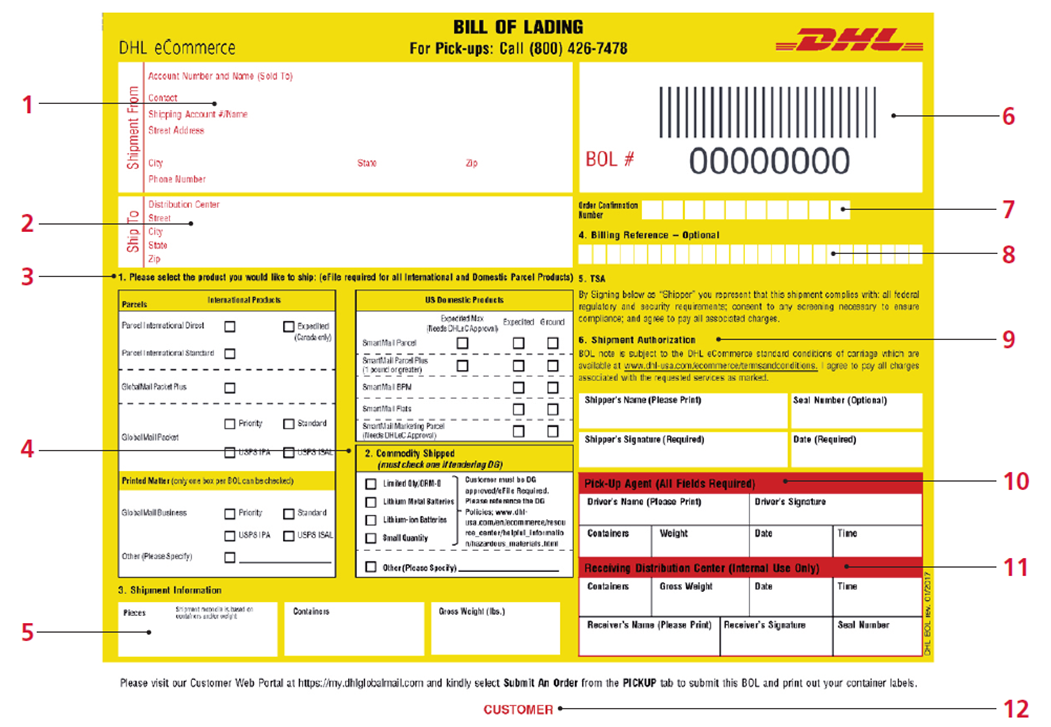
- Shipment From (required). Shipper’s contact information should be pre-entered by DHL eCommerce. If blank, contact Customer Service.
- Ship To (required). The distribution centre processing the shipment should be pre-entered by DHL eCommerce. If blank, contact Customer Service.
- Product/Service (required). Identify product and service leve
Note
Only one box can be marked for the “GM Business Mail” product or in the “US Domestic Products” section. Use a separate BOL for each product and/or service.
- Commodity Shipped (must check one if tendering DG). DHL eCommerce requires shippers to identify the type of Dangerous Goods being shipped in the eFile, as a content category code, and the BOL. Mark “Limited Qty/ORM-D” for packages tendered with content category code 08 (e.g. creams, alcohols, and perfumes). Mark “Lithium-Ion Batteries” for packages tendered with content category codes 04 – 06 (e.g. cell phone and laptop batteries). Mark “Small Quantity” for packages tendered with content category code 09. Please select “Other” if tendering “Lithium Metal Batteries” packages, content category codes 01 – 03 (e.g. watch and camera batteries).
- Pieces/Containers/Gross Weight (required). All shippers must indicate the number of containers and shipment weight (lbs.).
- BOL Number.
- Order Confirmation Number. Enter the number provided by Customer Service Representative when pick-up was scheduled.
- Billing Reference (optional). Note any internal reference.
- Shipment Authorization (required). Please complete and sign.
- Pick-Up Agent. DHL eCommerce and/or our agent will complete.
- Receiving Distribution Centre. To be completed by our distribution centre.
- BOL Sequence Copy. Note that each eBOL consists of four copies.
a) Billing – place this copy inside one of the containers.
b) Agent – provide this copy to the driver.
c) Operations – also provide this copy to the driver.
d) Customer – keep this copy for your records.
Sea Waybills
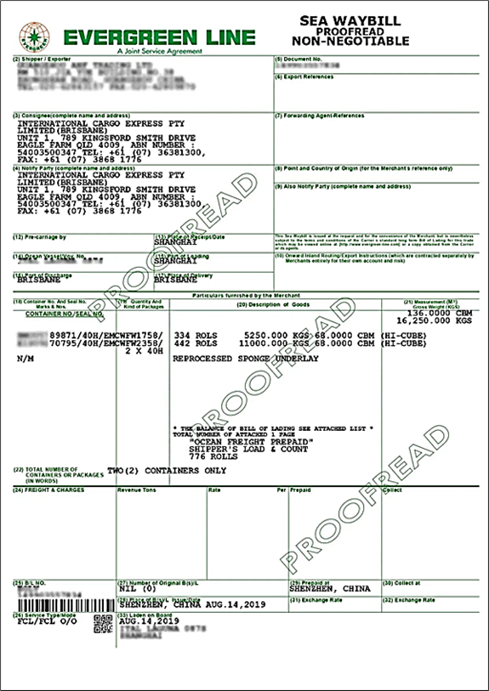
Bills of lading are required where a negotiable document of title is needed as security for payment. In some situations, such security is not necessary — for example, where a multinational company transfers goods between subsidiaries, or where parties with a long-standing trading relationship deal on credit and trust. In these cases, a bill of lading is not needed.
Where no negotiable document of title is required, parties may use a sea waybill. A sea waybill is similar to a bill of lading but performs only two of its three functions:
- It acts as a receipt for the goods
- Provides evidence of the contract of carriage
It is not a negotiable document of title, as indicated by the words Non-Negotiable Sea Waybill. The carrier delivers the goods to the named consignee upon identification, without requiring presentation of the original document.
Sea waybills are also used in short sea trades, such as the trans-Tasman trade between Australia and New Zealand, where the ship may arrive at its destination before the shipping documents
Voyage Charterparties
Large cargo shipments are typically covered by voyage charterparties, under which the charterer charters the entire carrying capacity of a vessel for a specific voyage from the port of loading to the port of discharge. The widely used standard form is Gencon 1994, prepared by BIMCO, and is accompanied by the Congenbill 2016 bill of lading.
|
Note Because the parties to a charterparty have relatively equal bargaining power, no legislative intervention has been considered necessary to protect cargo owners, and the Hague and Hague-Visby Rules do not apply. The rights and obligations of the parties are determined entirely by the written terms of the charterparty. |
A voyage charterparty is a contract for the carriage of goods, not a document of title. If a document of title is required, a bill of lading may be issued for the goods on the chartered vessel. In the charterer’s hands, that bill of lading performs two functions only: it is a receipt for goods and a document of title. For the charterer, the charterparty itself is the contract of carriage. In the hands of any other party, the bill performs all three functions.
Marine Insurance
Marine insurance covers the risk of physical loss or damage to goods and merchandise in transit by any mode of conveyance, or while in storage. Despite the name, marine insurance policies can also cover air shipments. The purpose of marine insurance is to restore the insured to the financial position they would have been in had the loss not occurred.
All marine insurance policies refer to the Institute of Cargo Clauses, the principal insurance clauses used in international trade, published by the Institute of London Underwriters (ILU). There are four variations:
|
Clause |
Cover Level |
|
C Clauses |
Minimum cover – specified risks only |
|
B Clauses |
Includes all cover provided under Clauses (C) cover plus volcanic activity and earthquakes |
|
A Clauses |
‘All Risks’ – highest level; includes all risks subject to listed exclusions (Clause B plus wilful negligence) |
|
Air Clauses |
Cover for goods transported by air freight |
The Marine Insurance Certificate
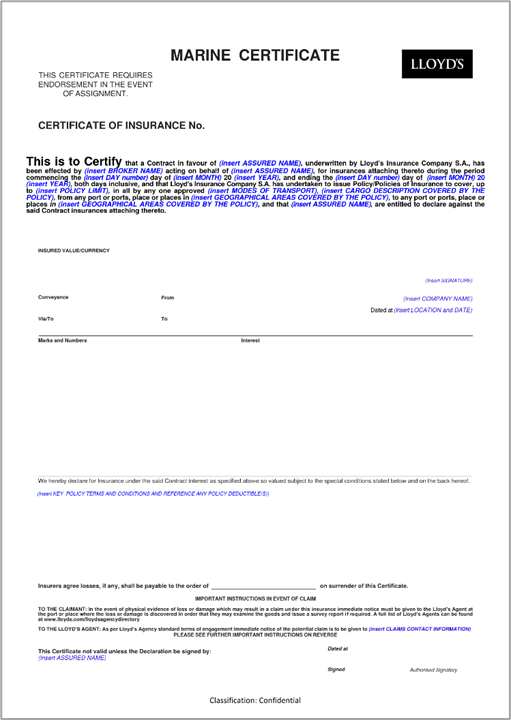
Under the British and Australian Marine Insurance Acts of 1906 and 1909, respectively, a compliant insurance certificate must contain:
- The name of the assured
- The name(s) and address(es) of the insurer(s)
- The subject matter insured and risks covered
- The voyage or period of time covered
- The sum insured (the ‘insurable value’ — normally the CIF/CIP value of the commercial invoice plus 10%)
- A signature by or on behalf of the insurer
- The place where claims are payable and the name of the agent to whom claims may be directed
A typical distribution comprises an Original and one non-negotiable copy sent by first dispatch to the buyer, followed by a Duplicate and a second non-negotiable copy. Further non-negotiable copies are sent to the broker and/or insurer as evidence of the risk under the policy. Under a documentary letter of credit, the negotiating bank will normally require both the Original and the Duplicate.
When documents must be transferred while goods are in transit, an insurance certificate can be made transferable by endorsement. This is done by signing the reverse of the original document to the order of the new owner, which transfers the right to claim under the policy to the endorsee.
Under the terms of a documentary letter of credit, the certificate is often required in negotiable form, prepared ‘To Order’ or ‘To Shipper’s Order’ and blank endorsed. In this case, the endorser does not designate a specific party as the endorsee, making the document freely negotiable by any holder. When credits require this, the accompanying bill of lading is also typically made out ‘To Order’ and blank endorsed.
The information on the insurance certificate must conform to the other documents presented under the credit.
|
Note The certificate must not be dated after the ‘on board’ or shipment date shown on the transport documents. |
Commercial Practice in ActionThe following example shows how the concepts covered so far come together in day-to-day international trade practice. It traces a typical shipment from the sales contract through to delivery at destination, highlighting where key parties (such as freight forwarders, loading brokers, and carriers) become involved, and where documentation, risk, and control of the goods shift in commercially important ways. Loading brokers handle logistics from the carrier’s side. They advertise the dates of sailings, supervise loading, and consult with shipowners’ cargo superintendent with regard to the stowage. In practice, it is not uncommon for a single forwarding firm to act as both forwarding agent and loading broker, although these tasks are usually handled by separate departments. The forwarder will reserve space on a particular vessel, and then will appropriately fill in a set of pre-printed bills of lading (a “set” comprises from 2 to 4 identical originals). Most shipowners or carriers print their own bills of lading and make these freely available. The forwarder will indicate on the draft bill of lading all necessary information, including the identity of the consignee, a description of the goods which includes shipping marks, and details regarding the payment of freight. The shipper, with the forwarder’s assistance, will make sure that the goods are either delivered alongside the ship or into the care of a port terminal, storage shed or warehouse. When the goods are delivered, the shipper will customarily receive a receipt document such as a mate’s receipt, dock receipt, cargo quay receipt or wharfinger’s note. The shipowner will record the details of the goods received, as well as any important defects or damages, on the mate’s receipt. This is important, because the bill of lading will be based on information from the mate’s receipt. If the mate’s receipt indicates damaged goods, then the shipowner will not issue a ‘clean’ bill of lading. The shipowner will compare the details of the goods as loaded (recorded by the shipowner’s clerks) with the draft bills of lading that the forwarder or shipper has provided. Provided the details match and the goods do not exhibit damage or defects, the shipowner will issue the completed and signed clean bills of lading. The information from the bills of lading is also recorded on a register carried by the ship itself, called the ship’s manifest. Once the goods have been loaded, and the shipper has in addition obtained a marine insurance policy (in CIF shipments, with buyer as policyholder) and prepared a bank draft, the shipper is able to assemble a set of shipping documents. This bundle of documents serves as the hub of many international payment and finance mechanisms. Control over the goods can be freely transferred by endorsement of the bill of lading. Endorsement is affected when the party holding the bill of lading and wishing to make the transfer signs the back of the bill of lading. The signature may also be accompanied by directions to deliver to a specific person. When the goods arrive at the port of destination, the ship’s master will deliver the goods to the first party who presents an original bill of lading. Commonly, the importer will present the bill of lading to the ship’s agent, who will then issue a delivery order; the importer then uses the delivery order to obtain release of the goods. It is not uncommon for the goods to arrive before the bills of lading have been processed through the payment system and received by the importer. Since a delay in receiving the goods may result in penalties or storage charges, the consignee may ask his bank to issue a letter of indemnity to the shipowner, which will protect the shipowner in the event that he incurs liability for delivery to the wrong person. The shipowner will then release the goods against the letter of indemnity. In some sectors, such as the oil trade, this practice is common.
Source: ICC, Guide to Export-Import Basics 5thrd Edition, 2018 |
|
International Carriage of Goods by Air
Goods transported by air differ from those transported by sea. They are often time-sensitive, high-value, or require special handling. Examples include perishable goods such as fresh seafood, temperature-sensitive items such as pharmaceuticals, and high-value goods such as jewellery and precious metals. Items that require supervision during transport, such as diplomatic bags, are also typically carried by air.
Dangerous goods transported by air must meet specific packaging and handling requirements. These are set out in an Annex to the Convention on International Civil Aviation (Chicago Convention, 1944), issued by the International Civil Aviation Organization (ICAO). The International Air Transport Association (IATA) publishes detailed guidance to support the safe transport of these goods.
A significant proportion of air cargo consists of air express consignments — often documents or low-value, low-duty goods of limited interest to customs from a revenue perspective. At the same time, the speed of air transport reduces exposure to risk, making it appropriate for high value goods including pharmaceuticals, medical supplies, prize livestock, artworks, and manuscripts. The need for rapid delivery places pressure on customs services to process these consignments efficiently while ensuring that the speed of air transport is not exploited for the importation of contraband.
While air freight rates are higher than ocean rates, air shipments can generate savings in other cost areas:
- Insurance: Premiums are generally less than half those for sea transport (approximately 0.3% of cargo value for air versus 0.7% for sea).
- Customs duties: May be assessed on gross weight, which is typically lower for air shipments due to lighter packaging.
- Packaging: Much lighter and less costly for air transport.
- Inventory and warehousing costs: Air transport can greatly reduce or eliminate the need for warehousing at either end of the transit, together with associated tax, insurance, and obsolescence costs.
- Financing costs: Where the buyer’s payment obligation is triggered by delivery to the buyer’s premises, the seller receives payment significantly sooner with air transport.
Legal Framework for Carriage by Air
International air transport is regulated by two systems: the Chicago System and the Warsaw System.
- The Chicago System governs international civil aviation by establishing uniform rules for the use and control of national airspace; it primarily governs relationships between States.
- The Warsaw System governs carrier liability in the carriage of cargo and passengers.
The key concept in the amended Warsaw Convention is “international carriage.” This refers to the transport of goods between the territories of two countries that are parties to the Convention.
This differs from the Hague Visby Rules. The Hague Visby Rules apply if the country of origin has adopted them. In contrast, the amended Warsaw Convention applies only when both the origin and destination countries have adopted the Convention. If one of the countries has not adopted the Hague Protocol, the amendments do not apply.
For example, Thailand and Taiwan have not adopted the original Warsaw Convention. As a result, air carriage between Australia and those countries is not considered international carriage under the Convention.
The Montreal Convention, concluded in 1999 and in force from 4 November 2003, incorporates most of the existing instruments in a single package that States must either accept or reject in its entirety. As more States ratify the Montreal Convention, the older Warsaw System instruments are becoming increasingly redundant.
Key Documents for Air Carriage
In air transport, there is one main type of carriage contract: the Air Waybill. The Air Waybill serves as a receipt for the goods and as evidence of the contract of carriage.
It is generally not negotiable and does not function as a document of title. This is because goods transported by air usually arrive before the documents, making a negotiable document unnecessary.
In some cases, a negotiable Air Waybill may be issued if the parties specifically request it.
A contract of carriage may be made between the consignor and the carrier, or between an air freight forwarder and the carrier. The forwarder may act as agent for the cargo owner or as a contracting carrier in its own right. Both the contracting carrier and the actual carrier are subject to the Guadalajara Convention 1961.
|
Note Unlike a bill of lading, an air waybill is normally made out by the consignor (sometimes completed by the carrier on the consignor’s behalf) and given to the carrier with the goods. The carrier verifies the information by signing the appropriate copy. |
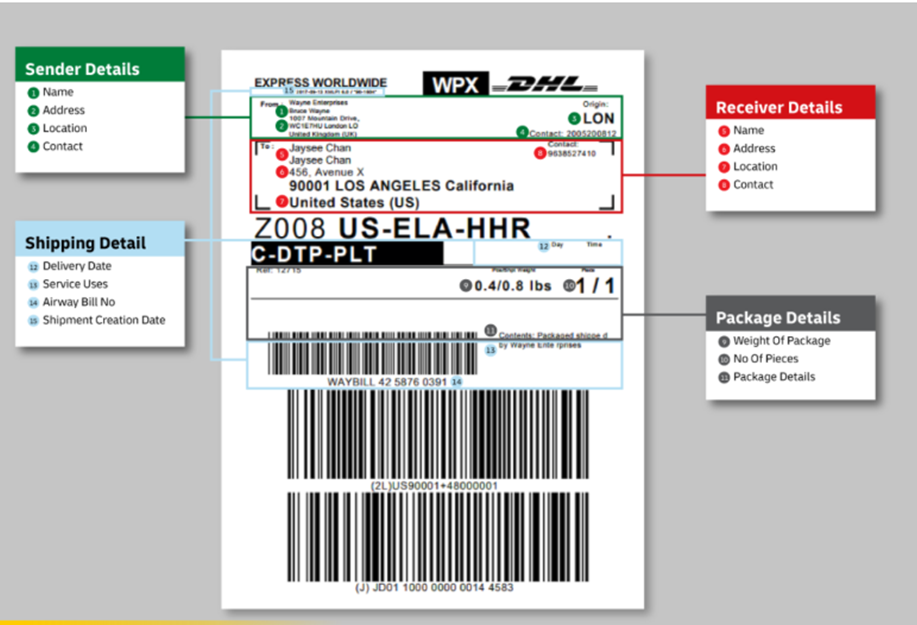
Source: DHL Express Air Waybill Explained
Freight forwarders acting as consolidators may issue Air Waybills (AWBs) in their own name as carriers. In this role, they operate in a similar way to Non-Vessel Operating Common Carriers (NVOCCs) in sea transport.
By grouping multiple consignments together, forwarders can access lower freight rates offered by carriers for larger shipments. This consolidation process is similar to the groupage function used in container shipping.
Consolidators may also provide supporting services at both origin and destination. These can include:
- warehouse handling at the point of departure
- notification of the consignee on arrival
- customs clearance
- insurance arrangements
- door to door delivery
When goods are consolidated, they are typically shipped under a single Air Waybill known as a Master Air Waybill (MAWB), with a cargo manifest listing all consignments attached. The freight forwarder then issues a separate Air Waybill to each shipper, known as a House Air Waybill (HAWB).
As noted, the exporter or consignor often appoints a freight forwarder or consolidator to arrange the transport of goods. The consignor provides a Shipper’s Letter of Instructions, which authorizes the forwarding agent to complete and sign documents, including the Air Waybill, on the consignor’s behalf.
In this situation, the Air Waybill must confirm that the goods have been accepted for carriage. It must be signed or authenticated by the carrier or an agent acting on its behalf. The signature must clearly identify the carrier. If an agent signs or authenticates the document, the name of the carrier and the agent’s authority to act on the carrier’s behalf must be stated.
Carriage of goods by multimodal transport
Multimodal transport is the carriage of goods using more than one mode of transport. It is common in international trade because buyers and sellers are often located away from ports, and buyers may require delivery from the seller’s premises to their own location. Depending on the terms of the contract of sale, such as Free On Board (FOB), Cost, Insurance and Freight (CIF), or Ex Works (EXW), the buyer or seller may need to arrange transport with different carriers at each stage of the journey.
In some cases, a single carrier or forwarder may contract with the consignor to manage the entire movement of goods. In this situation, that party accepts responsibility for transporting the cargo across all stages and is liable for its safety from origin to destination.
Each mode of transport is governed by different international conventions. To apply these conventions, separate contracts are often required for each stage of transport. When a through document of transport is used, such as a through bill of lading, the first carrier is responsible to the consignor under the main contract until delivery. The first carrier then contracts with subsequent carriers. The consignor does not usually have direct claims against subsequent carriers unless allowed by law.
This system reflects a lack of coordination between the legal frameworks that apply to different modes of transport. Important issues, such as the relationship between the cargo owner and the actual carrier, and the process for making claims, are not fully defined.
The UNCTAD ICC Rules for Multimodal Transport Documents, introduced in 1992, provide guidance on how parties can define their legal responsibilities. These rules apply only if they are included in the contract.
The UN Convention on International Multimodal Transport of Goods, adopted in 1980, aims to create a unified set of liability rules for multimodal transport involving at least two modes of transport. However, it has not entered into force.
Universal Postal Union Standards
The Universal Postal Union (UPU) is the main organization for cooperation between national postal services and includes 192 member countries. It sets the rules for international mail exchange and provides recommendations to improve service quality. It does not regulate domestic postal matters such as postage rates, stamp design, or the operation of national postal systems.
Within the UPU, the Standards Boards define and maintain technical and messaging standards for postal systems. Their purpose is to improve efficiency, support service quality, and ensure compatibility between postal networks and international systems.
The Standards Boards focus on:
- defining codes and data used in the exchange of postal information
- developing and maintaining standards for electronic data exchange
- creating standards for encoding data on physical items such as labels and documents
- supporting the use of printed symbols such as bar codes and two-dimensional codes
- developing standards for electronic data exchange between postal operators and airlines
The complete list of UPU Standards can be found here: UPU Technical Standards.
As mentioned in the section on air carriage of goods, a large proportion of air transport involves express consignments. These shipments typically consist of documents or low-value goods and are generally of limited interest to customs authorities.
However, a key issue is how these courier shipments are treated compared to government-operated standard postal services.
The UPU and the WCO have looked closely at this issue and issued a series of guidelines on how these items are to be processed. These guidelines can be found here: WCO-UPU Postal Customs Guide.
The main requirement of designated operators such as DPDHL is stated in the UPU Convention General Regulations:
|
Regulations art. 20-001 |
Designated operators shall accept no liability for the customs declarations. Completion of customs declarations shall be the responsibility of the sender alone. However, designated operators shall take all reasonable steps to inform their customers on how to comply with customs formalities, and specifically to ensure that CN 22 and CN 23 customs declarations are completed in full, in order to facilitate rapid clearance of items. |
|
Regulations art. 20-001.2.1 |
Items to be submitted to customs control shall bear on the outside a CN 22 customs declaration or be provided with a tie-on label in the same form. |
The CN 22 Customs declaration is specifically intended for items such as small packets, where the available physical space on the item is quite limited.
The UPU CN22 Customs declaration is shown below, with several key elements highlighted.
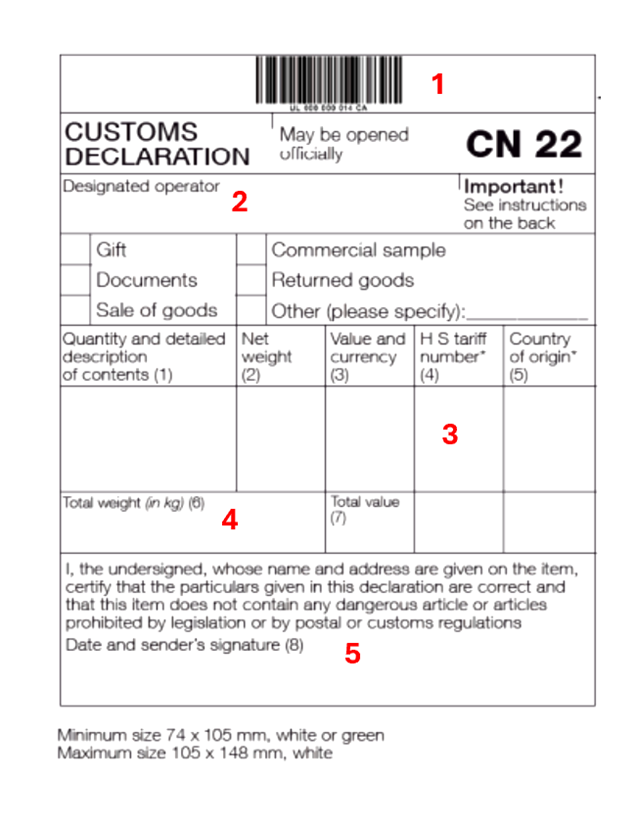
- Barcode: All postal items must have the S10 barcode. S10 refers to UPU Technical Standard S10. As shown here, the barcode is part of the Custom Declaration. However, the barcode can be affixed to the item separately.
- Designated Operator: The Designated Operator's name is typically pre-printed on the form.
- Content Boxes: These boxes are selected to accelerate Customs clearance at destination.
- Description of Goods: To accelerate Customs Clearance at the destination, it is very important that the goods are properly described, valued, and the country of origin identified. This reduces the need to inspect the package, adding to delays and costs
- Weight: Certain goods (e.g., chocolate) are weight-based, and hence the sender is required to record the item's weight (e.g., chocolates: 500 g). Where the item is not weight-based but value-based (e.g., shirts), the item's weight need not be recorded.
Declaraton: This is to ensure that the sender reads the important instructions on the back of the form.
Using this prescribed format, DPDHL business units utilise their own versions of the CN22 form. The following is a copy of the form used by DPDHL Germany:
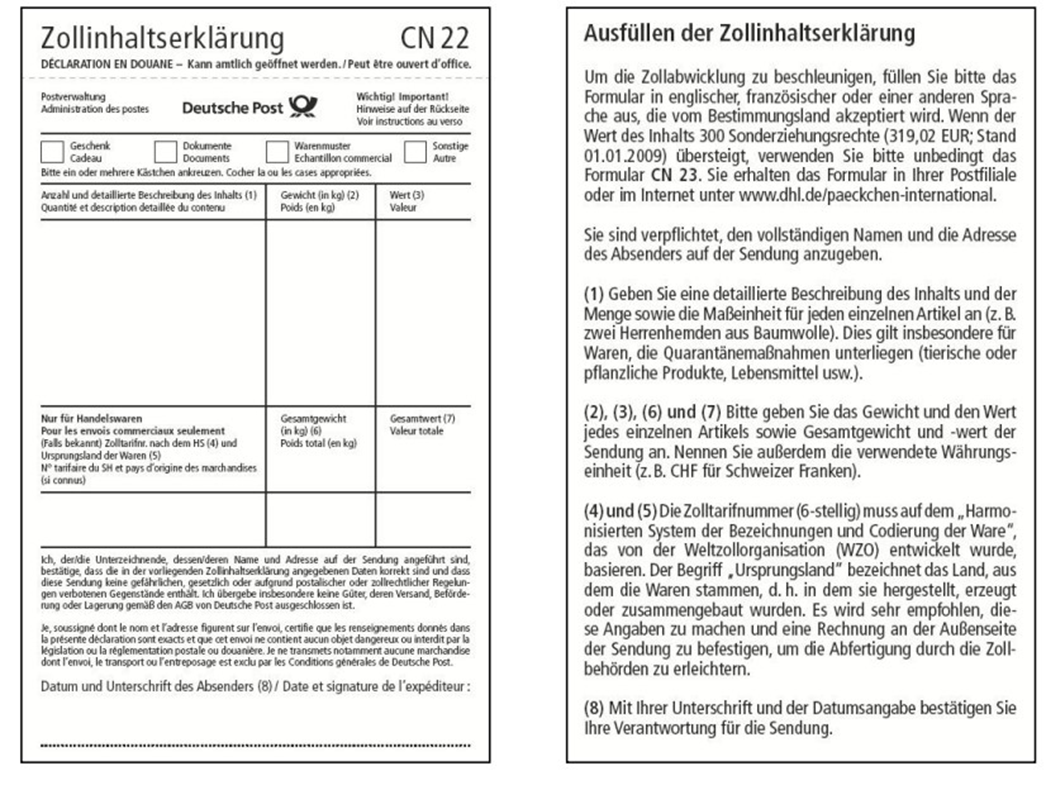
DPDHL provides staff and customer with detailed instructions on correctly completing customs information and complying with the CN22 requirements when sending parcels. The guide can be found Here
CN23 Form
The CN 23 Customs declaration may also be used for letter post items and allows for additional optional information not included on the CN22.
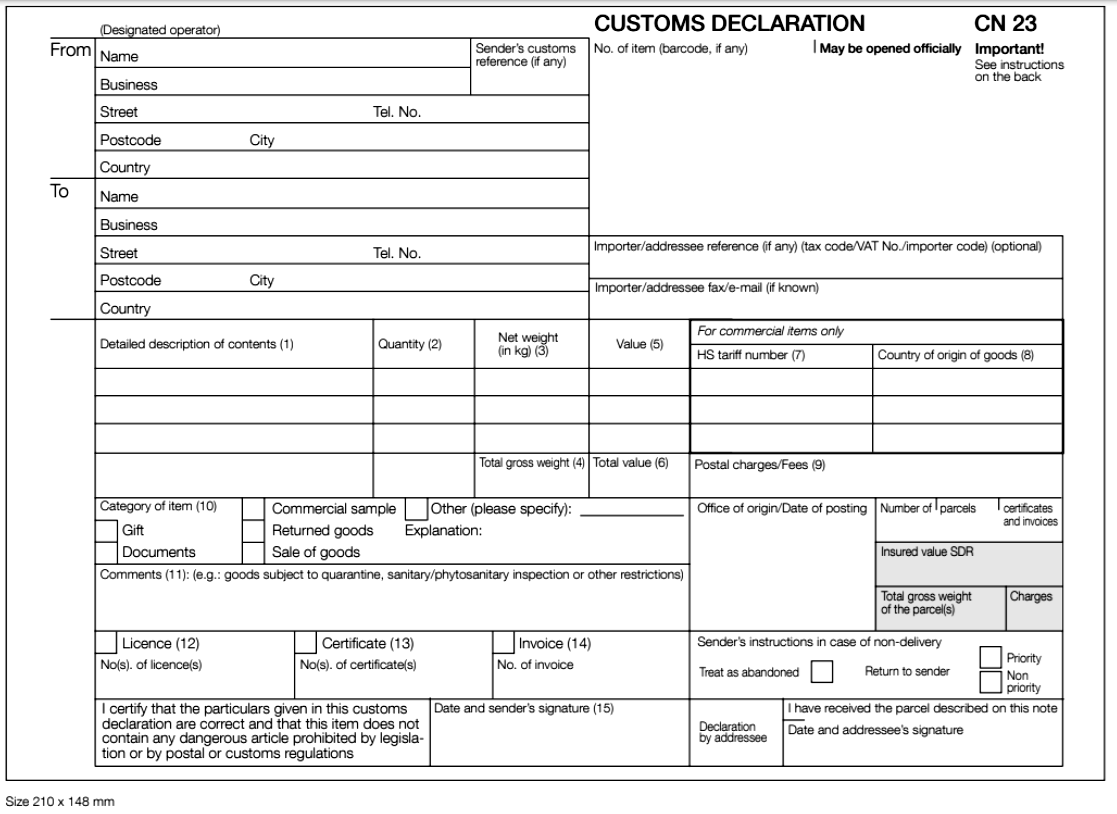
Using this prescribed format, DPDHL business units utilise their own versions of the CN23 form. The following is a copy of the form used by DPDHL Germany:
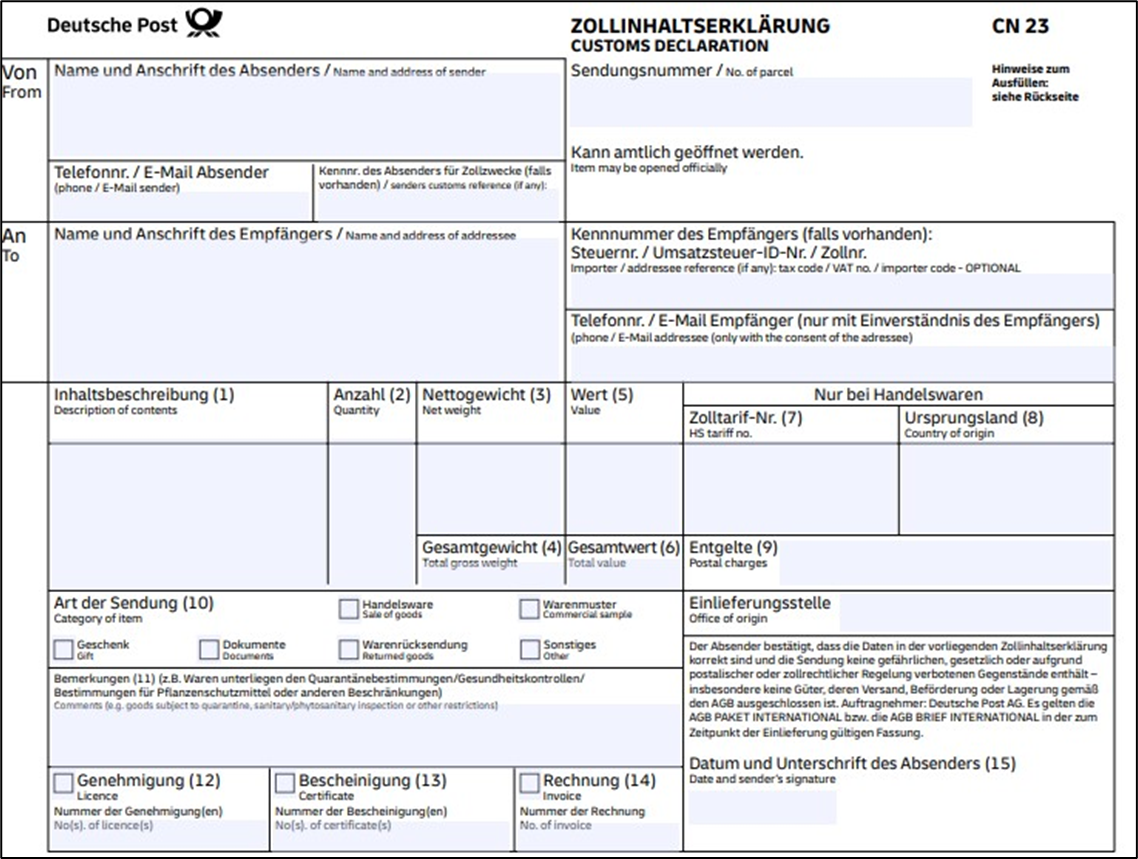
Electronic Advance Data (EAD)
The Electronic Advance Data (EAD) initiative is a joint program developed by the World Customs Organization (WCO) and the Universal Postal Union (UPU) to improve the security and efficiency of international postal services. EAD involves sending digital information about postal shipments before they arrive at their destination. This information typically includes details of the sender and recipient, a description of the contents, and the value of the items. Customs authorities use this data to assess risk and support faster clearance.
The objectives of the WCO-UPU EAD initiative are:
- Enhancing security: improve security by providing advance information to help identify prohibited or dangerous goods
- Facilitating trade: support trade by enabling faster processing of legitimate shipments and reducing delays
- Standardizing procedures: standardize procedures by promoting consistent electronic messaging formats across countries
- Regulatory compliance: support compliance with international and national legal requirements
The following schematic (EAD Global Postal Model) shows the various components developed to enable the postal sector to comply with emerging requirements for providing EAD for Customs (both regulatory compliance and trade facilitation purposes). The model identifies eight data flows between postal operators, airlines, and customs administrations.