Customs Regulatory Control Study Guide
| Site: | Centre for Customs and Excise Studies |
| Course: | DHL International Customs Program 2026: Cohort 1 |
| Book: | Customs Regulatory Control Study Guide |
| Printed by: | Guest user |
| Date: | Saturday, 17 October 2026, 2:26 AM |
1. Introduction
In Module 1 we examined the regulatory and commercial requirements that dictate how international trade is conducted. In this module we examine how international law agreements govern the relations between states in the exercise of Customs powers, and the principles that Customs and other regulatory authorities use to ensure compliance with international and domestic law.
The module is in two parts.
Part 1 introduces the key international agreements developed by the WCO and the WTO. We look closely at four agreements:
-
The Revised Kyoto Convention on the Simplification and Harmonization of Customs Procedures (RKC) and the WTO Trade Facilitation Agreement (TFA) — both establish legally binding obligations on how to clear goods for import, export and other Customs purposes, and on the collection of revenues.
-
The Harmonized System Convention (HS Convention) — delivers a global coding system for all goods engaged in international trade.
-
The WTO Valuation Agreement — provides the basis on which all WTO Members are to determine the value of goods at the time of importation.
The Activity for this module asks you to complete a short research task on these agreements, and one or two others that also bear on Customs work.
Part 2 examines the principles of regulatory compliance and how countries enforce these agreements at the national level. Key topics include:
-
Risk management — how it has been introduced into Customs work worldwide, and the legally enforceable standards the RKC and TFA set for administrations to follow.
-
Post-clearance audit — how Customs monitors compliance without intervening at the point of arrival or departure of goods, shifting from real-time intervention to audit-based controls.
-
Cooperative compliance — the use of techniques such as binding rulings to resolve difficult situations before they arise, built on cooperation with the trade rather than confrontation.
-
Enforcement and recognition — the range of measures available to penalise non-compliers, and the reward and recognition strategies available for highly compliant companies.
Information technology and risk management have been the key enablers that allow Customs to keep pace with increasing volumes of trade and passengers, and to ensure the border is well managed, without proportional increases in resources. Those of you in countries where ASYCUDA has been recently introduced will be familiar with how ASYCUDA World gives effect to international agreements such as the Harmonized System Convention.
We turn now to an examination of the key international trade treaties and conventions.
2. Part 1: International Trade Treaties and Conventions
Overview
Customs administrations operate in a complex legal environment where international law interacts with domestic law. As an instrument of the executive arm of government, Customs enforces a wide range of domestic laws — powers and responsibilities normally set down in a country's main Customs Act.
The doctrine of sovereignty allows a state to write its own domestic law as it sees fit. However, this is progressively modified by international instruments designed to create uniformity, simplicity, harmonisation and predictability in the way Customs operates worldwide. International law increasingly determines the role of Customs, the powers it should have, and the extent of its jurisdiction.
Several international treaties and conventions provide standards specifically for Customs activities. The most important are:
|
|
||||
|
|
The WCO Framework of Standards to Secure and Facilitate Global Trade (SAFE), while not a legally binding Convention, provides best practice guidance to secure international trade and promote partnership with industry. SAFE is examined in Module 3.
Several WTO agreements establish broader trade principles that Customs must also implement. All are founded on the General Agreement on Tariffs and Trade (GATT):
|
Agreement and Customs relevance |
|
Agreement on Sanitary and Phytosanitary Measures governs food safety and animal/plant health measures that Customs must enforce at the border. |
|
Agreement on Dumping (Anti-Dumping Agreement) sets rules for Customs enforcement of anti-dumping duties on goods exported below normal value. |
|
Agreement on Subsidies and Countervailing Measures provides the framework for applying countervailing duties on subsidised imported goods. |
|
Agreement on Technical Barriers to Trade ensures technical regulations and standards applied at the border are not unnecessarily trade restrictive. |
|
|
Further Reading These instruments demonstrate the importance of unified approaches to managing the clearance of goods and the collection of revenue. Full texts of all instruments are available on the WCO website and the WTO website. In this part of the module, we focus on the HS Convention and the Valuation Agreement, before turning to the Trade Facilitation Agreement. |
Learning Objectives
|
✓ |
International Customs Agreements and Member State Obligations Identify the primary international agreements governing Customs operations and explain the obligations they impose on member states. |
|
✓ |
The Harmonized System Convention: Structure, Purpose, and Administration Explain the structure and purpose of the Harmonized System Convention, including how it is administered and updated. |
|
✓ |
WTO Valuation Agreement: Methods, Application, and Implementation Challenges Describe the WTO Valuation Agreement's primary and alternative methods for determining customs value and identifying the key challenges in its implementation. |
2.1. Customs Specific Agreements
International Customs law is a collection of treaties and instruments that regulate how Customs agencies exercise their functions at the border. Central to these is the RKC, which sets standards for processing goods and passengers entering and departing a Customs territory. Countries that have acceded to the Convention must incorporate these standards into national law through their Customs Act and any supporting Regulations or Orders.
More recently, the WTO adopted the Trade Facilitation Agreement, which requires all WTO Members to accept standards for the clearance of goods that are almost identical to the RKC. The WCO Convention on Temporary Admission (the Istanbul Convention) establishes standards for the temporary entry of specific goods for defined purposes, such as exhibitions and events.
There are many other conventions on particular aspects of Customs work prepared by the WCO and adopted by its members. The most important of these is the Convention on the Harmonized Commodity Description and Coding System (HS Convention), adopted in 1988, which establishes the Harmonized System of tariff nomenclature that now has almost universal application.
In addition, the WTO has developed several agreements that establish principles relating to international trade which Customs agencies must implement. The most important of these for Customs purposes is the Agreement on Valuation. In addition to the Valuation Agreement, Customs agencies must also implement these WTO agreements:
|
Agreement |
Customs Relevance |
|
Sanitary & Phytosanitary Measures |
Establishes rules governing quarantine and the application of food safety and animal/plant health measures at the border. |
|
Agreement on Dumping |
Sets the rules for applying anti-dumping duties on goods exported to a country below their normal value in the exporting country. |
|
Subsidies & Countervailing Measures |
Provides the framework for applying countervailing duties to offset the benefit of subsidies granted to exported goods. |
|
Technical Barriers to Trade |
Allows countries to regulate the quality of imported goods, provided such regulations are not used as unnecessary barriers to trade. |
The principles set out in all these agreements are founded on the WTO's foundation document, the General Agreement on Tariffs and Trade (GATT). For our purposes here, we focus most closely on the HS Convention and the Valuation Agreement. Full texts and further information on all WCO and WTO agreements are available on their respective websites: WCO Conventions and Agreements and WTO Legal Texts.
2.2. The Harmonized System Convention (HS Convention)
The WTO adopted the Harmonized System Convention in 1988 as the global means for determining the tariff classification of all goods. Its full title is the International Convention on the Harmonized Commodity Description and Coding System.
The aims of the Harmonized System are to:
|
01 International Uniformity Achieve uniform classification of goods across all countries, removing divergent national approaches. |
02 Trade Statistics Enable the collection, analysis, and comparison of world trade statistics on a consistent basis. |
|
03 Common Coding System Provide a single international system for coding, describing, and classifying goods, usable by freight forwarders, insurers, transport associations, importers, and exporters. |
04 Responsive to Change Maintain an up-to-date document that can be amended to reflect technological developments and shifts in international trade patterns. |
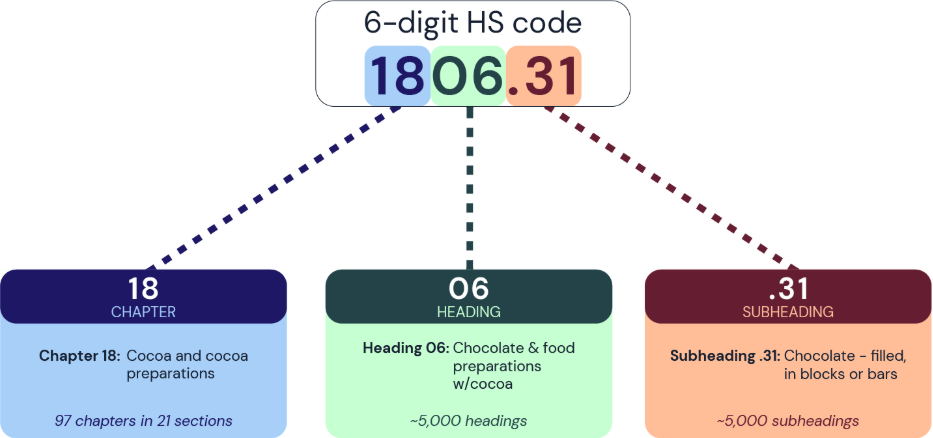
The Harmonized System (HS) is built around a standardised 6-digit code used globally to classify goods, ensuring each product is identified consistently as it is produced, traded, and transported. Its purpose is to replace multiple differing classification systems, allowing all countries and industries to use a single, common framework for identifying goods in international trade.
The Harmonized System is designed to be a multipurpose nomenclature. Some of the uses envisaged by its authors include being a basis for:
|
01 Customs tariffs Forms the basis for national tariff documents, enabling correct duty assessment, revenue collection, and the application of trade policy at the border. |
02 International trade statistics Provides a standardised framework for the collection, analysis, and comparison of trade data between countries. |
|
03 Rules of origin Supports the determination of where goods originate, critical for applying preferential tariff rates under trade agreements. |
04 Trade negotiations Used as the basis for WTO schedules of tariff concessions and other bilateral and multilateral trade agreement negotiations. |
|
05 Identifying restricted and prohibited goods Enables the consistent identification of goods that are subject to restrictions or outright prohibitions in international trade, supporting Customs enforcement at the border. |
|
The current primary function of the Harmonized System is to form the basis for national tariff documents. A large percentage of countries still depend heavily on customs duties for their national revenues, and goods need to be properly classified to ensure correct revenue collection. The Harmonized System forms the basis of the Customs tariffs of more than 200 countries, customs territories and the European Economic Union (EEU), representing approximately 98% of world trade.
HS Nomenclature
The HS Convention consists of 20 Articles and an Annex. The Articles govern the procedures for running the Convention. The Annex has more relevance for everyday use by Customs administrations. The HS Nomenclature is the Annex to the Convention. Under Article 1, it comprises:
|
Component |
Description |
|
Headings (4-digit) |
4-digit classifications and their goods descriptions, the primary level of classification. |
|
Subheadings (5- and 6-digit) |
More specific 5- and 6-digit classifications and their goods descriptions, providing greater granularity. |
|
Legal notes |
Notes applicable to headings and subheadings, legally binding interpretive rules appearing at the start of chapters and sections. |
|
Interpretative rules |
Rules for the classification of goods, providing the legal framework for determining which heading or subheading applies to any given product. |
Headings and subheadings are grouped into 97 chapters, which are further divided into 21 sections. Legal notes appear at the beginning of nearly all chapters and some sections. While it is not our intention to examine all 20 Articles, it is worth looking at a few key ones.
Article 3 specifies the obligations of Contracting Parties. It sets out three distinct points:
|
Point |
Obligation on Contracting Parties |
|
1 |
Adopt the HS as-is On signing the Convention, Contracting Parties are bound to adopt the HS as it stands, and as it is revised every five years. |
|
2 |
No changes to scope or order Texts and codes may not be amended in any way that would change the scope or order of the headings or subheadings. |
|
3 |
Only domestic implementation amendments The only permitted amendments are those necessary to give effect to the HS in domestic law, and even these must not affect the scope of headings or subheadings. |
Articles 4 and 5 permit developing countries that are signatories to participate initially in the HS at the 4-digit level only, and to receive technical assistance in adopting the Nomenclature. Partial application does not limit a country to using only the 4-digit headings; it may also elect to use only some of the 5- and 6-digit subheadings if it chooses.
Article 6 provides for the establishment of the Harmonized System Committee (HSC) and its associated sub-committees or working parties. Under this article, the HSC administers the general running of the HS, while the Review Sub-Committee conducts a systematic review of the structure of the Nomenclature on a regular basis to ensure it keeps up to date with technological developments and changes in trading patterns.
Article 7 allows for amendments to the HS documents and for the preparation and amendment of supplementary publications such as the Harmonized System Explanatory Notes and the Compendium of Classification Opinions.
Note
The six digits of an HS code are structured across three levels, Chapter, Heading, and Subheading.
The following image shows a specimen Nomenclature page illustrating how legal notes and classification numbers/descriptions appear in practice. It shows Chapter 18 (Cocoa and cocoa preparations) as an example, with legal notes at the top followed by 4-digit headings and 6-digit subheadings.
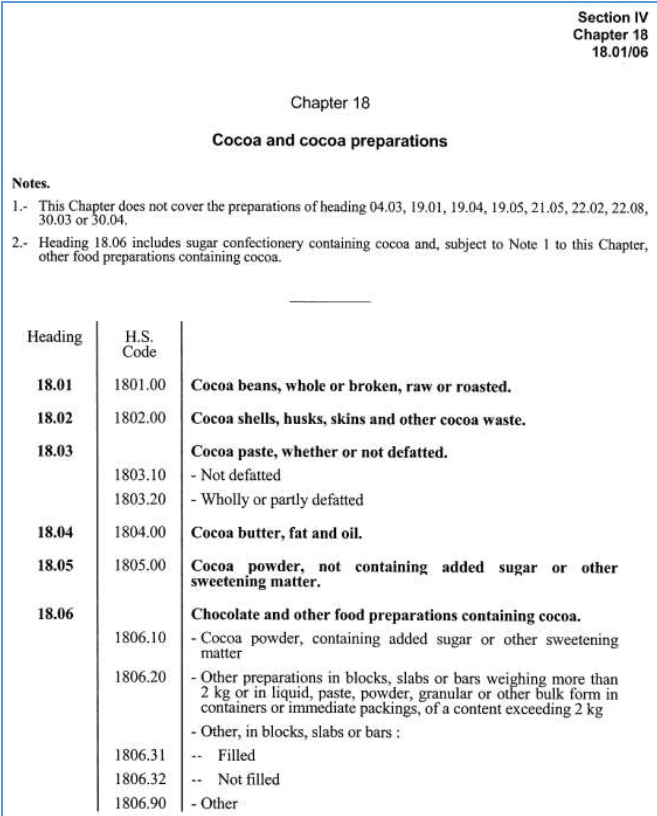
Figure 1: Specimen HS Nomenclature page showing legal notes and classification numbers/descriptions
Note
The latest version of the Nomenclature was introduced on 1 January 2022 and should now be in force in all Contracting Parties. The next review, originally scheduled for 2025, has been deferred for at least a year and is due to be implemented on 1 January 2028.
The Harmonized System Committee (HSC)
The HSC is the primary administrative body responsible for the uniform interpretation and application of the HS. Each Contracting Party has one vote. The exception is EU member states, which collectively hold one vote in the name of the European Economic Community.
|
Function |
What the HSC Does |
|
Guidance on HS interpretation |
Prepares Explanatory Notes, Classification Opinions, and individual formal advice to guide consistent interpretation of the HS across all Contracting Parties. |
|
Recommendations for uniformity |
Prepares recommendations to secure uniformity and transparency in how the HS is interpreted and applied, minimizing divergence between countries. |
|
Information collation and circulation |
Collates and circulates information on the application and maintenance of the HS, keeping all Contracting Parties informed of developments and decisions. |
The HSC is also the arbiter of classification disputes between Contracting Parties under Article 10. Where a dispute arises, the parties are first encouraged to reach agreement among themselves. Disputes that cannot be settled directly are referred to the HSC for adjudication at its bi-annual meetings. In the unlikely event that the HSC cannot settle a dispute, it may refer the matter to the WCO Council for a recommendation. Members not satisfied with the result have the right to appeal.
Continuous Updating of the HS
The HS has a built-in system of continuous amendment, essential because internationally traded goods are constantly changing — whether because of shifting demand or technological progress. The HS operates on a five-year review cycle. Each cycle may examine the Nomenclature as a whole, focus on certain sectors, or address particular areas — for example, a review period may focus on heavy machinery classifications or computer-related equipment. The review process is intensive and involves detailed submissions and consultations between the HSC and its sub-committees. Since its inception, the HS has undergone six major reviews. The sixth (current) version was implemented on 1 January 2022. The next review, originally scheduled for 2025, has been deferred for at least a year and is due on 1 January 2028.
Harmonized System Explanatory Notes (HSEN)
The HSEN are the largest and most important supplementary publication produced by the HSC. Although they do not form an integral part of the HS Nomenclature, they are the official interpretation of the HS structure and complement the legal text. The HS Convention and the HSEN will be studied in much more detail later in the course to assist you in classifying goods in accordance with the HS Tariff.
2.3. WTO Valuation Agreement
An important outcome of the Uruguay Round of multilateral trade negotiations in 1994 was the Agreement on Implementation of Article VII of GATT — the Valuation Agreement. It entered into force in 1995 and binds all WTO Members to apply uniform rules for determining the customs value of imported goods.
Building on Article VII of GATT, the Agreement provides that the primary basis for customs value is the transaction value of the imported goods. The transaction value is the price actually paid or payable for the goods when sold for export to the country of importation. The price actually paid or payable is to be adjusted where necessary to take account of certain specific elements — the various charges, costs and expenses incurred by the buyer in the importation process that are not already included in the price actually paid or payable for the imported goods.
The adjusted transaction value represents the customs value of the goods, provided that none of the four impediments to the use of "transaction value" are present in terms of sale or purchase of the imported goods (Article 1, paragraph 1 (a)-(d) of the Agreement).
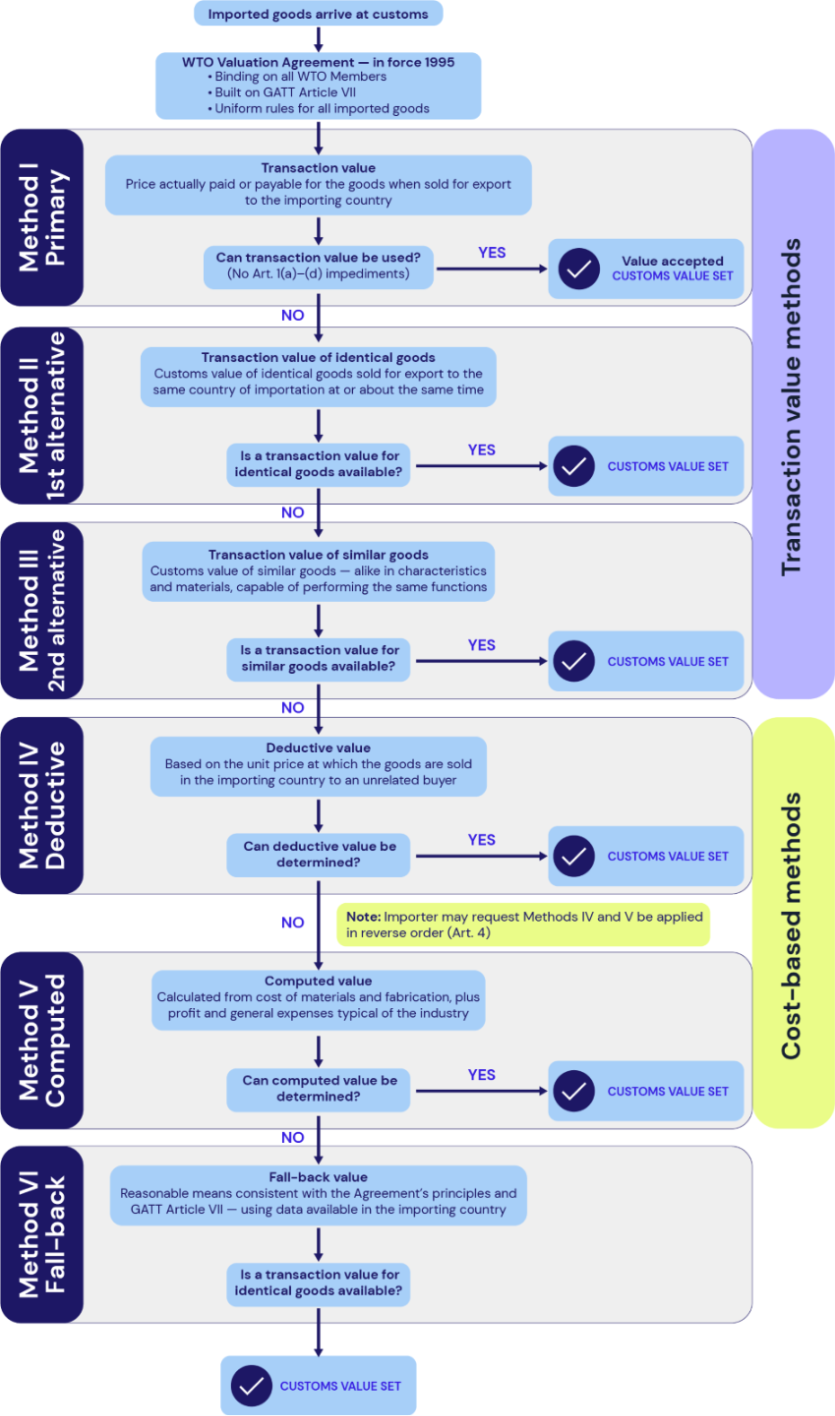
Where no transaction value can be determined, or where the stipulated conditions cannot be met, the Agreement provides five alternative methods for determining the customs value of the goods, which must be applied in hierarchical order:
-
Where the customs value cannot be determined based on the transaction value method (Method I), the customs value is to be determined based on the transaction value of identical imported goods (Method II).
-
If the customs value cannot be determined using the transaction value of identical goods, then the customs value shall be determined based on the transaction value of similar imported goods (Method III).
-
If the customs value cannot be determined on the basis of the transaction value of the imported goods or of identical or similar imported goods, it shall be determined based on the deductive value method (Method IV). Under the deductive value method, the customs value is determined on the basis of a unit price at which the goods are sold in the condition as imported to an unrelated buyer in the country of importation.
-
When the customs value cannot be determined based on the deductive value method, the next method is the computed value method (Method V). Under this method, the customs value is essentially calculated using the sum of the cost of materials and fabrication and an amount for profit and general expenses. If the WTO member country chooses to base the customs value on Cost, Insurance, and Freight (CIF), then the computed value also includes the cost of transportation and its related costs and insurance for transportation.
-
If the customs value cannot be determined under any of the five methods, the customs value shall be determined using reasonable means consistent with the principles and general provisions of the Agreement and of Article VII of the GATT 1994 (Fall Back Value Method; Method VI).
The WTO text of the agreement is available at Agreement of Implementation of Article VII of GATT and contains a helpful introduction which explains these concepts further.
Implementation of the Valuation Agreement has presented challenges in many countries. The biggest difficulty — particularly for developing country Customs administrations — has been re-skilling staff to understand and correctly apply the methodology. Where invoice values cannot be trusted, there is a tendency to revert immediately to the fallback method, which often means reverting to a database of notional or actual values from past transactions. This can lead to an assessment of value which is neither accurate nor strictly lawful in accordance with the Agreement. There is also a tendency in some countries to see valuation as negotiable between the importer and Customs, when the value should be determined by an objective application of the methodology. Valuation fraud continues to be a problem, with false invoices being substituted for the true invoice, thereby ostensibly reducing the value of the goods for valuation purposes. All of these issues have made some Customs administrations cautious in their implementation of the Agreement.
Both the WTO and the WCO have a Valuation Committee — the WTO to focus on policy and law; the WCO to focus on the practical application of the Agreement and to provide guidance to Customs administrations on its proper implementation. Later in this course, we will cover valuation in much more detail in Module 7.
Both the WTO and the WCO have a Valuation Committee – the WTO to focus on policy and law; the WCO to focus on the practical application of the Agreement and to provide guidance to Customs administrations on the proper implementation of it.
2.4. WTO Trade Facilitation Agreement
In 2013 the WTO adopted the Agreement on Trade Facilitation. It entered into force in 2017, and all WTO Members are bound by it although some developing countries have been granted extended timeframes in which to give effect to it in national legislation.
The TFA is largely consistent with the RKC and adopts the same principles, but it is not as comprehensive or detailed. The critical difference is that all its provisions are mandatory and legally binding. A WTO Member that fails to implement the TFA may find itself before a WTO dispute settlement body. The full text of the Agreement is available at WTO Trade Facilitation Agreement.
Key articles of relevance in your work include:
|
Article |
Topic |
What It Requires |
|
Article 3 |
Advance rulings |
Requires members to issue binding advance rulings on classification, origin, and valuation before goods are imported, giving traders certainty in advance. |
|
Article 4 |
Appeals and review procedures |
Requires accessible, impartial procedures for traders to appeal or seek review of Customs administrative decisions. |
|
Article 6 |
Fees and charges |
Regulates the fees and charges that may be imposed in connection with importation and exportation, requiring they reflect the cost of services rendered. |
|
Article 7 |
Clearance and release of goods |
Covers the release and clearance of goods, including provisions for Authorised Operators (AOs) and the specific benefits to which they are entitled. |
|
Article 9 |
Movement of goods under Customs control |
Governs the movement of goods while they remain under Customs control, including transit and transhipment arrangements. |
|
Article 10 |
Import, export & transit formalities |
Addresses the formalities, documentation, and procedures connected with the importation, exportation, and transit of goods, with a focus on simplification. |
|
Article 11 |
Freedom of transit |
Establishes the right of freedom of transit through WTO Member territories and the conditions under which transit charges and restrictions may be applied. |
Authorised Operators (AO)
Article 7, paragraph 7 of the TFA is worth examining in depth — not least because DHL is a strong supporter of the concept. The language of paragraph 7 builds on Transitional Standard 3.32 of the General Annex to the RKC. It is also aligned with, but separate from, the Authorized Economic Operator (AEO) scheme established by the WCO through the SAFE Framework of Standards for Supply Chain Security, which we examine in Module 3.
The main purpose of Article 7, paragraph 7 is to mandate the introduction of AO schemes by all WTO Members, unless the procedures promoted by the scheme are already available to all importers and exporters. Under the scheme, Customs must provide at least three of the following measures:
|
Low documentary and data requirements |
Reduced documentation and data requirements for customs declarations, as appropriate to the trader’s compliance record. |
|
Low rate of physical inspections |
Fewer physical inspections and examinations of goods compared to standard traders, as appropriate. |
|
Rapid release time |
Faster release of goods from Customs control, minimising dwell times and enabling efficient supply chain management. |
|
Deferred payment |
Deferred payment of duties, taxes, fees, and charges, improving cash flow for the business. |
|
Reduced or comprehensive guarantees |
Use of comprehensive guarantees or reduced financial security guarantees (securities) instead of full transaction-by-transaction bonds. |
|
Single periodic declaration |
A single customs declaration covering all imports or exports in a given period, significantly reducing administrative burden. |
|
Clearance at operator’s premises |
Clearance of goods at the premises of the Authorized Operator or another place authorised by Customs — rather than at the border. |
Companies seek accreditation through a self-assessment process, subsequently verified by Customs. Under Article 7.2, the applicant must demonstrate high levels of compliance with Customs procedures, both in their past record and as a commitment going forward.
Article 7.5 provides the legal basis for Mutual Recognition Agreements (MRAs), under which one country recognises the AO status of a company granted that status in another country. These are bilateral agreements, and there is already a growing network of these arrangements. The WCO reports that there are now 97 MRAs in existence. These give effect to the WCO's AEO scheme, but most will include provisions covering the AO scheme as well. Australia, for example, has 14 MRAs in place to allow its Trusted Traders to be recognised in other countries. For a full list of countries with MRAs, visit the WCO Authorised Economic Operator Compendium
In some jurisdictions, such as the EU, the AO and AEO concepts are kept separate — companies may be accredited as AOs, AEOs, or both. In many other countries, the two schemes have been brought together, as in Australia's Trusted Trader Scheme.
2.5. Activity: International trade agreements
Activity: International trade agreements |
|||||||||||||||||||||||||||||||||||
|
Part 1 of the Module has introduced you to some important international agreements and this activity is intended to help you learn a little more about them through your own research. The table below contains the short names of the 5 agreements we have referenced so far – the RKC, the TFA, the Istanbul Convention, the HS Convention and the Valuation Agreement – together with another important agreement, known as TRIPS. (TRIPS deals with Intellectual property and contains several enforcement provisions relating to the rights and powers of Customs to seize goods in breach of an Intellectual Property Holder’s rights.) Beside each agreement is a series of columns with self-explanatory headings. Your task is to fill in the gaps in the table. We have filled in the gaps beside the RKC for you as a guide. The data for each agreement will be found on either the WCO website or the WTO website at the locations we have already referred to in the Study Guide. When you have completed the table to your satisfaction, please load your answer onto the Moodle site so that it can be assessed as part of your overall assessment for the Module.
Your answer is due on the Monday of week 2 of the Module. |
3. Part 2: Customs Compliance Management
Overview
Customs administrations globally are grappling with the challenge of ensuring compliance with their laws in a rapidly changing world of new and emerging technologies, heightened commercial imperatives and changing social expectations. In this part of the module, we examine and analyse contemporary methods of regulatory compliance management that are successfully meeting these challenges. In many respects, this means giving full effect to the agreements we looked at in Part 1.
Four essential tasks of customs
The way Customs conducts these tasks directly affects the movement of internationally traded goods. Comprehensive, transparent legislation, policies, and procedures are essential to minimize unnecessary intervention.
|
01 Enforce the law Uphold customs legislation and ensure all traders comply with legal requirements at the border. |
02 Collect duties and taxes Assess and collect import duties, excise duties, VAT, and GST on internationally traded goods. |
|
03 Prompt clearance of goods Facilitate the efficient movement of legitimate goods through the border, minimising delays for traders. |
04 Ensure international compliance Apply international trade requirements and enforce restrictions arising from multilateral and bilateral agreements. |
Customs authorities are generally responsible for managing border administrative arrangements for matters for which other government departments and agencies have policy responsibility, such as health, immigration, agriculture, environment, and trade statistics.
Customs achieves this through a range of control systems that enforce regulatory requirements at import and export points. These border control responsibilities originate from Customs’ traditional role of collecting duties on traded goods and have expanded to include collecting other taxes such as excise, Value Added Tax (VAT), and Goods and Services Tax (GST).
In countries where import duties and related taxes represent a significant proportion of national revenue, the principal focus of Customs tends to be revenue collection. Where this is not the case, the principal focus is likely to be border protection — with particular emphasis on the enforcement of import and export prohibitions and restrictions, including restrictions arising from multilateral and bilateral trade agreements. Most developed economies are now placing increasing emphasis on border security, with Customs playing a key role.
All Customs administrations operate across three interconnected roles simultaneously:
|
Revenue collection |
Border protection |
Trade facilitation |
|
Collecting duties, taxes, VAT, GST and excise on all internationally traded commodities. |
Enforcing prohibitions, restrictions and multilateral trade agreement requirements. |
Minimising intervention in legitimate trade, an increasingly emphasised role driven by the global marketplace. |
Note
The international trading community is increasingly pushing Customs authorities to focus more on trade facilitation, meaning fewer delays and less direct intervention in business activities. This shift is driven by rapid changes in global trade, including advanced technologies and highly interconnected markets, which require faster and more efficient cross-border processes.
Learning Objectives
|
✓ |
Regulatory Compliance & Risk Management Explain the fundamental principles of regulatory compliance management and the role of risk management in achieving a balance between regulatory control and trade facilitation. |
|
✓ |
Integrated Compliance Management Framework Describe the key components of the Integrated Compliance Management Framework (Widdowson, 2020) and explain how each component contributes to achieving compliance. |
|
✓ |
Enforcement vs Recognition Strategies Distinguish between enforcement and recognition strategies and explain how they address the full spectrum of compliance behaviour. |
3.1. Fundamental Principles
Regulatory agencies are needed to make sure laws are followed in real-world conditions. Although they wouldn’t be necessary if everyone fully understood and complied with their legal obligations, in practice people may make mistakes or choose not to comply. Therefore, governments rely on regulators to oversee, support, and enforce compliance with laws and regulations. Here, then, are three important roles for regulators:
|
1 |
Enforce the law Ensure duties and taxes are correctly assessed and paid, and that all business dealings comply with regulatory requirements. |
|
2 |
Ensure awareness Make certain that members of the private sector are fully aware of their rights and legal responsibilities. |
|
3 |
Balance control and facilitation Apply risk management principles to minimise regulatory intervention while maintaining appropriate compliance control, keeping red tape to a minimum. |
Effective application of the principles of risk management is the key to achieving such a balance.
3.2. International Best Practice
Best practice in goods clearance is established by two key international frameworks:
|
Revised Kyoto Convention (RKC) |
Trade Facilitation Agreement (TFA) |
The RKC incorporates important concepts of contemporary compliance management — including the application of new technology, new philosophies on Customs control, and the establishment of partnership agreements between Customs authorities and private sector organizations.
Central to the governing principles of the RKC, and reinforced by the TFA, is a required commitment by Customs administrations to provide transparency and predictability for all those involved in international trade. In addition, administrations are required to:
|
✔️ Commit to adopt the use of risk management techniques. |
✔️ Co-operate with other relevant authorities and trade communities. |
|
✔️ Maximize the use of information technology. |
✔️ Implement appropriate international standards. |
These elements of compliance management are found primarily in Chapter 6 of the General Annex to the Revised Kyoto Convention available at RKC General Annex Chapter 6. There are ten broadly worded standards there, under the general heading of Customs control. Fundamental to all ten is the application of risk management.
Note
These are principles that have global acceptance.
We will now focus on understanding how risk management is applied in practice, specifically in line with the Revised Kyoto Convention (RKC), the Trade Facilitation Agreement (TFA), and internationally recognised ISO standards.
3.3. Risk Managed Approach to Compliance Management
Customs use of risk management
Customs compliance management is based on risk management. It directs resources to areas that may affect Customs objectives and improves efficiency. Agencies use risk assessment and selectivity to identify likely breaches of the law.
Risk management can be applied in manual or automated environments, but automated systems are far more effective:
|
Manual / paper-based |
Automated system |
|
✘ Slower analysis of selectivity criteria ✘ Limited intelligence integration ✘ Less consistent and less timely ✘ Higher risk of human error |
✔ Agency intelligence fed directly into system ✔ Profiles analysed systematically & accurately ✔ Timelier identification of high-risk targets ✔ Far greater probability of detecting fraud |
|
e.g., paper manifests, manual ledgers |
e.g., ASYCUDA World (RKC-compliant risk modules) |
The Revised Kyoto Convention requires systematic risk management, with modern systems such as ASYCUDA World supporting its practical application.
DPDHL use of Risk Management
Like Customs, DPDHL does not want its network to be used by dishonest customers. The use of risk management, including risk profiles, is therefore equally relevant to DPDHL operations as it is to Customs activities.
A profile should be thought of as a tool that can provide a 'picture' of a non-compliant trader, undervalued consignment, smuggling method, and so on. Many non-compliant shipments have common characteristics, and looking for these characteristics makes it more likely that high-risk consignments or customers will be identified.
Profiles, when properly developed and used, are very effective in identifying potential non-compliance. To remain effective, however, profiles must be continually updated as new information becomes available. Profiles should not be regarded as totally effective — many seizures of illegal contraband have been made that do not fit any established profile.
Generally, high-risk situations usually involve several indicators. The more indicators present, the higher the risk. Risk management relies on selectivity, profiling, and targeting. Selection criteria for dutiable goods include the parties' histories, the goods' origin and route, and any applicable restrictions.
Risk indicators are specified selectivity criteria such as: specific commodity code, country of origin, country whence consigned, licensing indicator, value, trader, level of compliance, type of means of transport, purpose of the stay in the Customs territory, financial consequences, or financial situation of the trader/person.
Risk profiling is the means by which Customs puts risk management into practice. It replaces random examination of documents and goods with a planned and targeted working method, making maximum use of Customs resources. A risk profile should contain:
|
✔️ |
Risk area description |
|
✔️ |
Risk assessment |
|
✔️ |
Countermeasures |
|
✔️ |
Action date |
|
✔️ |
Results and evaluation |
Once established, the profiles along with other information and intelligence will provide a basis for targeting potentially high-risk movements of consignments, means of transport, or travelers.
In the following pages we examine three case studies on the use of risk management. They show that proper risk management can make for a much more cooperative and effective compliance process.
3.4. Case Studies in Risk Management Implementation
The case studies below have been adapted from the WCO Customs Risk Management Compendium and provide a snapshot of the experience of two Customs administrations as they modified their systems and processes and incorporated a Risk Management Framework to underpin their core functions.
Case study 1 – Risk Management ImplementationJamaica Customs Agency (JCA) |
The Jamaica Customs Agency (JCA) has implemented a proactive risk management process. It established a Risk Management Unit responsible for:
n Implementing risk management plans and processes.
n Gathering and collating information; identifying, analysing and reporting areas of risk.
n Developing targets and profiles.
n Establishing and maintaining a risk management database.
n Monitoring the application of risk management remedies across the Agency.
The JCA formulated an Agency Risk Management Policy (2014) to ensure that practices are aligned with the RKC and other international benchmark guidelines, such as the WCO’s SAFE Framework and the Revised Arusha Declaration.
The table below compares the JCA’s previous Customs controls with its current risk-based approach and includes lessons learned.
|
Previous Approach |
Risk-based Approach |
|
100% examinations conducted |
Focus on high-risk areas, with minimal intervention in low-risk areas Increased focus on post-transaction compliance assessment Balance between regulatory control and trade facilitation |
|
Lack of coordination and structure within operating environment – “fragmented” |
Strategic and holistic approach Centralised risk management coordination |
|
Focus on identifying noncompliance |
Focus on identifying both compliance and noncompliance Focus on assessing the integrity of trader systems and procedure |
|
Lack of formal feedback mechanism, limited incentives for compliance |
Consultative, cooperative approach Rewards for recognized compliant traders Dual enforcement/client service focus |
|
Unilateral approach & inflexible procedures |
Simplification of procedures with appeal mechanisms |
|
Limited automation & IT integration |
Information management focus Pre-arrival import clearance Greater integration of systems Intelligence driven |
Through the application of risk management techniques and modern practices supported by improved Information Communication Technology (ICT), the implementation of the Automated System for Customs Data (ASYCUDA World) in 2016 centralized the JCA’s operations and created a coordinated approach to risk management across border regulatory agencies.
Implementing a risk management framework has delivered measurable improvements across every dimension of the JCA’s operations — for traders, passengers, and the Agency itself:
|
Improved trader compliance with laws and regulations |
|
Speedy clearance/processing for legitimate traders and passengers |
|
Approximately eighty (80%) of commercial cargo is released from JCA controls within 24hrs |
|
Establishment of recognition programmes for compliant traders e.g., Authorised Economic Operators (AEO) |
|
Greater transparency in the Agency’s decision-making process |
|
Improved cooperation between traders and the JCA |
|
Improved agency efficiency and stakeholder satisfaction |
|
Better coordinated activities with other border regulatory agencies |
|
Improved risk identification, targeting and selectivity |
|
Key lesson Transitioning from a ‘gatekeeper’ model to a risk-based approach — supported by ASYCUDA World and aligned with the RKC and SAFE Framework — delivered measurable improvements in compliance, clearance speed, and cooperation with the trading community. |
3.5. Customs Compliance Management Framework
|
Reading 1 |
|
Widdowson, D. (2020). Managing Customs Risk and Compliance: An Integrated Approach. World Customs Journal, 14(2), 63–80. https://doi.org/10.55596/001c.116418 To view, please click on the following link: https://www.worldcustomsjournal.org/article/116418-managing-customs-risk-and-compliance-an-integrated-approach |
Risk management allows administrations to direct resources towards areas that have the potential to impact on the achievement of their objectives and assists in maximising the effectiveness and efficiency of the organisation. Risk management is nothing new, and the vast majority of Customs administrations have in place some form of risk management procedures or guidelines, either formal or informal. For example, Customs officers do not check every passenger, consignment or transaction. Indeed, it is neither possible nor desirable to individually examine, check, or approve all relevant activities and transactions.
A Risk-Based Customs Culture
Tom Hayes, a former Comptroller-General of Australian Customs and former Secretary-General of the WCO, was an early proponent of the need for Customs authorities to reconsider their traditional approach to international trade control. In an address to the 1993 Pan-Asian EDI Summit in Kuala Lumpur, Malaysia, he used an analogy contrasting the role of gatekeeper with that of the village policeman, and in so doing, he popularised the term 'gatekeeper' to describe the control-focused Customs enforcement strategies that have traditionally been employed by Customs authorities:
Basically, the policeman makes it his business to know what is going on in the village. He collects a constant stream of information about the life of the villagers by observation and by communication with individuals … If he is a good policeman, he will sense trouble before it arises, and he might even take the step of delivering a warning. From time to time the policeman will fail to deter someone from committing an offence. When that happens his intimate knowledge of the affairs of the village will help him to gather evidence quickly and efficiently.
The table below contrasts the two approaches:
|
Traditional ‘Gatekeeper’ Style |
↔ |
Risk Management Style |
|
Legislative Framework |
||
|
Legislative base provides for a ‘one size fits all’ approach to compliance management |
↔ |
Legislative base provides for flexibility and tailored solutions to enable relevant risk management & administrative strategies to be implemented |
|
Onus for achieving regulatory compliance is placed solely on the trading community |
↔ |
Legislative base recognises responsibilities for both government & the trading community in achieving regulatory compliance |
|
Sanctions for non-compliers |
↔ |
Sanctions for non-compliers |
|
Administrative Framework |
||
|
‘One size fits all’ compliance strategy |
|
Strategy dependent upon level of risk |
|
Control focus |
|
Balance between regulatory control and trade facilitation |
|
Enforcement focus |
|
Dual enforcement/client service focus |
|
Unilateral approach |
|
Consultative, cooperative approach |
|
Focus on assessing the veracity of transactions |
|
Focus on assessing the integrity of trader systems and procedures |
|
Inflexible procedures |
|
Administrative discretion |
|
Focus on real-time intervention and compliance assessment |
|
Increased focus on post-transaction compliance assessment |
|
Lack of/ineffective appeal mechanisms |
|
Effective appeal mechanisms |
|
Risk Management Framework |
||
|
Indiscriminate intervention or 100% check |
|
Focus on high-risk areas, with minimal intervention in low-risk areas |
|
Physical control focus |
|
Information management focus |
|
Focus on identifying non-compliance |
|
Focus on identifying both compliance and non-compliance |
|
Post-arrival import clearance |
|
Pre-arrival import clearance |
|
Physical control maintained pending revenue payment |
|
Breaks nexus between physical control and revenue liability |
|
No special benefits for recognised compliers |
|
Rewards for recognised compliers |
Figure 1: Compliance Management Styles Adapted from David Widdowson, 2004, p95
The international instruments introduced in Part 1 are all designed to help Customs transition from the gatekeeper model to the village policeman model — in a way that strengthens rather than diminishes Customs' ability to ensure compliance with the law. Customs is both a regulatory agency and a law enforcement agency, and as such has a broad range of compliance techniques available to it.
Introduction to Compliance Management
Chapter 6 of the RKC relates specifically to Customs control. It reinforces the view that Customs should place greater emphasis on risk-managed controls. The RKC states:
|
Customs administrations have to apply efficient and effective controls by implementing risk management techniques, in order to simultaneously fulfil the responsibility to collect revenue, implement trade policy, safeguard the public, manage the increase in world trade and tourism, reduce Customs personnel and offer trade facilitation to legitimate traders, travellers and carriers. Customs administrations should shift from exclusive movement controls to more audit-based controls, e.g. from the introduction of simplified procedures to authorisation for trader self-assessment. This will enable Customs to manage the growth in world trade, and the increasing demand to reduce resources, as well as the need for greater trade facilitation; and Customs administrations today are required to provide extensive facilitation while maintaining control over the international movement of goods, means of transport and persons. The level of risk is determined in the context of the priorities of the Customs administrations e.g. whether the priority is collection of duties and taxes or checking prohibitions and restrictions or any other specific area that has been identified (Section 6. Risk Management in Customs) |
A risk-managed approach to compliance is characterized by the identification of potential risks, with resources directed towards high-risk areas and minimal intervention in low-risk areas. Such regimes adopt strategies that break the nexus between physical control over goods and a trader's revenue liability, and permit Customs clearance to be granted prior to the arrival of cargo.
Another element of a risk-based approach is the acceptance that one size does not fit all.
|
01 Identify and target Risk Potential risks are identified and resources directed towards high-risk areas, with minimal intervention in low-risk areas. |
02 Break the physical control nexus Strategies break the link between physical control over goods and a trader’s revenue liability, allowing pre-arrival clearance. |
03 Context-specific application Different methods are used to enforce the same law depending on circumstances, greater discretion given to regulatory authorities. |
While Customs has a fundamental responsibility to ensure that statutory requirements are met, the manner in which this is achieved is often flexible. For example, the law may require that certain goods may only be imported under license. However, the manner in which licensing arrangements are implemented by the administering agency is often open to administrative discretion. A license may, for example, be issued on a transaction-by-transaction basis, on a periodic basis (e.g. six or twelve months), or for an indefinite period provided certain conditions are met.
The distinction between statutory and administrative requirements is an important one, particularly in the context of organizational flexibility and change management. The potential for change, the processes and stakeholders involved in effecting change, and the timeframe in which change may be achieved differ markedly depending on whether the requirement is for a change to statutory provisions or to administrative procedures. When examining the concept and principles of regulatory compliance management, it is therefore important to consider potential administrative solutions that may not be specifically identified in national legislation but are nevertheless fully consistent with the relevant legislative provisions.
3.6. Contemporary Compliance Models
When examining contemporary approaches to compliance management, we need to understand the theory of compliance management, under which a strategic compliance plan can be developed by a regulatory agency to ensure that traders and service providers are compliant with the legislation, or can readily be identified as non-compliant and dealt with in the appropriate way. The model we are about to examine recognises that some, but not all, non-compliance will be intentional. Traders and service providers may be non-compliant for many reasons, including, for example:
n Failure to understand the law
n Unintentional error in compiling and lodging declarations
n Errors caused through reckless disregard for requirements
n In the worst cases, deliberate fraud or criminal intent
The risks posed by these different forms of behaviour need to be identified and dealt with. But the treatments to deal with these risks must also be different, depending on the behaviour involved. Treatments might range from information and education programs, through various types of audit to investigation and prosecution, culminating in either administrative or criminal penalties. The important factor in any compliance strategy is to have a range of options available to treat the risks, and to minimise both the likelihood of non-compliance and the consequences of non-compliance.
In this part of the Study Guide we will look closely at the work developed by Professor David Widdowson, the CEO of CCES, as set out in his seminal article Managing Customs Risk and Compliance: An Integrated Approach. The full article is available on line at Managing Customs Risk and Compliance: An Integrated Approach and I would encourage you to read it carefully.
The integrated model provides practitioners with a logical and systematic methodology for managing compliance in the Customs context. 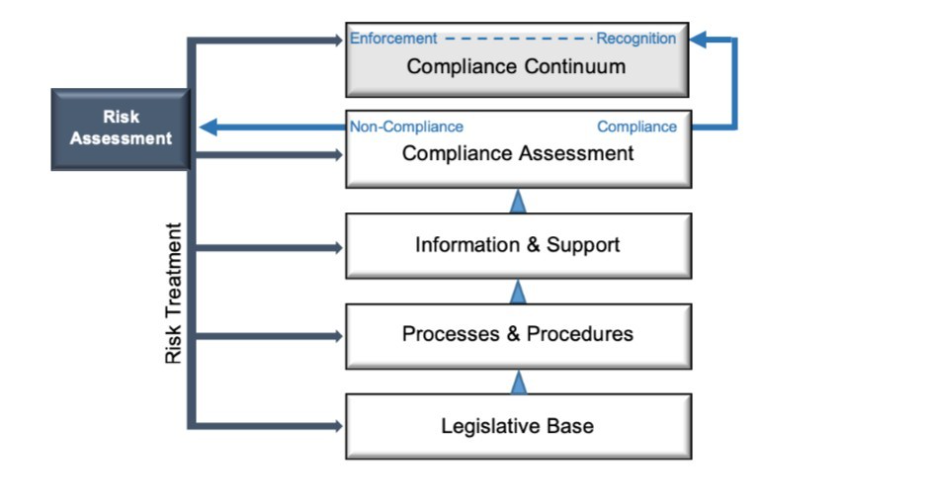
Figure 1: Integrated Compliance Management Framework Source: Widdowson (2020)
The framework incorporates the key aspects of an effective risk-based compliance management strategy, including:
|
01 The law that is to be enforced |
02 Processes and procedures that regulate the way in which the law is applied |
|
03 Services to support the community’s ability to comply with the law |
04 Compliance assessment methods |
|
05 Risk assessment processes of non-compliance with the law |
06 Risk mitigation techniques |
|
07 Strategies to address the continuum of compliance behaviour |
|
Professor Widdowson (2020) summarises this framework as follows:
In essence, the framework is based on the legislation and associated processes and procedures which represent the regulatory requirements for which Customs has administrative responsibility. This includes all aspects of their direct regulatory responsibilities, including the import, export and transit of goods, as well as any matters that are administered on behalf of other agencies, such as health, agriculture, taxation, environment, statistics and in some cases, immigration. In order to ensure compliance with such requirements, there is firstly a need to make certain that members of the trading community are aware of their rights and responsibilities, by providing them with the necessary information and support to comply.
It is then necessary to assess levels of compliance through the use of various techniques such as data screening, documentary checks, non-intrusive inspection, audit and investigation, the result of which will be the identification of either compliance or non-compliance. Where non-compliance is identified, the reason for non-compliance must be established by assessing the relevant risk, leading to the identification of appropriate risk mitigation strategies, which may involve revisiting the legislative base, processes and procedures, information and support, or compliance assessment techniques, or may require some form of enforcement action.
In situations where compliance is identified, the appropriate response is to actively recognise the compliant behaviour. In practice, the level of compliance identified will form part of a continuum from criminal behaviour and fraud through to voluntary compliance. The relevant response will therefore depend on the trader’s position on the compliance continuum. Enforcement strategies for identified non-compliers include warnings, penalties and other sanctions, while recognition strategies for compliers include increased levels of self-assessment, reduced regulatory scrutiny, and increased levels of facilitation.
Let us look at each of these aspects of the model in a little more depth.
Legislative base
The risk to be managed by any government agency is the risk to the achievement of its fundamental objective — that is, the risk of non-compliance with the laws for which it has administrative responsibility. Since the primary role of Customs administrations is to ensure compliance with the law, the starting point in any regulatory regime must be the establishment of an appropriate legislative framework.
Legislation exists to give effect to government policy. It must reflect accurately the wishes of the government, the policy intent, and the international obligations taken on by the government. The legislation must also fully support the customs compliance strategy.
For example, where the strategy is based on a self-assessment regime, with compliance measured through post-transaction audit, the legislation must support that approach. It will require some or all of the following elements:
|
Legislative element |
What it needs to be provided |
|
Self-assessment lodgement |
Provision for the lodgement of documents based on self-assessment by the trader. |
|
Self-assessed transaction processing |
Provision for processing transactions on the basis of self-assessed submissions, without prior Customs review. |
|
Audit and compliance powers |
Provision for audit and other compliance activity, covering the rights and obligations of the party being audited, and the powers and duties of those undertaking the audit. |
|
Third-party audit recognition |
Provision for the regulatory authority to rely on third-party audits where that approach is preferred over direct Customs audit. |
|
Sanctions for non-compliance |
Provision for sanctions to be applied for non-compliance, whether with transaction requirements or with the audit process itself. |
There is considerable guidance provided by the RKC, the HS Convention, the SAFE Framework of Standards, the Valuation Agreement and the Trade Facilitation Agreement — all of which inform the content of Customs legislation and of the Regulations that support and expand the legislation. As well as providing detailed guidance on matters such as tariff, valuation and clearance procedures, they also provide guidance on the nature of Customs legislation, which is to be clear, simple and accessible.
Processes and Procedures
The next section of the Framework expands and supports the legislative base by providing the practical detail on how the law is to be applied, and how those regulated by the law can be compliant with it. As Professor Widdowson's (2020) article explains:
|
Regulatory processes and procedures provide further clarity and detail about how a particular law is administered and enforced…. Guidelines, directives, operating instructions, procedural statements and the like support the application of legislative provisions by specifying details such as information that must be provided to the authorities, the manner and timeframe in which it should be provided, the way in which compliance may be demonstrated, and the systems and procedures that are deemed to satisfy legal provisions. They put the meat on the legislative bones by providing the degree of detail that may not be appropriate to include in the statutes or regulations, particularly in relation to matters that may be subject to regular review. The manner in which such processes and procedures may be determined often allows the administration a degree of flexibility in terms of the way in which laws are enforced. For example, the legislation may require traders to obtain a permit in order to import certain commodities. However, Customs may have the discretion to administer this provision in a number of different ways, depending on the perceived level of risk. Trusted traders may, for example, be granted a permit that allows unlimited importation for a period of time, whereas higher risk traders may be required to obtain permits on a shipment-by shipment basis. Importantly, as noted in the preamble to the RKC, customs procedures and practices should be applied in a predictable, consistent and transparent manner. |
Information and support
Customs has a responsibility to ensure that the international trading community has a clear understanding of its rights and responsibilities. There is a need for people to know what the rules are — if they do not, how can they be expected to comply? Customs authorities are increasingly recognising the need to provide meaningful advice to those being regulated. This is often referred to as a policy of 'informed compliance', which involves the use of a range of 'client service' initiatives designed to ensure that those being regulated know what the rules are.
The manner in which regulatory requirements are publicised will vary depending on the circumstances, but a logical starting point is to provide comprehensive information on the administration’s website. This should include, as a minimum, the legislation itself; details of any rulings, decisions and determinations that help inform the way in which the law is interpreted; a clear overview of relevant processes and procedures; administrative guidelines and explanatory material such as factsheets that serve to clarify such processes; and details of where further information may be obtained, including available learning packages. (Widdowson 2020).
In addition to the website, Customs needs to establish an appropriate range of client service strategies to provide the public with the means to achieve certainty and clarity in identifying their rights and responsibilities and assessing their liabilities and entitlements. These may include (but are not limited to):
n Consultation and cooperation
n Clear administrative guidelines
n Advance rulings
n Education and awareness
n Technical assistance and advice
n Appeal mechanisms
A guiding principle of the RKC is that its rules and practices should be transparent and accessible to anyone dealing with Customs, and that interested parties should be provided with all necessary information regarding Customs laws, regulations, administrative guidelines, procedures and practices. The RKC requires that all relevant information concerning Customs law is readily available to any interested person (Standard 9.1). The associated guidelines make clear that the scope of such information is extremely broad:
|
Such information would include the tariff classification of goods, rates of duty and taxes, valuation of goods for Customs purposes, information relating to exemptions, prohibitions and restrictions, Customs administrative arrangements and requirements, and any other pertinent information which will be of interest to the relevant interested parties. (RKC General Annex Guidelines, Ch. 9, Standard 9.1) |
The need for assistance to traders also underpins the Trade Facilitation Agreement, and the wealth of explanatory materials provided by the Harmonized System Committee are designed to assist traders and brokers to apply the classification rules of the HS Convention correctly.
Compliance assessment
The modern Customs service has a wide range of compliance assessment tools available to exercise Customs control in accordance with Chapter 6 of the General Annex. Because Customs has a responsibility to enforce the law, it must determine whether those being regulated are complying with the law.
|
The powers that are available to officers to undertake this task are generally quite extensive. Like the laws they are assigned to enforce, the powers of officers must themselves be based in legislation, supported by formal processes and procedures, and promulgated to ensure that the public is fully aware of the administration’s legal authority. (WCO, 2011, pp. 1–2). The various methods of assessing compliance all form part of the system of customs control, which is addressed in Chapter 6 of the RKC. The Convention specifies that all internationally traded goods shall be subject to customs control (Standard 6.1)15 and provides that such control shall be limited to that necessary to ensure compliance with the law (Standard 6.2), and that it should be applied using the principles of risk management (Standards 6.3 and 6.4). Consequently, there is a clear expectation that the various methods of compliance assessment should be applied in a way that provides legitimate trade and travel with an appropriate level of facilitation, and while physical intervention is appropriate in certain circumstances, such methods should only be used when there is a legitimate risk-based reason to do so. The arsenal of controls that is available to Customs includes data screening and verification (generally prior to arrival); profiling and targeting; documentary checks; non-intrusive inspection; physical examination of the goods, including verification checks and analysis; leverage exercises; pre- and post-clearance audit activity, including desk and physical audits; and investigations. (Widdowson 2020). |
Customs administrations that adopt a risk-based approach are selective in their use of these controls. They recognize that members of the regulated community present varying levels of risk in terms of potential non-compliance. Those with a good compliance record are unlikely to require the same level of scrutiny as those with a history of poor compliance. Companies considered to represent a high risk, and those for which no risk assessment has been undertaken, are more likely to be selected for higher levels of intervention and control. Regulatory intervention in such circumstances may include:
n More stringent documentary checks
n Frequent physical examinations
n Audit activity
n Investigations
In all cases, the level and type of intervention should be based on the level of identified risk.
Documentary Controls
Receipt and examination of documents (goods declaration, invoice, waybill, etc) to enable verification for compliance purposes and matching against risk profiles. Customs will also verify the Customs declaration for correctness with regards to:
|
01 Goods description |
02 HS tariff codes |
|
03 Valuation |
04 Origin |
|
05 Quantities |
06 Other relevant factors |
During this process, other documents directly linked to the cargo being cleared may be called for to validate the authenticity and correctness of the declaration. These documents may include packing lists or documents related to the trade transaction, such as orders, contracts or conditions of payment. Review of these documents may clarify questions arising from the initial documentary examination.
Physical examination/search
If the documentary review indicates that the movement is satisfactory and no discernible risks are present, a physical examination is not normally necessary. If the documentary check indicates a need for physical examination, the extent of that examination will depend on the type of goods and the suspected Customs offence.
The physical examination of goods and the search of commercial means of transport are undertaken to verify the nature and/or the relationship between the goods/means of transport and the documents presented. Customs authorities may also carry out checks to ensure that the means of transport fulfil technical conditions laid down by certain international agreements for the international transport of goods. Where exercised, such physical examinations or searches should be carried out as rapidly as possible.
There are two levels of physical examination:
|
LEVEL 1 Summary examination External checks without opening containers or packages |
LEVEL 2 Detailed examination Opening containers examining goods directly against the declaration |
||||||||||||||
|
What is checked:
|
What is verified:
|
The level and nature of physical examination should be determined by the information available on the consignment, the Customs procedure under which the goods are declared, provisions in international agreements, and any special nature of the goods (e.g., perishable cargo, live animals, dangerous goods, jewels, antiques, works of art, etc.). Other relevant factors include urgency, location, and the resources available to conduct the examination. If it is not possible during the physical examination to determine the tariff classification of the goods, samples may be drawn in order to expedite the release of the goods.
Identification of goods
To allow goods subject to certain Customs procedures — e.g., transit, transshipment, temporary admission, warehousing, inward processing, etc. — to enter or move through the Customs territory without paying duties and taxes, specific measures are required to ensure their identification. These measures may include affixing seals, stamps, perforations or identification marks, describing the goods, or making reference to samples, plans, sketches, or photographs.
In cases of temporary storage, warehouses or free zones, Customs may require the trader to identify the type of goods being stored as well as the location of the storage facility. Such facilities should be appropriately secured and supervised, and in all cases, Customs will retain the right to enter and examine the facility and take stock of the goods periodically.
Audit
A common form of compliance assessment in any regulatory environment is through the use of audit. There are a number of different audit approaches available to Customs, including desk audits, transaction-based audits, and systems-based audits. The nature of the potential risk identified by Customs when selecting a company for audit will generally dictate the approach adopted.
|
In relation to audit procedures, the RKC asserts the need for these to be consistent with a country’s generally accepted accounting principles (GAAP) and highlights the value of the systems-based audit approach (commonly referred to as post-clearance audit, or PCA) that involves an evaluation of a trader’s commercial systems and procedures. The Convention describes PCA as ‘an effective tool for Customs control because it provides a clear and comprehensive picture of the transactions relevant to Customs as reflected in the books and records of international traders. (Widdowson 2020 |
Desk audits are generally used to further examine an unusual transaction that falls outside established parameters or normal patterns for a particular type of company or transaction. The desk audit approach may simply involve contacting the company concerned and asking it to provide additional information to support the data declared in the transaction — for example, commercial documentation to support a declared value, such as invoices, contracts and trade catalogues.
Transaction-based auditing involves testing transactions identified as a potential risk. This approach is often used for small traders, such as those who import goods on an infrequent basis. Auditors verify information provided by the company by referral to all available related documentation — for example, comparing import declarations against company purchase orders, buying or selling contracts, suppliers' invoices, bills of lading, air waybills, bank statements or guarantees.
Systems-based audits
The identification of several errors during a transaction-based audit may indicate potential systemic problems in the preparation and supply of information to Customs. In such circumstances, the Customs auditor may adopt a systems-based audit approach — especially for larger companies — to review the systems and controls which produce that information.
The systems-based audit approach is a step up from transaction testing. It gauges compliance levels by seeking assurance over the systems which create those transactions. It involves understanding the business systems and, importantly, testing the internal controls in those systems which have been developed to ensure compliance.
Systems-based audit is the most efficient way to gauge the compliance levels of a large business with a large and often complex number of transactions. This approach is the most effective in determining the overall compliance level of major service providers such as DPDHL, although less developed Customs authorities will not progress beyond transaction audits.
Compliance assessment methods should be applied in a way that identifies both compliant and non-compliant behaviour. Recognising compliant traders is just as important, as it allows authorities to classify them as low risk and reduce unnecessary intervention. This enables administrations to focus resources on higher-risk or unassessed traders. Programs like the WCO’s Authorised Economic Operator (AEO) support this approach by formally recognising low-risk, compliant businesses. The next focus is on how enforcement and recognition operate within the compliance framework.
3.7. Enforcement and recognition
Enforcement and recognition strategies are designed to address identified non-compliers and recognised compliers. For identified non-compliers, there is a range of enforcement strategies. For recognised compliers, strategies include increased levels of self-assessment, reduced regulatory scrutiny, less onerous reporting requirements, periodic payment arrangements, simplified procedures, and increased levels of facilitation. This approach is reflective of a compliance improvement approach, the principal focus of which is the achievement of future compliance and ensuring that an appropriate balance exists between incentives for compliance and sanctions for non-compliance.
An effective compliance management strategy seeks to find the cause of non-compliance and identify ways of preventing its recurrence. This is achieved through the application of the risk management process, the key elements of which are shown in Figure 2 below.
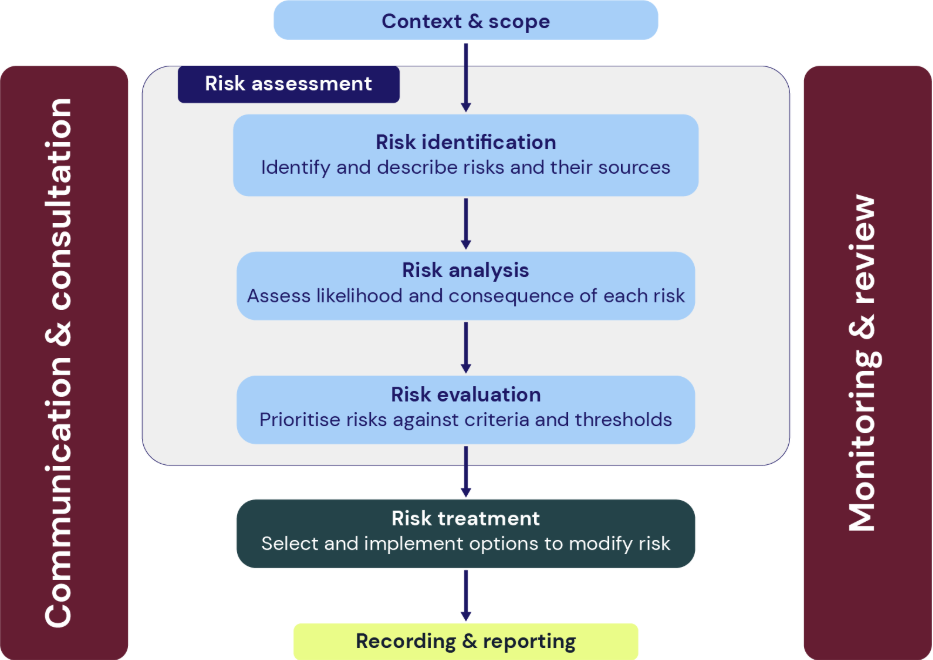
Figure 2: Risk management process | Source: Modified from ISO 31000 (ISO, 2018)
Context and scope
The context and scope of the risk being managed is defined by the context and scope of the audit (or other compliance assessment activity) itself. For example, the audit may be focusing on a trader's compliance with Customs requirements in general, or with particular aspects of the regulations such as those relating to transit, export or warehousing activities.
Risk identification
Risk identification — the first step of the risk assessment process — essentially involves answering two questions:
|
“What could happen that may have an impact on the agency’s objectives?” |
“How and why could it happen?” |
|
→ Clarifies the nature of the risk |
→ Reveals potential causes of the risk event |
The first question helps clarify the nature of risk; the second provides valuable information about potential causes.
Note that the error identified during the course of the audit has already answered the first question. The next task is to determine how and why the error has occurred — for example, whether the company made an inadvertent error, whether its procedures are flawed, whether there is a general misconception within the industry sector, or whether the error resulted from an intentional act. On the other hand, the legislation may be unclear, or the administrative requirements may be ambiguous.
Risk analysis and evaluation.
The next step is to analyse the risk by considering two discrete elements — the likelihood of the risk occurring, and the impact if it does in fact occur. The impact of a risk occurring is relatively easy to quantify in the context of revenue compliance; in other situations, there is generally a need to make qualitative assessments — for example, failure to obtain import or export permits. Determining the likelihood of a risk occurring depends on two factors: those which Customs can control, and those which it cannot. When examining these factors in a criminal context, the effectiveness of existing controls is often referred to as 'vulnerability', whereas the factors over which Customs has little or no control are referred to as the 'capability' and 'intent' of the criminal organisation. In the intelligence community, the assessment of capability and intent is generally referred to as a threat assessment.
Both the likelihood and impact of a risk are considered when determining the overall level of risk. This leads to the risk evaluation stage, which involves determining whether a risk is acceptable or unacceptable, and how the unacceptable risks are to be prioritised.
Risk treatment
Having identified the risks that require mitigation, the next step is to identify effective strategies that will eliminate or minimise the likelihood of the risk recurring, its potential impact, or both. The appropriate mitigation strategy will depend on how or why the risk occurred. It may be necessary to address systemic problems within the company, to review the administration's published guidelines, or to provide formal clarification of the law through binding rulings. As such, one or more stages of the Integrated Compliance Management Framework will need to be reviewed.
The WCO Customs Risk Management Compendium contains a wealth of practical information to assist administrations to assess risk and identify effective risk mitigation strategies. The compendium includes guidance on developing an organisational framework for managing risk; embedding risk management in the organisational culture; risk assessment, profiling and targeting; risk indicators; and guidelines for intelligence analysis.
Enforcement
In the process of assessing compliance, Customs authorities will encounter two situations: compliance and non-compliance. The non-compliance spectrum will range from innocent mistakes to blatant fraud. If the error nears the fraudulent end of the spectrum, some form of sanction will need to apply, including administrative penalties or, in the more severe cases, prosecution and licence revocation.
|
Step 1: Establish why the error occurred |
Before determining the need for or nature of a sanction, Customs should identify the true nature of the risk by establishing the root cause of the error. The error may be the result of a control problem within the company, due to flawed systems and procedures, or it may be the result of a deliberate attempt to break the law. On the other hand, the relevant legislation may be unclear, or the administrative requirements may be ambiguous.
|
Step 2: Match the response to the cause |
The mitigation strategy adopted will depend on the nature of the identified risk. Unless the error is found to be intentional, Customs will typically seek to systemic problems within the company, or provide the company (or an entire industry sector) with advice on compliance issues, or provide formal clarification of the law through binding rulings or other means.
It is important to recognise that different solutions will be used to address honest mistakes on the one hand, and deliberate non-compliance on the other. Industry familiarisation seminars and information brochures may adequately address errors that result from a lack of understanding of the relevant regulatory provisions. However, if someone is actively seeking to commit fraud, seminars and information brochures will have absolutely no impact on their activities. Indeed, such members of the trading community are likely to have a very good understanding of their obligations and entitlements. To treat the risks posed by such organisations, Customs is likely to adopt a rigorous enforcement approach.
Recognition
A finding of compliance by the audit team is a legitimate and useful operational outcome. For every instance of compliance identified, the population of potential non-compliers reduces. It is now widely accepted that traders who can demonstrate high levels of compliance require a lower level of scrutiny than those with a history of poor compliance, or those about which little is known. There is also an increasing realisation that compliant behaviour should not only be recognised through a reduction in regulatory scrutiny, but through various forms of positive reinforcement.
|
|
What Is ‘Recognition’? Recognition describes the strategies Customs employs when companies are deemed to be trustworthy. Rather than applying the same level of scrutiny to all traders, Customs acknowledges proven compliance and rewards it with reduced intervention, faster clearance, and administrative concessions. |
The concept of recognising trusted traders has evolved from a single RKC standard into a binding international obligation:
|
Revised Kyoto Convention General Annex • Chapter 3 • Standard 3.32 First introduced the concept of the “accredited client” |
→ |
formalised in TFA |
Trade Facilitation Agreement Article 7 • Paragraph 7(3) Lists binding benefits for Authorized Operators |
Potential Benefits for Authorized Operators
TFA Article 7(3) lists the following benefits that WTO members shall provide to Authorized Operators — in each case, “as appropriate” to their context:
|
Low documentary and data requirements |
Low rate of physical inspections and examinations |
|
Rapid release time |
Deferred payment of duties, taxes, fees and charges |
|
Reduced or comprehensive guarantees |
Single customs declaration per period |
|
Clearance of goods at operator’s premises |
|
The SAFE Framework formally recognises the need to provide benefits to compliant companies in the context of its AEO concept. Authorized Economic Operators are expected to benefit from faster processing of goods by Customs, e.g. through reduced examination rates. These processes will ensure that AEOs see a benefit to their investment in good security systems and practices, including reduced risk-targeting assessments and inspections, and expedited processing of their goods. The WCO further specifies that such benefits should be clear, tangible and documented in order to provide members of the trading community with an incentive to seek AEO status, and to justify the costs incurred in achieving such. As such, the WCO provides a formal link between a trader's low risk rating and the provision of regulatory benefits.
Note
It is worth noting here that the concept of Authorized Operators is different from the concept of Authorized Economic Operators as proposed in the SAFE Framework, which we will look at in Module 3.
4. Conclusions
This module has examined the main treaties governing how Customs administrations approach trade facilitation, revenue management and Customs control. These agreements establish standards designed to achieve a sound balance between facilitation and compliance — ensuring that legitimate trade can proceed with minimal intervention, while illicit trade is prevented and penalised appropriately.
The foundation of this approach is risk management. Customs supports voluntary compliance by providing information and services to traders, while applying appropriate penalties for non-compliance — whether through genuine error or deliberate intent. This has fundamentally transformed Customs administrations over the past 30 years, though implementation continues as more countries accede to the RKC and the TFA and align their domestic law with modern requirements.
The agreements examined in this module do not, however, address supply chain security in depth. Module 3 will examine the practices and procedures developed since 2001 to protect the supply chain from terrorism and other hostile threats.
5. Bibliography
European Express Association, The Customs Strategy, https://www.euroexpress.org/e-library/position-papers.
Government of Australia. Australia – United States Free Trade Agreement, 2005. Canberra, 2005. Viewed 26/10. /2006. https://www.dfat.gov.au/trade/agreements/in-force/ausfta/Pages/australia-united-states-fta
Global Express Association 2010, GEA and Trade Facilitation, https://global-express.org/index.php?id=14
International Chamber of Commerce ,2016 Discussion paper - Updated ICC recommendations for a WTO agreement on trade facilitation, ICC Paris. Available at https://iccwbo.org/publication/updated-icc-recommendations-for-a-wto-agreement-on-trade-facilitation/
Oxford Economic Press 2009, The Impact of the Express Delivery Industry on the Global Economy. Oxford Economic Forecasting, Available at https://global-express.org/assets/files/FULL-Oxford-Economics-Study-Report.pdf
Widdowson, David, ‘Managing risk in the customs context’, in Luc De Wolf & Jose B Sokol (eds), Customs modernization handbook, World Bank, Washington, DC, 2004 pp. 91-99.
Widdowson, David, Managing customs risk compliance: an integrated approach (2020). World Customs Journal Volume 14, Number 2
World Customs Organization, International Convention on the simplification and harmonisation of customs procedures, (Revised Kyoto Convention), General Annex Guidelines, rev. edn, Ch 1. World Customs Organization, Brussels, 1999.
World Customs Organization, Framework of Standards to Secure and Facilitate Global Trade. The World Customs Organization, Brussels, 2005
World Customs Organization, The ATA System. An Instrument for Promoting International Trade. World Customs Organization, Brussels, 2006. http://www.wcoomd.org/-/media/wco/public/global/pdf/topics/facilitation/instruments-and-tools/conventions/ata/pf_ata_brochure.pdf?la=en
World Customs Organization, Council Minutes SC0066E1a-105th/106th Sessions, 2005
World Customs Organization, Report on Open Day for the Express Carrier Industry, 2000
World Customs Organization. Document TAXUD/1250/05 Rev. 5, Annex 5, Annex 30A of the CCIP, Data requirements for pre-arrival and pre-departure summary declarations and for simplified procedures, Brussels, 2006
World Customs Organization, Immediate Release Guidelines, Brussels, 03/2006