Study Guide
| Sitio: | Centre for Customs and Excise Studies |
| Curso: | DHL International Customs Program 2026: Cohort 1 |
| Libro: | Study Guide |
| Imprimido por: | Pengguna tetamu |
| Día: | sábado, 17 de octubre de 2026, 03:33 |
1. Introduction
In this Module, we examine how Customs laws and regulatory principles are applied by Customs administrations across different operational environments. We focus on the environments that affect the international movement of goods, and on how international law and compliance management intersect with commercial transactions.
The approach used in this Module is to examine the common business processes adopted by customs in each operational environment. In many countries these processes align closely with the standards set out in the World Customs Organization’s International Convention on the simplification and harmonization of Customs procedures (Revised Kyoto Convention).
In some countries, however, the actual business processes used by the customs administration fall short of those standards. Rather than describing the lowest common denominator, this Module outlines the business processes most commonly practiced by customs administrations.
The operational environments covered in this Module are:
|
01 Air cargo Carried by both passenger aircraft and all-cargo freighters; risk-assessed at the air waybill level. |
02 Express cargo A specialized stream of air cargo, optimized for speed, with onsite Customs facilities at express depots. |
|
03 Post International mail handled at dedicated mail handling units, with separate screening arrangements. |
04 Sea cargo Carried in containers as full container loads (FCL) or less-than-container loads (LCL), discharged at designated ports. |
|
05 Land borders Road and rail crossings, where two customs administrations may operate side by side. |
06 Depots and warehouses Licensed facilities holding goods under customs control before clearance is finalized. |
|
07 Free zones Locations treated as outside the customs territory, where goods are generally not subject to the usual customs controls. |
|
The final topic covered in this Module will be the issue of Customs integrity. We will examine what is being done internationally to upgrade the integrity of Customs administrations.
2. Clearance of goods and other customs procedures
Learning objectives
|
✓ |
Explain the role of the Goods declaration and identify the customs procedures it can place imported goods under. |
|
✓ |
Describe how the Revised Kyoto Convention sets standards for the clearance of goods, including pre-arrival processing under Standard 3.25. |
|
✓ |
Outline how customs administrations assess and collect duties and taxes, and the conditions under which relief may be granted. |
Regulating international trade and clearing goods that cross international borders are among the most traditional activities of customs. Even in countries that do not apply customs tariffs, trade is still regulated and goods are still cleared. This is done for statistical purposes and to identify prohibited and restricted goods.
A key element of customs regulation is how the law is applied in practice. Customs authorities must ensure that statutory requirements are met, but the way they do so is often flexible. For example, the law may require that certain goods be imported only under license. The way that license is implemented is often left to administrative discretion. A license may be issued for one shipment, for a period such as twelve months, or for an indefinite period as long as certain conditions are met. The same flexibility may apply to physical control of goods, the movement of goods, information requirements, the timing and method of reporting, and the timing and form of revenue collection.
|
Note: Key principle for examining customs regulation When examining the principles of customs control, always consider administrative solutions that may not be specifically named in national legislation but are still fully consistent with the relevant legislative provisions. The absence of a named solution in the law does not mean it is unavailable. |
2.1. WCO Guidelines
The World Customs Organization (WCO) provides guidelines and tools to support the clearance of goods across borders, with a focus on efficiency and security. These guidelines cover areas such as risk management, advance cargo information, and authorized economic operator programs.
The Revised Kyoto Convention (Chapter 3 of the General Annex Guidelines) sets out the WCO’s expectations for the clearance of goods and other customs formalities. It aims to create a more efficient, secure, and predictable customs environment. According to the WCO:
|
The Customs formalities place obligations on the person concerned with the goods. This person is generally the owner of the goods, a third party designated by the owner or a transporter of the goods, depending on the formality to be completed. The overall obligations are to produce the goods and the means of transport to Customs at the earliest possible time; to lodge the Goods declaration with any required supporting documents (invoice, import license, certificate of origin, etc.); to furnish security where appropriate and to pay duties and taxes when applicable. There are also obligations on Customs which include establishing Customs offices, designating the hours of business, checking the Goods declaration, examining the goods, assessing, and collecting duties and taxes, and releasing the goods. These formalities are essential to ensure compliance with Customs laws and regulations and to ensure that Customs’ revenue and regulatory interests are safeguarded. At the same time, they should be as simple as possible and should cause a minimum of inconvenience to international trade. |
|
Note: There is an international expectation that customs formalities should be as simple as possible and should cause a minimum of inconvenience to international trade. |
|
|
Reading 1: Revised Kyoto Convention, General Annex Chapter 03. To view, please click the following link: Text of the Revised Kyoto Convention |
The Kyoto guidelines (General Annex Chapter 3 – see Reading 1) cover several aspects of customs clearance, including:
·
- · Establishment of Customs offices
- · Rights and responsibilities of the declarant
- · The Goods declaration
- · Lodgment and registration of the Goods declaration
- · Amendment or withdrawal of the Goods declaration
- · Checking the Goods declaration
- · Special procedures for authorized persons
- · Examination and sampling of the goods
- · Errors
- · Release of the goods
- · Abandonment or destruction of goods.
2.2. The Role of the Goods Declaration
Once goods have been imported, they are placed under a customs procedure within a certain time. Examples of customs procedures include home consumption (or home use), temporary admission, transit, and customs warehousing. The declarant indicates which procedure is to be applied to the goods by lodging a Goods declaration.
Goods declarations can be lodged manually or electronically using electronic data interchange (EDI). They often combine information required by Customs with information required by other agencies such as Quarantine or Health administrations. Where the Goods declaration is submitted by EDI, the World Customs Organization (WCO) encourages the use of the internationally accepted standards for customs messages developed under United Nations Electronic Data Interchange for Administration, Commerce, and Transport (UNEDIFACT).
2.3. Pre-Arrival Processing
Kyoto Standard 3.25 is particularly important in the context of trade facilitation. It requires national legislation to allow customs declarations and supporting documents to be lodged before the goods arrive. This gives customs a head start: screening can begin in advance, and a high percentage of shipments can be pre-cleared on the strength of that early information.
Pre-arrival checks can be done more efficiently with automated systems, but they do not depend on electronic clearance procedures and can be introduced while manual processing is still in use. The term "pre-clearance" is often used for this process, but pre-clearance is not the same as pre-release.
Pre-clearance is not the same as pre-release
|
Pre-clearance |
Pre-release |
|
• Customs can pre-screen and pre-clear a high percentage of shipments based on information provided before the goods arrive. May still be conditional on: • Payment of duty • X-ray scanning • Physical examination if the consignment raises concerns |
• The goods are released and free to move into domestic distribution. Granted only after: • All pre-clearance conditions are met • Customs is satisfied no further intervention is required |
2.4. Duties and Taxes
|
|
Reading 2: Revised Kyoto Convention, General Annex Chapter 04. Revised Kyoto Convention, General Annex Chapter 04. To view, please click on the following link: Text of the Revised Kyoto Agreement |
2.5. Kyoto Provisions
The 24 Revised Kyoto Convention standards and transitional standards relating to duties and taxes (see Reading 2) place a strong emphasis on the need for national legislation to specify a number of revenue-related matters. The aim is to give the trading community a high degree of clarity and certainty in their dealings with customs, especially on revenue matters.
What national legislation must specify
|
01 When liability begins The point at which revenue liability is incurred. |
02 Who is liable Who carries responsibility for paying the duty or tax. |
|
03 How it is assessed When and how the liability must be assessed. |
04 How it is paid When, where, and how the duty or tax must be paid. |
|
05 How to challenge How an assessment may be challenged. |
06 Interest on amounts owed How interest may be charged on outstanding amounts. |
Not all provisions need to be spelt out in national law. For example, an appropriate basis in law must exist to enable a customs authority to break the link between its physical control over internationally traded goods and the revenue liability (customs duty and other taxes) those goods may attract. This does not mean that the differentiation must be explicitly addressed in the relevant statutory provisions. If the legislation itself is silent on the relationship between customs control over cargo and revenue liability, there is usually scope for administratively flexible solutions.
Clearing goods usually involves lodging a Goods declaration with or without supporting documents (such as an import or export permit or certificate of origin) and paying applicable duties and taxes. Traditionally, payment of duties and other taxes has been a prerequisite for customs clearance, and clearance has been withheld until all payments are made and all formalities are complete. Modern customs regimes use strategies that break the link between physical control over goods and a trader’s revenue liability, so customs clearance can be granted as soon as possible.
The Revised Kyoto Convention provides customs authorities with a modernization framework that includes contemporary methods of assessing, collecting, paying, and refunding duties and taxes. The framework includes the concept of deferred payment, which is designed to facilitate the clearance of goods to the greatest extent possible, while ensuring that the correct amount of revenue is collected.
Some customs administrations now allow payment to be deferred and made on a transaction-by-transaction or periodic (usually monthly) basis, provided the importer or owner meets certain conditions. For example, security may be required to guarantee payment.
National customs legislation is required to set out the requirements for duties and taxes and the circumstances in which liability may be incurred. These circumstances typically arise when goods are cleared for home use after arriving in the customs territory, or when they are cleared for home use from a free zone or warehouse. Other circumstances arise when goods are exported from countries that have export duties and taxes. In addition, goods under a temporary admission procedure that are not exported within the stipulated time period may be subject to duties and taxes.
2.6. Assessments of Duties and Taxes
What Customs must publish
Customs authorities are required to set out in their national legislation and official publications:
|
01 Timing of assessment When during the import process duties and taxes are calculated, for example on lodgment, on acceptance, or on release. |
02 Basis and conditions Which factors drive the assessment and the conditions under which they apply. |
03 Applicable rates The actual duty and tax rates that apply to the goods. |
What the assessment is based on
The assessment of duties and taxes is generally based on the following criteria:
|
01 Tariff classification Identify the goods against the Customs Tariff to find the applicable duty rate. |
02 Value or quantity Apply an ad valorem rate, a specific rate, or both, depending on how the duty is structured. |
03 Origin Establish the country of origin or consignment when liability depends on it. |
These rules are examined in detail later in the program.
How duty rates are expressed
For most commodities, the duty is expressed as an ad valorem rate (a percentage of the value). For others, the rate is specific. Sometimes the rate is a combination of ad valorem and specific rates.
|
01 Ad valorem A percentage of the value of the goods. Used for most commodities. |
02 Specific A fixed amount per unit, for example a certain amount per liter of product. |
03 Combination Both an ad valorem rate and a specific rate applied together. |
When the rate is fixed
The rate charged can be based on different points in time, for example:
|
01 On arrival When the goods arrive in the customs territory. |
02 On lodgment When the customs declaration is lodged. |
03 On acceptance When the declaration is accepted by Customs. Most common choice. |
|
04 On payment When the duties and taxes are paid. |
05 On release When the goods are released. |
|
Whichever point is chosen, Customs will state it in their national legislation. For currency conversion, there should also be a published list of exchange rates to the domestic currency on the determined date, so importers and brokers can establish the actual rate that applies to each import transaction.
Who pays, and when no duty is collected
Customs legislation also specifies who is responsible for paying the duties and taxes, for example the importer, agent, broker, or carrier. In some cases, two or more persons may be held jointly liable.
Some jurisdictions specify minimum values (known as de minimis values) and/or minimum amounts of duties and taxes below which no duties and taxes will be collected. This facility is often available to express carriers and postal freight services. This issue is discussed in more detail later in the program.
2.7. Relief from Import Duties and Taxes
Customs authorities generally provide relief from import duties and taxes on certain goods subject to specific provisions. These provisions may be set out in the Customs Tariff or in separate legislation or regulations. Relief is usually provided on goods entered for home use subject to specific conditions, such as use by religious organizations, by educational institutions, or for scientific purposes. Duty relief may also be available for certain commercial purposes, for example on raw material imported for the manufacture of shoes.
|
Note: Definition Relief from import duties and taxes means the clearance of goods for home use free of import duties and taxes, irrespective of their normal tariff classification or normal liability, provided that they are imported in specified circumstances and for specified purposes. Source: WCO Revised Kyoto Convention Specific Annex B3 |
The WCO Revised Kyoto Convention recommends that relief from import duties and taxes and from economic prohibitions and restrictions should be granted in respect of the following goods, under the conditions specified, provided that any other requirements set out in national legislation for such relief are complied with:
Categories of goods eligible for relief
|
Category |
Conditions for relief |
|
Therapeutic substances |
Therapeutic substances of human origin, blood grouping and tissue typing reagents, where they are consigned to institutions or laboratories approved by the competent authorities |
|
Samples of no commercial value |
Samples of no commercial value which are regarded by the Customs to be of negligible value and which are to be used only for soliciting orders for goods of the kind they represent |
|
Personal removal effects |
Removable articles other than industrial, commercial or agricultural plant or equipment, intended for the personal and professional use of a person or members of his family which are brought into the country with that person or separately for the purpose of removal of his residence to the country |
|
Inherited effects |
Effects inherited by a person who, at the time of the death of the deceased, has his principal residence in the country of importation and provided that such personal effects were for the personal use of the deceased |
|
Personal gifts |
Personal gifts, excluding alcohol, alcoholic beverages and tobacco goods, not exceeding a total value to be specified in national legislation on the basis of retail value |
|
Charitable goods |
Goods such as foodstuffs, medicaments, clothing and blankets sent as gifts to an approved charitable or philanthropic organization for distribution free of charge to needy persons by the organization or under its control |
|
Awards |
Awards to persons resident in the country of importation subject to the production of any supporting documents required by the Customs |
|
Military cemetery materials |
Materials for the construction, upkeep or ornamentation of military cemeteries; coffins, funerary urns and ornamental funerary articles imported by organizations approved by the competent authorities |
|
Documents and publications |
Documents, forms, publications, reports and other articles of no commercial value specified in national legislation |
|
Religious objects |
Religious objects used for worship |
|
Products for testing |
Products imported for testing, provided that the quantities imported do not exceed those strictly necessary for testing, and that the products are used up during testing or that remaining products are re-exported or rendered commercially valueless under Customs control |
Source: WCO Revised Kyoto Convention Specific Annex B3.
2.8. Payment of Duties and Taxes
Customs administrations specify the methods and criteria for each method used for the payment of duties and taxes. A modern practice that helps to facilitate clearance is electronic funds transfer, which allows for quick and efficient payment. This is especially beneficial to companies such as DPDHL that import and export frequently on a large scale and pay considerable amounts of duties and taxes.
Many customs administrations allow payments to be made periodically (usually monthly), as well as on a transaction-by-transaction basis.
Two ways customs administrations may allow payment
|
Transaction by transaction |
Periodic payment |
|
• Duty and tax paid on each individual import. • No special arrangement required. • Suitable for occasional importers. |
• Duty and tax paid in batches, usually monthly. • Requires a security deposit or 'current account' arrangement. • Suited to traders with a large volume of monthly transactions. Interim payments through the month can keep security requirements low. |
When customs administrations allow periodic payment, they are required to provide traders with regular (for example, daily, weekly, or monthly) statements listing all transactions accepted by Customs during the previous period. These statements should include the total amount payable for the transactions processed within the billing period, and indicate the date when payment is due. All interim payments made within the billing period should also be shown in the statement. Statements can be provided electronically or in paper format depending on the systems in use. Once generated, the amount on the periodic statement should be paid in full. After that point, any outstanding amounts are usually subject to interest charges and/or penalties.
Duties and taxes must usually be paid at the time when a Goods declaration is lodged or accepted, or before the goods are released. When national legislation specifies that duties and taxes may be paid after the release of the goods, the period allowed for payment must be at least ten days.
A receipt must be issued to the payer unless there is other evidence constituting proof of payment. The receipt is often given on the declarant’s copy of the declaration or, in the case of periodic payments, on the periodic statements. Sometimes the receipt may be issued by an authorized body other than a customs office, such as an approved bank.
2.9. Cargo Clearance Lifecycle at a Glance
Although the operational details differ by mode, the customs clearance lifecycle follows a common pattern across air, sea, and land cargo. The steps below provide a reference point for the mode-specific chapters that follow.
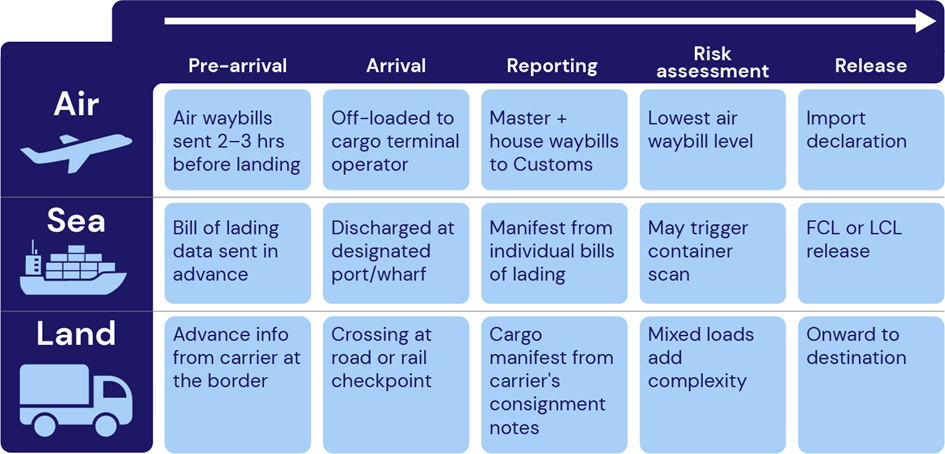
The chapters that follow examine how each mode applies this lifecycle in practice, including the points where the process diverges.
3. Air Cargo
Learning objectives
|
✓ |
Describe how air cargo moves from arrival at an international airport through to release, including the role of master and house air waybills. |
|
✓ |
Explain how customs uses the information on inwards cargo reports and import declarations to risk-assess and clear air cargo. |
|
✓ |
Compare the customs handling of express cargo and postal traffic with that of general air cargo, including the role of the WCO Immediate Release Guidelines. |
International air cargo is carried by both passenger aircraft and all-cargo freighter aircraft. International flights arrive at and depart from designated international airports.
Aircraft arriving at international airports want to turn around quickly, so air cargo and baggage need to be offloaded promptly on arrival. Air cargo is first moved to cargo terminal operators, who usually have direct access to the airport tarmac. There can be a delay in moving air cargo to the terminals because loading cargo for export is often a priority.
Air cargo is carried in Unit Load Devices (ULDs), also known as airfreight containers, or is loaded onto air freight pallets. There are many aircraft types and many more aircraft cargo configurations. Each aircraft and configuration may require customized containers.
A manifest of all air cargo on an aircraft must be provided to Customs by the principal carrier, usually the airline carrying the cargo. This manifest is a consolidation of the master air waybills for each flight. An air waybill is the document made out by or on behalf of the shipper. It is the contract between the shipper and the carrier for carriage of the goods on that flight.
Master air waybill compared with house air waybill
|
Master air waybill |
House air waybill |
|
• Issued by or on behalf of the principal carrier (usually the airline) • One per flight, covering all cargo carried • Identifies the airline as the carrier • Forms the basis of the cargo manifest provided to Customs |
• Issued by the freight forwarder to its customers • One per consignment within a freight-forwarder consolidation • Identifies the actual consignee and consignor • Reported separately to Customs alongside the master |
Customs will usually risk-assess for prohibited import purposes from the lowest level air waybills. Until this risk assessment has been completed, air cargo will not be permitted to move outside Customs licensed premises. Cargo may be allowed to move from the cargo terminal operator to other licensed depots in the airport area.
Customs administrations using electronic systems will usually request reporting of air cargo consignments two to three hours before the aircraft arrives. If airlines meet this requirement, Customs will usually carry out the risk assessment before the cargo is landed. Customs then provides clear status, subject to the lodgment of an import declaration, for goods that do not require examination.
Where Customs decides to examine a consignment, the examination will usually be done in the cargo terminal or at the licensed depot. Air cargo consignments are smaller, so the examination is usually a full examination, sometimes supported by a mobile X-ray van. These examinations usually take a maximum of an hour. Where container X-ray machines are available, larger air cargo consignments may be transported to those facilities for examination.
When Customs is satisfied that the consignment does not contain any contraband, the container is repacked and made available for delivery once an import declaration has been completed. If contraband is found, Customs and other authorities will take appropriate action.
Each air cargo consignment is reported to Customs twice: first at air waybill level as part of the inwards cargo report, then again by the owner (directly or through their customs broker) on the import declaration.
The customs clearance of the import declaration allows the goods to move from the air cargo terminal operator into domestic distribution or into a customs warehouse. With air cargo, there is usually a separate process to move the cargo on the basis of the air waybill from the terminal operators to licensed depots, often owned by freight forwarders. This can be either a full ULD or several separate consignments.
Customs also undertakes a risk assessment of the cargo based on the information provided on the import declaration. This may lead to further examination of the documents relating to the consignment to determine the correct duties and taxes to be paid.
A full examination of the goods may be undertaken to:
Reasons for full examination
|
01 Verify compliance Check that the goods match the invoice details and meet customs legislation. |
02 Detect contraband Identify drugs, firearms, explosives, or other prohibited and restricted items. |
03 Meet agency rules Satisfy quarantine, import permit, and other government agency requirements. |
Once Customs is satisfied that a consignment meets all requirements, it will provide clearance for the goods, subject to the payment of duty and taxes if applicable.
3.1. Express Cargo - Express Handling Units
Express cargo is a specialized stream of air cargo, optimized for speed. It arrives on passenger aircraft or on dedicated air freighters, which are often operated by the express courier company itself.
Express cargo moves in the same way as general air cargo from the aircraft to the cargo terminal. In many countries express courier companies will operate a cargo terminal with direct access to the tarmac and their consignments will be taken directly into their Customs licensed premises. At airports where express cargo is initially moved into the cargo terminal, the cargo is usually moved under bond to the express courier company’s depot before release.
Express cargo is consolidated under one master air waybill consigned to the express courier company, with house air waybills identifying the individual consignments inside. Customs treats those consignments differently depending on what they contain, as shown below.
|
# |
Consignment type |
Customs treatment |
|
1 |
Documents |
Reported as a consolidation on HAWBs. Generally screened "free" by Customs without an import declaration. If examined, mass screening is used, such as X-ray and/or detector dogs. |
|
2 |
Very low value Items |
Generally screened "free" by Customs without an import declaration. Considered of no commercial value. Customs retains the right to examine these consignments at any time. |
|
3 |
General express consignments |
Risk assessed at the HAWB level. Consignments selected for examination will usually undergo a full physical examination at the express carrier's depot. |
|
4 |
Targeted / high-risk consignments |
Selected following risk assessment. Full examination conducted. X-ray units may be permanently stationed within the express carrier's depot to support rapid screening. |
To support the mass screening described above, Customs X-rays are often permanently placed inside the express carrier's depots. In some countries these have effectively become express cargo handling units, similar to international mail exchanges where Customs maintains a permanent presence. Because the express courier business is built on speed, having Customs and their screening tools located inside the depot provides a significant advantage.
Different countries have different approaches to the need for an import declaration for low value cargo. Some countries adopt a de minimis approach where cargo below a certain value does not require an import declaration. This has significant benefits for the express industry because a significant proportion of their consignments may be below the de minimis threshold.
Two approaches to express low-value declarations
|
De minimis approach |
Standard declaration approach |
|
• Cargo below a defined value threshold does not require an import declaration • Significantly reduces declaration volume for the express industry • A large proportion of express consignments may fall below the threshold |
• All express consignments require an import declaration regardless of value • Standard declaration process applies (same as general air cargo) • Process is uniform across consignment values |
Where an import declaration is required for an express consignment, the process is likely to be the same as for general air cargo. Unique characteristics of the express freight industry are likely to include:
Express freight characteristics
|
01 Airside depots Express depots are usually airside, with on-site Customs facilities. |
02 Last on, first off Cargo is usually last on and first off. |
|
03 Higher freight costs Higher freight costs ensure shipments are offloaded before general cargo. |
04 Confirmed space Express companies book confirmed space on air cargo freighters to ensure delivery timetables. |
3.2. Post-Mail Handling Units
International mail arrives in all modes of transport, although increasingly the main mode is air. The Post remains one of the most widely used channels for sending personal and commercial items across borders, including gifts and other goods.
Customs is necessarily involved in international postal traffic. As with goods imported by any other means, Customs must collect the appropriate duties and taxes, enforce import and export prohibitions and restrictions, and ensure compliance with the laws it is responsible for enforcing. The international framework for postal traffic is set by the Acts of the Universal Postal Union (UPU), and the World Customs Organization and the UPU have jointly produced a guide on international postal shipments and customs matters, based on the Universal Postal Convention and the postal traffic provisions of the Revised Kyoto Convention.
|
|
Reading 3: WCO-UPU Postal Customs Guide For more on the WCO-UPU Postal Customs, go to WCO-UPU Postal Customs Guide |
Because of the very high volume of postal consignments and the largely unreported nature of postal traffic, standard cargo procedures would create unacceptable delays. Customs and postal authorities have therefore developed separate administrative arrangements and risk assessment techniques for international mail. In most countries this involves the postal authority setting up dedicated international mail handling facilities that house a permanent Customs presence.
|
Standard cargo approach |
International mail: requires a different approach |
|
• Relatively small number of consignments per shipment • Detailed commercial documentation available • Standard declaration and clearance procedures apply |
⚠️ Very high volume of individual consignments arriving simultaneously ⚠️ Largely unreported in nature; limited advance data available • Standard cargo procedures would create unacceptable delays |
When mail arrives in a country, it is in mail bags. These bags are usually sealed and the administrative arrangement requires that unsealed bags be delivered to an international mail handling facility. The mail can be divided broadly into three categories: parcels, letter class, and Express Mail Service (EMS). Generally, the postal authority and Customs have an agreement to give priority to EMS parcels. Any postal article containing goods should carry an attached customs declaration describing the contents, along with an invoice or other supporting documentation.
How customs treats the three mail categories
|
Parcels |
Letter class |
Express Mail Service (EMS) |
|
Screened manually because of the lack of documentary information on what is in each mail bag. High-risk articles are targeted for full screening; remaining parcels are subject to X-ray and/or detector dog screening. |
Generally not examined in detail. Considered low value and low risk in terms of containing prohibited items. May be screened using X-ray, customs drug and firearm detector dogs, or any other appropriate method. |
Given priority by agreement between Customs and the postal authority. Otherwise treated like parcels for screening purposes. |
Because of the lack of documentary information on what is in each mail bag, the screening process for parcels and EMS is generally manual. The type of risk assessment used for air and sea cargo cannot be carried out by examining documents or electronic reports. To make judgements about whether a parcel presents a threat, a customs officer needs to examine the details written on or attached to the parcel.
Carrying out this type of physical screening on every mail article entering the country is not practical, so Customs generally targets articles considered high risk for full screening. The remaining parcels are subject to X-ray and/or detector dog screening. This still requires physical tipping of mail bags but is a much quicker process.
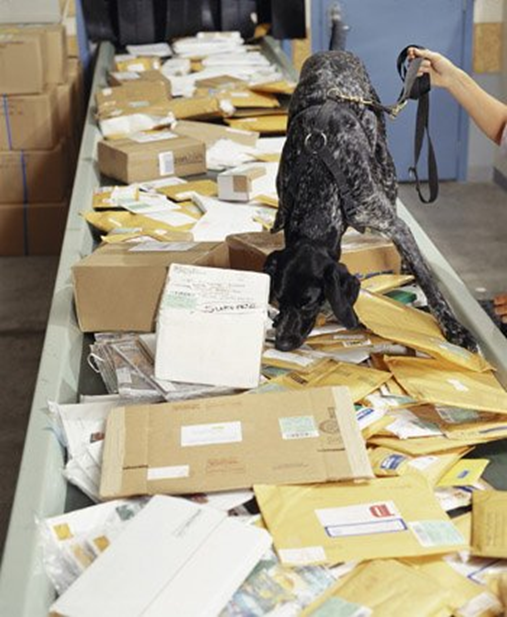
From the screening, a decision is made on whether the article needs to be further assessed. The decision for further assessment can be related to concerns that the article contains contraband or that there is duty payable.
Most countries set a threshold value for postal articles, and the rules below it, above it, and around the exceptions work as follows:
How postal article duty is treated
|
01 Below threshold No duty or tax collected. The article moves through without further customs action on duty. |
02 Above threshold Duty and tax may be payable. A full examination is often needed because the customs declaration is usually inadequate. |
03 Exceptions Some goods (typically tobacco and alcohol) attract duty regardless of value. |
In many countries, Customs is not permitted to open postal articles, and the opening must be done by a postal officer. Generally, because Customs and postal officers are co-located in the mail handling unit when international mail is being processed, this does not result in delays.
If it is determined that duty is payable on an article, the addressee is notified and asked to lodge an import declaration. If, when examining the goods, Customs is not satisfied with the declared value, additional documentation is sought to verify the value on the declaration. The import declaration and clearance procedure are generally the same as for air and sea cargo once the threshold has been reached.
These administrative arrangements and risk assessment techniques may change in some administrations as national postal services become deregulated, start to compete in new markets, and increase their efforts to develop standard electronic messages for postal traffic.
The best practice guide to Customs formalities in respect to postal traffic can be found in the Revised Kyoto Convention in Annex J, chapter 2.
|
|
Reading 4: Revised Kyoto Convention, Specific Annex J Chapter 2, Postal Traffic Revised Kyoto Convention, Specific Annex J Chapter 2, Postal Traffic. To view, please click on the following link: Text of the Revised Kyoto Agreement |
3.3. Immediate Release of Cargo
To support negotiations between express carriers (or their trade associations) and individual administrations, and to achieve a more universal implementation of international best practice, the World Customs Organization has produced a set of guidelines for this area. The WCO Immediate Release Guidelines are the standard against which each country is expected to benchmark its express clearance activities.
|
Note: World Customs Organization Immediate Release Guidelines The WCO developed a set of release and clearance procedures in early 1990 to assist both Customs and trade in expediting the clearance of large numbers of small or negligible value goods across borders that were primarily being carried by courier and express mail services. These Guidelines operate on the principle of information being provided by the operator to Customs in advance of the arrival of the goods. In addition to the documentary and physical issues related to customs clearance of express consignments, the WCO Immediate Release Guidelines also place emphasis on the desirability of providing the information required by the control authorities through the use of information technology to exchange electronic data. The Guidelines state:
|
The Guidelines cover the areas of most concern to both Customs and business. These include four categories of consignments, with outlines of appropriate procedures to deal with the generic risk represented by each. In addition, contentious issues such as de minimis limits are provided with guidance against which to construct or benchmark national standards. When examining the recommendations in the Guidelines, it is important to keep in mind that they are not part of an international treaty. They provide important and credible guidance, but they are not binding on any administration.
Use of electronic data is central to the Guidelines.
Benefits of using electronic data
|
↑ Speed Electronic data enables faster processing of express consignments through automated risk assessment and pre-arrival clearance. |
✔ Accuracy Digital data submission reduces transcription errors and enables more reliable matching against risk profiles and compliance records. |
↓ Cost Reduction Reduced administrative burden and paperwork costs for both business and government, supporting the economic case for express trade. |
The Guidelines provide practical advice to all parties on the process and potential data requirements, while linking the needs of express consignments to the overall provisions of the Revised Kyoto Convention on customs information technology issues, supplementing the principles set out in the legal text of the Revised Kyoto Convention.
The Guidelines provide an indicative list of data elements for the different categories of consignments, detailed in Appendix 1 of the Guidelines. Customs administrations are encouraged to limit data requirements to only those details deemed necessary to ensure compliance with customs laws. Consideration of the need for physical intervention by Customs and other control authorities at the frontier has also been taken into account in the WCO Immediate Release Guidelines, with recommendations on risk management and coordinated examinations detailed in section 12 of the Guidelines.
The pressure for continued development of processes that facilitate trade and ensure that the expansion in demand for express services is effectively met has led to a continuing dialogue between the industry and government at international, regional, and national level.
The need for dialogue between all levels of government and industry has been clearly recognized by both the express industry and the WCO, with encouragement to undertake negotiations on Memoranda of Understanding expressly provided for in section 16 of the Guidelines.
|
|
Reading 5: World Customs Organization, 2018, Immediate Release Guidelines To view, please click the following link: Immediate Release Guidelines |
4. Sea Cargo
Learning objectives
|
✓ |
Describe how sea cargo is reported, discharged, and risk-assessed in the seaport environment. |
|
✓ |
Distinguish between full container loads (FCL) and less-than-container loads (LCL), and explain how each affects customs examination and release. |
|
✓ |
Explain the role of the bill of lading and the inwards cargo report in the customs clearance of sea cargo. |
The sea cargo clearance process follows the same general pattern as air cargo, manifest reporting, risk assessment, import declaration, and release, but the scale and timing differ significantly.
Customs controls the seaport environment by designating the ports that can be used to discharge imported cargo. Vessels arriving from overseas can only arrive at these designated ports and discharge their cargo in certain licensed parts of the port. With most major ports, there are several wharf operators and/or container terminal operators, each with a specific licensed area.
What a container terminal contains
|
Component |
What it does |
|
Container yard |
Stacking area where discharged containers are held until they leave the terminal. |
|
Handling equipment |
Straddle carriers, rubber-tired gantries, and forklifts that transport and stack containers around the yard. |
|
Shore-based cranes |
Lift containers on and off ships at the wharf. |
Containers arrive at and leave the terminal by road or rail.
Shipping companies are required to provide a manifest of the cargo on each ship entering a port. The cargo report is required not only by Customs but also by the port authorities. Port authorities need to know the quantity of cargo being offloaded to determine their charges, and they also need to know the commodities being discharged, particularly cargo that requires special treatment such as hazardous cargo.
There are often several charterers of space, or “slots”, on each vessel. These charterers arrange the shipping of containers for importers. For example, one vessel may have three charterers, with several other freight forwarders organizing containers within their chartered space on the vessel. All are required to report the contents of their containers.
|
Full container load (FCL) |
Less-than-container load (LCL) |
|
Most sea cargo containers are shipped as FCL |
The remaining containers are usually LCL |
|
Single importer per container |
Multiple importers per container, each with a consignment too small to fill a container |
|
Once cleared from the wharf, the container can be taken straight to the importer’s premises |
Containers require deconsolidation before delivery to the importers |
|
No deconsolidation step |
Deconsolidation usually takes place on the wharf or at a Customs licensed depot |
Depending on the number of containers on a vessel, discharging all containers consigned to a port can take more than 24 hours. Containers are not necessarily available immediately after discharge because of other priorities in the container terminal. If the port has limited infrastructure, priority is given to getting export cargo onto the vessel. Delivery of imported containers may have to wait until the vessel departs, which may be 24 hours after import cargo is discharged.
The information that makes up the manifest comes from the individual bills of lading for each consignment. A bill of lading can cover several containers or a consignment that is part of an LCL.
What a bill of lading does
|
01 Receipt Confirms that the cargo described on it has been received on board. |
02 Evidence of contract Documents the contract of carriage between shipper and shipowner. |
03 Evidence of title Establishes ownership of the goods described on it. |
Customs administrations will usually risk-assess cargo for prohibited import purposes using information from the manifest. Shipping companies therefore need to provide a specified set of data to Customs. This is usually the information contained on the bill of lading.
The risk assessment is done to allow examination of cargo as soon as possible, and before it leaves the wharf. Customs needs to intercept any contraband (such as drugs or firearms) as soon as possible. These goods will not be declared on the manifest or on the import declaration. Customs will often remove these containers from the wharf, once they have been discharged from the ship, to a separate examination facility to conduct the examination. The examination facility may include screening with a container X-ray unit before conducting a full examination of the container.
Unpacking and examining the goods in a 40-foot container can take up to 24 hours. When Customs is satisfied that the container does not contain any contraband, the container is returned to the wharf. If contraband is found by Customs and/or other authorities, an investigation and further action will be undertaken.
Where the targeted consignment is part of an LCL container, the examination is programmed for when the consignment is unpacked at the wharf or at a depot. Depending on the time of unpack, the examination of a consignment from an LCL container may result in lengthy delays in the release of the consignment.
Each sea consignment is also reported to Customs twice: first via the bill of lading data that feeds the inwards cargo report, then on the import declaration lodged by the owner or their broker. The import declaration may cover several containers or a single consignment within an LCL.
Once the import declaration is cleared, goods can leave the wharf for home consumption or for a customs warehouse. LCL containers usually take a separate route to a depot for deconsolidation before the individual consignments are released.
As with air cargo, Customs runs a second risk assessment on the information in the import declaration. With sea cargo this may trigger a documentary check to verify duties and taxes payable, or, given the scale of container cargo, a full physical examination of the goods.
Full physical examination of a container after the lodgment of the import declaration can lead to further delays in clearance, depending on the purpose of the examination and where it takes place.
The sea cargo clearance process, from the time of arrival of a vessel, can be a lengthy one, depending on the timeliness of cargo reporting, the discharge time of the vessel, cargo availability, and the level of customs intervention.
What drives delay in sea cargo clearance
|
01 Cargo reporting Whether the manifest and bill of lading data reach Customs early enough to risk-assess before the ship arrives. |
02 Vessel discharge time How long it takes to offload all containers consigned to the port, sometimes more than 24 hours. |
|
03 Cargo availability Whether containers can be released from the terminal once discharged, given other terminal priorities. |
04 Level of customs intervention Whether the consignment is cleared on documents, X-rayed, or selected for full unpack and examination. |
5. Land (Road and Rail)
Learning objectives
|
✓ |
Outline how cargo reporting and import declaration procedures at land borders compare with those at air and sea ports. |
|
✓ |
Explain the value of border cooperation between neighboring customs administrations and the principle of single check point control. |
|
✓ |
Describe how customs handles the different complexities of road and rail cargo, including mixed consignee loads and rail transit movements. |
Land border crossings present significant challenges to Customs because of the volume of people and vehicles that pass through every day. Generally, however, the cargo reporting procedures and import declaration process are the same as for air and sea cargo. The provision of advance information at a land border considerably speeds up the process, as it does in an air or sea environment.
A land border is also a unique point where two customs administrations may operate alongside each other, dealing with the export and import of goods.
Border cooperation between neighboring countries has significant advantages for both countries.
What border cooperation delivers
|
01 Time saved Goods clear faster when authorities do not duplicate checks on either side of the border. |
02 Cost saved Avoids two sets of inspection infrastructure, two staffing rosters, and duplicated paperwork. |
03 Human resources saved Both customs administrations and economic operators avoid repeating the same work twice. |
Cargo passing through land borders needs to be reported by the carrier. The form of this report is a cargo manifest based on consignment notes. This allows Customs to risk-assess the consignments. Cargo can be carried in inter-modal containers, road trailers, or rail freight wagons, and each can hold either a single-consignee or a mixed-consignee load.
How cargo can be carried across land borders
|
|
Single-consignee load |
Mixed-consignee load |
|
Inter-modal container |
One importer fills the container. |
Multiple importers share the container. |
|
Road trailer or rail wagon |
One importer fills the trailer or wagon. |
Multiple importers share the trailer or wagon. |
The different types of carriage in both road and rail add to the complexity of examination for customs purposes. Three issues stand out:
|
01 Knock-on delays Examining one targeted consignment in a mixed-consignee load holds up every other consignment in the same container or trailer. |
02 Distance from final destination Final deconsolidation and delivery may be hundreds of kilometers inside the country, far from where the examination occurred. |
03 Driver detention Holding a truck at the border for examination, whether of one consignment or the whole load, keeps the driver waiting for an extended period. |
How road and rail examinations differ
|
Road |
Rail |
|
Trucks selected for examination are diverted to an examination area, usually alongside the border crossing |
Examination is unlikely to occur at the border crossing |
|
Examination may require full unloading of the contents of the container or trailer, which could delay the truck for up to 12 hours |
Trains may be delayed if all cargo has not been reported, but the fuller examination takes place at a designated cargo depot further inside the importing country, sometimes at the ultimate cargo destination |
|
Container X-ray facilities and truck-mounted X-rays are present at a number of border crossings and can considerably speed up the process |
Special transit provisions are in place in most countries to allow this type of movement |
6. Depots and Warehouses
When cargo arrives in a country, there is often a need, due to limited space at gateway ports and airports, to move the goods to a depot or warehouse before the import declaration is completed. This means goods can be moved beyond the border without having cleared customs, but they remain under customs control.
The final destination of many consignments is not known at the time of importation, or other relevant information is not yet available. Customs therefore allows the storage of goods, for logistical reasons, in temporary storage. Temporary storage also allows commercial interests to check whether the goods conform to contract conditions. An increasing percentage of world trade is made up of intra-company movements or transactions between related firms, and just-in-time delivery logistics managed by advanced automation and communication systems. As a result, the relative importance of temporary storage has decreased.
Three Types of Storage: A Comparison
Temporary storage, customs warehousing, and free zones are often confused, but they serve fundamentally different purposes:
|
Temporary Storage |
Customs Warehouse |
Free Zone |
|
Logistical Facilitates the physical movement of goods in the international supply chain while Customs processing is pending. |
Economic + Logistical Goods may be stored, processed, or manipulated for commercial purposes while duty and tax is suspended. |
Economic Designated area where normal Customs rules are suspended to promote trade, manufacturing, and distribution activity. |
|
Key Characteristics |
||
|
• Short-term, pending Customs clearance • Final destination may be unknown • No independent economic function • Declining in relative importance |
• Duty and tax suspended during storage • Goods may be processed or repackaged • Defined time limits apply • Important commercial function |
• Operates outside normal Customs territory • Supports manufacturing and re-export • Important economic development function • Independent of transport logistics |
|
Note: The fundamental distinction Temporary storage is primarily intended to facilitate logistical requirements in moving goods internationally; it is essentially a holding arrangement pending Customs processing. Warehousing and storage in a free zone, by contrast, have an important economic function independent of transport. They serve commercial, manufacturing, or distribution purposes in their own right. |
6.1. Depots
Depots
Depots can be used for the deconsolidation of import cargo shipments (LCLs) and the consolidation of export consignments before they are taken to the wharf or airport. In many countries, these depots can be inland or some distance from the port. This allows importers who do not live near the international ports to clear their goods close to home. This is particularly advantageous to Customs if they need to examine the goods with the owner present.
To move the goods to these depots, the depot owners or the shipping agents/airlines lodge a transshipment form or permit. The form identifies the goods in accordance with the manifest lodged for the ship or aircraft and seeks approval to move the goods from the port cargo terminal to a licensed depot. Often the approval will require the goods to be sealed to ensure they are not accessed prior to clearance.
To be licensed, depot owners usually have to meet these requirements:
|
Requirement |
What it covers |
|
01 Facility and security |
Strict requirements for facility suitability and physical security. |
|
02 Financial bond |
Bond lodged to cover any losses on goods that have not yet been cleared. |
|
03 Holding-time limit |
License specifies the maximum time cargo may be held at the depot before clearance.
|
|
04 Customs officer accommodation |
Office space and facilities for customs officers stationed at the depot, permanently or temporarily, to conduct physical examinations and audits. |
Goods cannot be moved out of the depot unless an import declaration has been lodged. In effect, depots are an extension of the port or airport. Goods cannot enter home consumption unless the correct revenue has been collected and all import permit requirements have been met.
6.2. Bonded Warehouses
Importers do not always know, at the time of importation, how their goods will finally be disposed of (for example, new motor vehicles). The bonded warehouse procedure gives importers a way to hold goods under Customs control while that decision is made, or while other conditions (such as obtaining a required permit) are met.
The scope of this procedure may not cover only imported goods. For example, some administrations allow goods that are liable to, or have been subject to, internal duties and taxes to be stored in a customs warehouse so that they may qualify for exemption from or repayment of those internal duties and taxes. Some administrations provide additional facilitation to the trade through a simplified warehousing procedure for special categories of goods, for example aircraft spare parts in the UK.
|
What Is a bonded warehouse? |
Legal status of goods inside |
|
• A licensed and regulated facility, operated by either the government or the private sector. • Goods may be stored for a period after importation without immediate payment of duty. • Both imported goods and domestic goods destined for export may be placed in a bonded warehouse. |
✔ Imported into the country ✘ Not yet released from Customs Goods are legally imported but remain under Customs control until formally released for home consumption or re-exported. |
Placing goods in customs warehouses generally holds significant benefits for importers, such as:
|
01 Defer duty & tax Payment Duties and taxes are assessed but not paid at the time goods enter the warehouse. Payment is deferred until goods are released for domestic consumption or exported. |
02 Defer marking & labelling compliance Compliance with certain requirements, such as marking and labelling, can also be deferred, continuing until the goods are released. |
|
03 Manage uncertain disposal When the final use or destination of goods is not yet known at importation (e.g. new motor vehicles), the warehouse allows time to make that decision. |
04 Meet permit conditions Goods can be held in a warehouse until the importer can meet the conditions relating to a required permit before release into home consumption. |
Where a decision is made to place imported goods into a bonded warehouse, the importer or their representative is required to present to Customs a special import declaration for warehousing, along with relevant documents. The duties and taxes liable on the goods are assessed but not required to be paid. Prohibited goods, or restricted goods without required permits, are not permitted in a bonded warehouse.
The goods are then moved to the warehouse, where they are usually stored under strict guidelines prescribed in the warehouse license. To gain a warehouse license, an applicant must demonstrate a high level of security, good accounting processes, and provide a suitable level of financial security or bond. Customs will also conduct regular audits of bonded warehouses to ensure that the owners have properly accounted for all goods leaving the premises.
How the process works
|
1 → |
2 → |
3 → |
4 ✔ |
|
Special declaration lodged Importer or representative presents a special import declaration for warehousing plus relevant documents to Customs. |
Duties assessed (not paid) Customs assesses the duties and taxes payable, but payment is not required at this stage. |
Goods moved to warehouse Goods are transported to the licensed bonded warehouse and stored under strict guidelines in the warehouse license. |
Release decision made Importer decides: release into home consumption (duties paid), re-export (no duty), or continue storage. |
What cannot be stored and how Customs oversee
|
✘ What Cannot Be Stored • Prohibited goods; regardless of circumstances • Restricted goods that do not have the required permits |
✔ Customs Oversight • Customs conducts regular audits of bonded warehouses • Audits verify that owners have properly accounted for all goods leaving the premises • Goods must be stored under strict guidelines in the warehouse license |
Restrictions are also placed on the activities that can be carried out in bonded warehouses. These may include some of the following:
Allowed activities in a bonded warehouse
|
01 Cleaning |
02 Sorting |
|
03 Disassembling and reassembling |
04 Inspecting and testing |
|
05 Marking and labeling |
06 Packing and packaging |
|
07 Sample removal for orders |
|
Goods can only be removed from the bonded warehouse when the correct duties and taxes have been paid or they are exported.
|
|
Reading 5: Revised Kyoto Convention, Specific Annexes D – Customs Warehouses and Free Zones To view, please click on the following link: Text of the Revised Kyoto Agreement |
6.3. Free Zones
As part of government policies to develop a country’s exports and international trade in general, some customs administrations grant relief from import duties and taxes for goods imported into locations that are generally regarded, at least as far as duties and taxes are concerned, as being outside the “Customs territory”. These locations are referred to as free zones, but may also be referred to as “free port”, “free warehouse”, or “foreign trade zone”. Goods imported into a free zone are generally not subject to the usual customs controls.
Imported goods that enter the customs territory for home consumption from a free zone, and which have not been processed there, are liable to import duties and taxes as if they had been imported directly from overseas. Special assessment rules, set out in national legislation, are applicable to imported goods that have been processed in the free zone. They also apply when the goods utilized are of national origin or have been imported against payment of import duties and taxes and granted exemption from or repayment of duties and taxes when they were introduced into the free zone.
|
Note: Commercial free zones and industrial free zones In many customs territories, a distinction is made between “commercial” and “industrial” free zones.
|
7. Bibliography
World Customs Organization, International Convention on the simplification and harmonization of customs procedures, (Revised Kyoto Convention). Brussels, 2008.
7.1. Readings
Reading 1
WCO-UPU Postal Customs Guide
The document is available on Moodle in the Module 1 Block.
Reading 2
WCO 2008, Revised Kyoto Convention, Specific Annex J Chapter 2, Postal Traffic
The document is available on Moodle in the Module 1 Block.
Reading 3
WCO 2006, WCO Revised Kyoto Convention 1999, Specific Annex D
The document is available on Moodle in the Module 1 Block.
Reading 4
Revised Kyoto Convention, General Annex Chapter 04
Reading 5
World Customs Organization, 2018, Immediate Release Guidelines.
Immediate Release Guidelines (PDF)