Study Guide
| Site: | Centre for Customs and Excise Studies |
| Course: | DHL International Customs Program 2026: Cohort 1 |
| Book: | Study Guide |
| Printed by: | Guest user |
| Date: | Saturday, 17 October 2026, 3:33 AM |
1. Introduction
Historically, identifying the origin of goods was simpler because most products were manufactured within one country. Today, few products are made solely in one country, or even within one enterprise. Goods are now composites of inputs, transformations, and value-added activity from producers in many nations. Multinational corporations make investment decisions based partly on minimizing input costs and securing ready access to materials and labor for components that are consolidated into a final product and shipped worldwide using just-in-time logistics.
Components are often sourced from several countries, transported to a third country for consolidation, and then exported. What is the origin of those final goods? It may not be the country of export. The decision becomes harder when components or the final goods are produced within an area governed by a regional trade agreement with its own rules of origin.
|
|
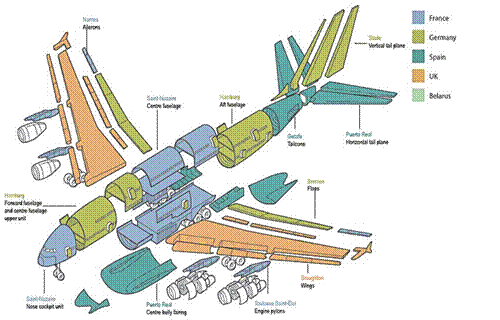
Example: Components sourced from different countries Consider the Airbus A380. Its components are sourced and partly assembled in five different countries, with final assembly in Toulouse, France.
Figure 1: Airbus A380 component sources. Source: Aviation WA |
A further difficulty has been the proliferation of regional trade agreements. These agreements often exclude non-contracting parties and limit producers in those States from competing for contracts. A framework was needed to govern the origin of goods. It also had to align with existing trade rules in the General Agreement on Tariffs and Trade (GATT) 1947 and GATT 1994. That framework became the Agreement on Rules of Origin 1995.
This Module gives you a foundation in Rules of Origin. You should supplement it with your own research and reading. The material covers both theory and practice across these areas:
|
01 Rules of Origin under GATT/WTO How rules of origin sit within the global trade rules established by GATT 1947 and GATT 1994. |
02 Meaning of origin What "origin" means in customs terms, and the difference between non-preferential and preferential rules. |
|
03 WTO Agreement on Rules of Origin The four parts and two annexes of the 1995 Agreement, including the three tests for substantial transformation. |
04 Revised Kyoto Convention, Specific Annex K |
|
05 Case study: AUSFTA |
|
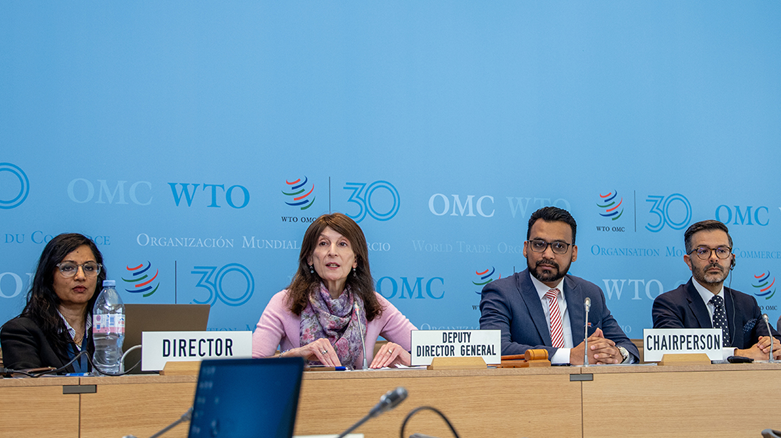
Figure 2: WTO Deputy Director-General Angela Ellard delivering her opening remarks on the 30th anniversary of the Agreement on Rules of Origin on 4 April 2025.
Source: https://www.wto.org/english/news_e/news25_e/roi_04apr25_e.htm
2. Rules of Origin
Rules of origin
Learning objectives
|
✓ |
Explain why Rules of Origin are essential to the operation of free trade agreements and regional trade agreements. |
|
✓ |
Distinguish between free trade areas, Customs unions, and bilateral trade agreements, and identify the role of Article XXIV of GATT. |
|
✓ |
Describe how rules of origin can act as hidden protection within a free trade area. |
2.1. Overview

Figure 3: Rules of Origin make accessing the benefits of trade agreements about as easy as eating a bowl of noodles with only one chopstick.
Source: Australian Government Productivity Commission, 2017
Rules of Origin are often complex. The 1992 Agreement establishing the European Economic Area illustrates the scale: its Rules of Origin sits in Protocol 4 and contains 40 Articles, 8 Titles, 7 Annexes, across 151 pages.
This chapter looks at the law developed to deal with that complexity. The international instruments on Rules of Origin are less developed than those for Tariffs and Valuation. The World Trade Organization's (WTO) Agreement on Rules of Origin is designed to help resolve this, and there is a complete Specific Annex in the Revised Kyoto Convention (RKC) dealing with Rules of Origin (see Specific Annex K), but gaps in the law remain. We will examine these international instruments focusing on how governments are directed to administer the rules domestically. It is then up to companies such as DHL to seek to explain the rules to their customers, as seen in: DHL Guidance on Rules of Origin.
2.2. Free Trade Areas and Agreements
Free trade areas and Agreements
Preferential agreements
A preferential agreement provides preferential tariffs and market access to goods from a particular region while excluding others.
A preferential agreement grants preferential tariffs and market access to goods from a particular region or country, while excluding others from those same benefits. These arrangements are discriminatory by design: they favor specific trade partners over the rest of the world.
|
Model 1: Post-colonial access |
Model 2: Regional stability access |
|
A former colonial power maintains preferential market access for its former colonies, and sometimes vice versa. The relationship reflects historic political and economic ties rather than a purely commercial rationale. |
A large regional power grants preferential access to smaller neighboring states, recognizing that their prosperity and political stability improves when they can access larger markets. |
Real-word examples
|
Post-colonial |
Post-colonial |
Regional ctability |
|
British Commonwealth Preference The UK granted continuing preferential access to goods from its former colonies, reflecting historic Commonwealth ties. |
Lome Convention France (and the EU) granted preferential market access to African, Caribbean, and Pacific (ACP) countries, many of which were former French territories. |
Australia and New Zealand / Pacific Islands Australia and New Zealand grant easier market access to goods from Pacific Island countries than to goods from other countries, supporting regional stability and development. |
These Agreements reflect a political relationship more than a trading one. They do, however, reduce protectionism in developed economies and create a base for export growth in smaller countries.
|
|
Scale of regional trade agreements today RTA in force 382 RTAs are in force and notified to the WTO as of 20 April 2026 375+ RTAs are in force but not notified to the WTO as of February 2026[1] Source: WTO |
[1] World Trade Organization, Regional Trade Agreements (2026), https://www.wto.org/english/tratop_e/region_e/region_e.htm
Free trade agreements (FTAs)
Free trade areas and agreements have expanded substantially in recent years and continue to grow, with rules of origin central to many aspects of that development.
Free Trade Agreements (FTA) remove tariffs and non-tariff barriers between member states, but member states usually keep their own national tariffs and trade rules for non-members. Rules of Origin therefore remain essential, ensuring only goods entitled to preference between members receive that treatment. Rules of Origin also encourage member-state businesses to source local material, so that enough value is added within the free trade area to qualify for reduced tariffs.
For some industries and countries, there may be substantial gain from an FTA by using their expertise and local production to expand into other member markets under the lower tariffs. Others lose ground when tariffs or non-tariff protections are removed.
|
✔ Who gains from an FTA • Industries with export expertise and local production capacity • Member states whose goods become competitive in new markets under lower tariffs • Economies where exports expand under preferential access |
! Who loses from an FTA • Domestic producers losing tariff or non-tariff protection • Sectors where duty-free imports from other members are cheaper or more attractive than home-produced goods • Sectors where the duty saved exceeds transport cost making imports especially competitive |
This risk is highest where the duty that would have been payable exceeds the cost of transportation. A system for monitoring imports and demonstrating that products comply with the Rules of Origin matters politically. Governments receiving competitive imports need this evidence to defend their decision to join the FTA.
2.3. Regional Trade Agreements
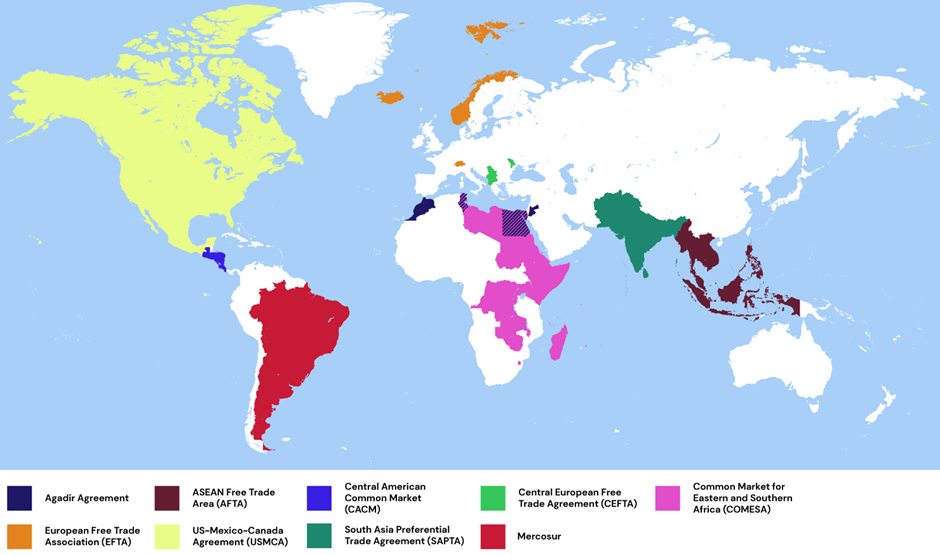
Some of the plurilateral agreements between states or blocs in the same geographic region include:
|
Agreement |
Member states |
||
|
Morocco, Tunisia, Egypt, Jordan |
|||
|
Brunei Darussalam, Cambodia, Indonesia, Lao People’s Democratic Republic, Malaysia, Myanmar, Philippines, Singapore, Thailand, Vietnam |
|||
|
Costa Rica, El Salvador, Guatemala, Honduras, Nicaragua |
|||
|
Albania, Bosnia and Herzegovina, Kosovo, Moldova, Montenegro, North Macedonia, Serbia. Bulgaria, Croatia and Romania’s memberships terminated on EU accession. |
|||
|
Burundi, Comoros, Democratic Republic of Congo, Djibouti, Egypt, Eswatini, Eritrea, Ethiopia, Kenya, Libya, Madagascar, Malawi, Mauritius, Rwanda, Seychelles, Somalia, Republic of Sudan, Tunisia, Uganda, Zambia, Zimbabwe |
|||
|
Iceland, Norway, Switzerland, Liechtenstein |
|||
|
United States-Mexico-Canada Agreement (USMCA) *previously North American Free Trade Agreement (NAFTA) |
Canada, the U.S., Mexico |
||
|
|
Afghanistan, Bangladesh, Bhutan, India, Maldives, Nepal, Pakistan, Sri Lanka |
||
|
|
MERCOSUR |
Argentina, Bolivia, Brazil, Paraguay, Uruguay, Venezuela (suspended). Chile, Colombia, Ecuador, Guyana, Peru and Suriname are associate members; Mexico has observer status. |
|
A full list is available at the WTO website: https://rtais.wto.org/UI/PublicMaintainRTAHome.aspx.
The three tables below show bilateral free trade agreements concluded by Australia, China, and the United States. They illustrate how the bilateral approach has expanded alongside the regional one, and why Certificates of Origin remain central to international trade; they provide the key evidence of entitlement to preferential access to markets.
Australia has bilateral agreements with:
|
Australia has bilateral agreements with: |
|
|
New Zealand |
Indonesia |
|
Singapore |
Hong Kong |
|
United States |
Peru |
|
Thailand |
China |
|
Chile |
Japan |
|
Malaysia |
Korea |
|
India |
United Kingdom |
|
United Arab Emirates |
|
|
The People's Republic of China has bilateral agreements with: |
|
|
Costa Rica |
Chile |
|
Hong Kong |
Macao |
|
Singapore |
New Zealand |
|
Pakistan |
Peru |
|
Australia |
Indonesia |
|
Japan |
South Korea |
|
USA |
Thailand |
|
Iceland |
Switzerland |
|
The United States of America (USA) has bilateral agreements with the following countries and blocs: |
|
|
Australia |
Chile |
|
Bahrain |
Colombia |
|
Singapore |
Israel |
|
Jordan |
Peru |
|
Morocco |
Oman |
|
South Korea |
Dominican Republic/CAFTA |
Most free trade agreements allow members to keep their national tariffs. Rules of Origin are critical for without it, goods from outside the free trade area could be imported into the member with the lowest external tariff and then re-exported to another member as if they qualified for preference.
Well managed origin rules also encourage regional trade in raw materials and intermediate products, because producers prefer to use inputs sourced within the area so their goods qualify for preferential status and gain maximum market access. If the origin process is too expensive or complex to document, businesses may prefer to keep paying the external tariff. This can undermine regional trade.
As GATT rounds continue to reduce Customs duty rates, rules of origin (rather than tariffs themselves) may become the main method of offering some protection to industries within free trade areas, whether formal or informal.
An Oxford academic paper on Rules of Origin identified four ‘Laws’ on the operation and impact of preference within free trade areas:
|
01 Hidden protection ‘Law 1: RoO can insulate an industry from the consequences of an FTA and it can provide hidden protection for intermediate inputs used by it. It may well be that the ability to insulate an industry makes FTAs easier to pass than Customs Unions. Agents who stand to lose from an FTA can undo its effects without, for the most part, even being seen as doing so! For example, in the US-Canada Free Trade Area (FTA), the production of aged cheese from fresh milk does not confer origin. This in effect prevents free trade of cheese in the FTA.’ |
02 Precise form matters ‘Law 2: The precise form of the RoO matters. Lawyers and trade negotiators have clearly understood this for a long time. This is evident in the importance placed on the details of the RoO negotiated. For example, great importance was placed on the treatment of interest costs by Honda when content requirements were being defined for the FTA between the US and Canada.’ |
|
03 Time horizon matters ‘Law 3: The time period matters. Responses to RoO take time. Short-run partial equilibrium effects can differ greatly from long-run, general equilibrium ones. For example, in the short run the response to RoO may be primarily in terms of trade flows, while in the long run it may take the form of investment flows. Hence, it is vital to specify the time frame for analysis and to incorporate the major linkages across sectors and options available to firms.’ |
04 Too much can backfire ‘Law 4: You can have too much of a good thing. Having more restrictive RoO may result in higher, not lower imports! This point is quite subtle and provides a warning to policymakers and potential users that RoO may well backfire!’ |
2.4. Free Trade Zones, Customs Unions and Article XXIV, GATT
As shown by the European Union, an original Customs Union can evolve into a detailed political and economic entity with its own currency and market, operating under different rules depending on whether goods originate inside or outside the Union. The drafters of GATT recognized this potential.
They included Article XXIV in the Agreement because they believed regional trade liberalization would encourage global trade liberalization.
To establish a Free Trade Area or a Customs Union that is GATT compliant, the FTA or union must meet the requirements of Article XXIV, GATT:
|
01 Internal liberalization Duties and restrictive regulations must be removed on ‘substantially all trade’ between members. |
02 Common external regime The union must apply ‘substantially the same duties and regulations of commerce’ in trade with non-member countries - a common external tariff. |
03 No net rise in protection The common tariff and other regulations shall not, on the whole, be higher or more restrictive than they were before. |
The emergence of unions and free trade areas has created a growing need for Rules of Origin that are uniform across the world. The more that Rules of Origin are set by regional groupings rather than at the global level, the greater the risk that Customs Unions will use Rules of Origin to shut out goods on criteria not used anywhere else.
Article XXIV is likely to remain a contentious legal provision. The stall and lack of progress of the Doha Round has again raised the risk that the world divides into trading blocs, creating external tariff and non-tariff barriers between those blocs while protectionism disappears within them.
|
Note: WTO and Domestic Law The Agreement Establishing the World Trade Organization requires member states to ensure their domestic law conforms to their treaty obligations. Article XVI (4) provides that each member shall ensure the conformity of its laws, regulations and administrative procedures with its obligations as provided in the annexed Agreements. A failure to do so puts the country in breach of its international obligations. It may also lead to a negative report under the Trade Policy Review mechanism. Either way, it could lead to pressure on the country concerned to abide by its obligations. This pressure may be economic and/or political rather than legal. In practice, this comes down to actions by individual Customs officers, or the systems used by Customs to determine matters such as origin or value. If Customs, for example, uses a system to determine origin inconsistent with the Annex 1A Agreement on Rules of Origin, it is putting its country in potential breach of GATT, and open to legal or other sanctions. |
2.5. Bilateral Trade Agreements
Bilateral agreements have long been a feature of international trade relations. They were common before GATT was created, and for many countries they have taken on new importance. Australia has recently concluded bilateral free trade agreements with the United Kingdom, India, and Indonesia. The Australian government has recently concluded negotiations for a free trade agreement with the European Union in March 2026; however, the FTA is not in force as yet. Australia’s agreement with the Gulf Cooperation Council (GCC) is still under consideration while its FTA with the United Arab Emirates (UAE) entered into force on 1 October 2025. Note that some bilateral agreements amount to the creation of a free trade area, as done by ANZCERTA, the Agreement between Australia and New Zealand.
ANZCERTA is a good example of a bilateral agreement that gives greater force and clarity to WTO commitments under GATT and the related agreements. Not all bilateral agreements have that effect.
3. The Meaning of Origin
Learning objectives
|
✓ |
Define ‘Origin’ and explain why it matters for tariff treatment, quotas, and anti-dumping duties. |
|
✓ |
Distinguish between non-preferential and preferential Rules of Origin and the role each plays in trade. |
|
✓ |
Identify the two general bases on which origin is determined: wholly obtained and substantially transformed. |
Origin is the country in which goods were made or manufactured. It is not necessarily the country where the goods were shipped from. Origin matters because it determines whether a good qualifies for preferential treatment, or whether it is subject to discriminatory controls such as quotas or anti-dumping duty. These preferences or discriminations can arise under GATT, or from other trading Agreements such as bilateral free trade agreements, agreements establishing free trade areas or Customs zones, and preferential agreements such as the Lome Convention.
Given current global trading patterns and the intra-industry flows of raw and intermediate inputs, determining the origin status of a finished product is not always easy. The number of free trade Agreements continues to grow, each with its own Rules of Origin, and there is not yet a global set of standards on how those rules are to be defined and administered. Rules of origin fall into two categories: non-preferential and preferential.
3.1. Non-Preferential and Preferential Rules of Origin
|
Non-preferential Rules of Origin |
Preferential Rules of Origin |
|
Determines Origin but do not confer any tariff benefits. |
Determines which goods enter under preferential treatment at zero or reduced tariff rates. |
|
Used for: quota determination, anti-dumping and countervailing duty calculation, and country-of-origin labeling. |
Used for: preferential market access between economies under a trading arrangement (FTAs, customs unions, preference schemes). |
|
Applied on a most-favored-nation (MFN) basis; non-discriminatory. |
Discriminatory by design; the donor country’s benefits are restricted to qualifying trading partners. |
|
The WTO is actively developing harmonized rules in this area. |
The principal objective is to ensure preferential benefits flow only to selected partners. |
3.2. The 'Rules' Generally
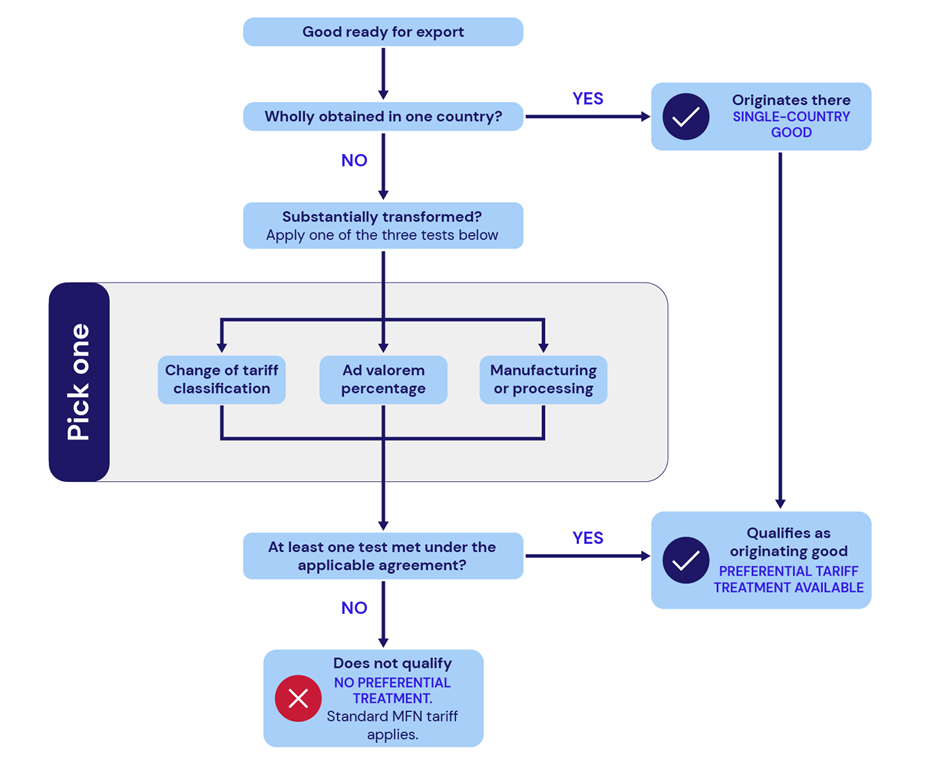
A good is considered wholly obtained if it is entirely produced or manufactured in one country, making that country its origin. When more than one country is involved in production, origin is determined by which country substantially transformed the good. Substantial transformation is established by one of the following methods, or a combination of them:
|
01 Change in tariff heading Substantial transformation occurs if the finished good is classified to a different tariff heading from that of its component materials after production. |
02 Specified process or manufacturing operation An item of goods is transformed if it has undergone the operations of process or manufacture that the rule specifies. |
03 Percentage of value-added The cost of the manufacturing process in the country equals or exceeds a specified percentage of the good’s value. |
|
|
Example: Transformation criteria in the EC The transformation process on non-originating material is a key factor in determining the origin of a product. Further information on determining the rules of origin in the EC is available at EC Taxation and Customs Union Common Provisions. HS transformation is critical in those rules. |
|
Note: Agreements and Rules of Origin Agreements reached outside the GATT/WTO framework will usually establish their own rules for determining origin. The United States-Mexico-Canada Agreement (USMCA) of 2020, for example, between the USA, Canada and Mexico, has extensive origin rules which apply only between the three parties. |
4. WTO Agreement on Rules of Origin
Learning objectives
|
✓ |
Summarize the structure of the WTO Agreement on Rules of Origin (its four parts and two Annexes). |
|
✓ |
Identify the three tests for substantial transformation recognized in Article 2 of the Agreement. |
|
✓ |
Explain the purpose of the harmonization work program under Article 9 and its progress to date. |
GATT contains many provisions which require the determination of origin. Rules of Origin are important in implementing trade policy instruments such as anti-dumping and countervailing duties, origin marking, and safeguard measures. To ensure as much uniformity as possible in interpreting GATT, the Uruguay Round produced a WTO Agreement on Rules of Origin which is an Annex to the WTO Agreement. We consider this Agreement first.
The Agreement is in 4 parts and has 2 Annexes.
|
Section |
Topic |
Articles |
|
Part I |
Definitions and Coverage |
Article 1 |
|
Part II |
Disciplines to Govern the Application of Rules of Origin |
Articles 2 and 3 |
|
Part III |
Procedural Arrangements on Notification, Review, Consultation and Dispute Settlement |
Articles 4-8 |
|
Part IV |
Harmonization of Rules of Origin |
Article 9 |
|
Annex I |
Technical Committee on Rules of Origin |
n/a |
|
Annex II |
Common Declaration with regard to Preferential Rules of Origin |
n/a |
The first point to note is Article 1, paragraph 1, which expressly provides that the Agreement is not intended to apply to ‘contractual or autonomous trade regimes leading to the granting of tariff preferences going beyond the application of paragraph 1 of Article I of GATT 1994.’ In other words, the determination goods’ origin enjoying preference granted beyond the basic MFN treatment provided for in Article I will not be caught by this Agreement.
Conversely, Article 1, paragraph 2 of the Agreement provides:
|
Rules of origin…shall include all rules of origin used in non-preferential commercial policy instruments, such as in the application of most-favored nation treatment under Articles I, II, III, XI and XIII of GATT 1994, anti-dumping and countervailing duties under Article VI of GATT 1994; safeguard measures under Article XIX of GATT 1994; and any discriminatory quantitative restrictions or tariff quotas. They shall also include rules of origin used for government procurement and trade statistics. |
The Agreement contemplates a work program for the harmonization of Rules of Origin, based on work to be done within the WCO, to determine Rules of Origin for each tariff heading in the Harmonised System. This work began in 1995 but has not yet been completed, and has proved much harder than originally envisaged. The Agreement contemplated one set of rules to apply during the transitional period, and a new set of disciplines to apply after the work had been completed. We are still in the transition period, and the disciplines set out in Article 2 still apply.
Origin is now well understood for wholly obtained goods. Substantial transformation is where the contention remains.
During the Uruguay Round, three tests for substantial transformation were recognized, but it did not prove possible to reach agreement on one single determinant of origin. Article 2 therefore reflects all three tests as being legitimate:
|
01 Change of tariff classification A good is so transformed in a country that it changes its tariff classification. An example is the conversion of leather into shoes. |
02 Ad valorem percentage A defined percentage of the goods’ value, usually 50%, must be added in the country of manufacture. |
03 Manufacturing or processing operation The basic process of manufacture occurs in the country claiming origin. |
Article 2 does not attempt to define each of these tests but sets out criteria under which they are to be administered. Article 3 of the Agreement sets out the basic principles about the way in which Rules of Origin are to be applied once the transitional phase is over. Article 2, paragraph (c) requires that rules of origin shall not themselves create restrictive, distorting or disruptive effects on international trade.
The concept of the transitional phase comes from Part IV of the Agreement. Article 9 establishes a work program (with the WCO) to harmonize origin rules on the basis of certain key principles, set out in paragraph 1 of Article 9 (the principles largely included in Articles 2 and 3). The agenda for this harmonization program is set out in Article 9, paragraph 2 (c), which also requires the work to be conducted on a product sector basis, as represented by various chapters of the Harmonised System. The work was designed to achieve the following objectives:
|
01 Wholly obtained definitions Harmonized definitions of the goods to be wholly obtained in one country, and the minimal processes or operations that do not confer origin. |
02 Substantial transformation criteria |
03 Other transformation criteria |
The Agreement also contains two Annexes. Annex I establishes a Technical Committee on Rules of Origin, and Annex II contains a Common Declaration with regard to Preferential Rules of Origin. The Declaration seeks to apply similar administrative rules to non-GATT origin issues as to GATT origin issues. These relate to matters such as transparency of regulations, the need for positive standards rather than negative ones, judicial review of administrative decisions, and the treatment of confidential commercial information.
|
|
Further reading 1: WTO 1994. Agreement on Rules of Origin, Geneva |
|
|
Further reading 2: Pryles, Waincymer and Davies 2004, International Trade Law, Lawbook Co, Sydney, pp 942/3 |
5. Rules of Origin under the Revised Kyoto Convention
Learning objectives
|
✓ |
Outline the structure of Specific Annex K of the Revised Kyoto Convention and identify which categories of goods are taken as wholly obtained. |
|
✓ |
Apply the Recommended Practices on substantial transformation, including the ad valorem percentage rule and the list of operations that do not confer origin. |
|
✓ |
Explain the purpose, types, and issuing authorities of certificates of origin and how compliance is verified at the border. |
We now look at some of the standards in the WCO's Revised Kyoto Convention, Specific Annex K, which sets out how Customs agencies should administer their rules of origin as part of revenue collection.
5.1. Revised Kyoto Convention - Specific Annex K
There has been considerable activity within the WTO and the WCO to develop standard origin rules. Although this work has proved harder than anticipated and is still incomplete, substantial agreement on the basic rules of origin now exists. These understandings find their latest expression in Annex K to the Revised Kyoto Convention.
The Annex contains three chapters.
|
Chapter 1 |
Rules of origin, as they have emerged from the WTO/WCO development work. |
|
Chapter 2 |
Certificates of origin — proof that goods were manufactured or substantially transformed in a particular country. |
|
Chapter 3 |
Further provisions on Certificates of origin. |
Most of the provisions in Annex K are Recommended Practices rather than Standards, which suggests that they do not yet enjoy universal support, and which allows states to enter reservations against them should they wish.
Chapter 1 provisions are worth a closer look. The table below sets out those goods which can be regarded as wholly obtained from a particular country.
|
Wholly obtained Goods produced wholly in a given country shall be taken as originating in that country. The following only shall be taken to be produced wholly in a given country: (a) mineral products extracted from its soil, from its territorial waters or from its seabed (b) vegetable products harvested or gathered in that country (c) live animals born and raised in that country (d) products obtained from live animals in that country (e) products obtained from hunting or fishing conducted in that country (f) products obtained by maritime fishing and other products taken from the sea by a vessel of that country (g) products obtained aboard a factory ship of that country solely from products of the kind covered by the paragraph (f) above (h) products extracted from marine soil or subsoil outside that country's territorial waters, provided that the country has sole rights to work that soil or subsoil (i) scrap and waste from manufacturing and processing operations, and used articles, collected in that country and fit only for the recovery of raw materials (j) goods produced in that country solely from the products referred to in paragraphs (a) to (i) above. Source: WCO, 1999. Standard 2, Specific Annex K |
In addition, Recommended Practice (RP) 3 says that the substantial transformation criterion should apply to any good that is manufactured in more than one country. RP 4 recommends that the Harmonized System is be used to assist in determining substantial transformation.
RP 5 recommends that where the substantial transformation criterion is expressed in terms of the ad valorem percentage rule, the values to be taken into consideration should be:
|
Materials imported |
Goods produced |
|
• The dutiable value at importation. For materials of undetermined origin, the first ascertainable price paid for them in the territory of the country in which manufacture took place. |
• Either the ex-works price or the price at exportation, according to the provisions of national legislation. |
RP 6 recommends that operations which do not contribute, or which contribute only to a small extent to the essential characteristics or properties of the goods, and in particular operations confined to one or more of those listed below, should not be regarded as constituting substantial manufacturing or processing:
|
01 Preservation operations Operations necessary for the preservation of goods during transportation or storage. |
02 Packaging operations Operations to improve the packaging or the marketable quality of the goods or to prepare them for shipment, such as breaking bulk, grouping of packages, sorting and grading, repacking. |
|
03 Simple assembly Simple assembly operations. |
04 Mixing goods of different origin Mixing of goods of different origin, provided that the characteristics of the resulting product are not essentially different from the characteristics of the goods which have been mixed. |
The table below sets out some special WCO rules to assist with determining origin:
|
Special Cases of Qualification for Origin 1. Recommended Practice Accessories, spare parts and tools for use with a machine, appliance, apparatus or vehicle should be deemed to have the same origin as the machine, appliance, apparatus or vehicle, provided that they are imported and normally sold therewith and correspond, in kind and number, to the normal equipment thereof. 2. Recommended Practice An unassembled or disassembled article which is imported in more than one consignment because it is not feasible, for transport or production reasons, to import it in a single consignment should, if the importer so requests, be treated as one article for the purpose of determining origin. 3. Recommended Practice For the purpose of determining origin, packings should be deemed to have the same origin as the goods they contain unless the national legislation of the country of importation requires them to be declared separately for tariff purposes, in which case their origin should be determined separately from that of the goods. 4. Recommended Practice For the purpose of determining the origin of goods, where packings are deemed to have the same origin as the goods, account should be taken, in particular where a percentage method is applied, only of packings in which the goods are ordinarily sold by retail. 5. Standard For the purpose of determining the origin of goods, no account shall be taken of the origin of the energy, plant, machinery and tools used in the manufacturing or processing of the goods. Source: WCO, 1999. Standard 2, Specific Annex K |
Despite the activities of the WTO and the WCO, there is still considerable scope for States to determine within their own legislation what criteria they will use to determine origin. There are also some creative bilateral arrangements in place. Where bilateral or other agreements stipulate a particular methodology, that methodology must be incorporated into domestic law.
|
|
Further reading 3: World Customs Organization (WCO) 1999, Revised Kyoto Convention, Special Annex K, Origin, Brussels. |
5.2. Certificates of Origin
A Certificate of Origin is a document certifying that the products being exported originate and are manufactured in the country of the seller. With the Certificate of Origin, a buyer (typically the importer) is assured that the products being purchased originate and are manufactured in the country of the seller (typically the exporter).
Importing countries consider the origin of imported goods when determining the duty that will be assessed on the goods imported and whether the imports are given preferential access. Other considerations are whether the goods are subject to quota, and whether they come from an embargoed nation, in which case the goods will not be allowed entry.
5.3. What do they look like?
There is no prescribed form for a certificate or declaration by the manufacturer. It should, however, describe the goods and indicate that, in accordance with the Customs Act or whichever applicable legislation, the goods are eligible for preference. The name of the person signing the certificate or declaration should also be clearly stated.
A sample form is shown in Annex 1 to Specific Annex K (Reading 3) and actual samples are shown in Figure 4 and Figure 5 below.
How do you obtain a Certificate of Origin?
Australia deals with two types of certificates of origin:
|
Certificate type |
What it certifies |
|
Certificate of Australian Origin |
The location within Australia where the goods were grown, produced or manufactured |
|
Certified Declaration of Origin |
Goods manufactured in countries outside of Australia |
In Australia, a Certificate of Origin can be obtained from a Chamber of Commerce by completing a Declaration of Origin and providing the relevant export documentation. A Declaration of Origin is an affidavit signed by the exporter or their representative certifying the country of growth, production or manufacture of the exported goods. Copies of the following documents must also be provided:
|
01 Commercial invoice Required for every application. |
02 Bill of lading Required for sea freight shipments. |
|
03 House airway bill Required for airfreight shipments. |
04 Letter of credit Required only if applicable to the transaction. |
Some examples of goods that require Certificates of Origin include chemicals, garments, jewelry, meat, pharmaceuticals, rice, sugar, textiles, wool, and wheat.
As Chambers of Commerce are often one of the principal issuing authorities for Certificates of Origin, the ICC provides the following information for its members on its website: ICC Certificates of Origin.
What is a Certificate of Origin?
A Certificate of Origin (CO) is a document attesting that goods in a particular export shipment are wholly obtained or produced or manufactured or processed in a particular country (country of origin). Virtually every country in the world considers the origin of imported goods when determining what duty will be assessed on the goods or, in some cases, whether the goods may be legally imported at all.
There are two types of certificates.
|
Non-Preferential C.O. |
Preferential C.O. |
|
The “ordinary” certificate. Issued by Chambers of Commerce. Certifies the country of origin of a particular product. |
A certificate that enables products to enjoy tariff reduction or exemption when exported to countries extending these privileges. |
|
✘ Does not qualify the product for any preferential treatment. |
✔ Qualifies the product for tariff reduction or exemption. |
|
Used for general country-of-origin documentation, customs records, and commercial purposes. |
Used under schemes such as GSP and Commonwealth Preference Certificate. |
Certificates of origin may be needed to comply with Letters of Credit, foreign Customs requirements, or a buyer’s request.
Unlike the ATA Carnet, there is no international chain among chambers of commerce for the issuance of certificates of origin.
In most countries, Chambers of Commerce are the key agent in the delivery of Certificates of Origin. In some countries, this privilege may also be extended to other industry groups. The role of Chambers of Commerce in delivering Certificates of Origin can be traced back to the 1923 Geneva Convention relating to the Simplification of Customs Formalities (Article 11), eventually updated by the Kyoto Convention.
Under the Convention, signatory governments were obliged to make the process and procedures as simple as possible for companies requiring Certificates of Origin. The State may also allow these certificates to be issued by other organizations “which possess the necessary authority and offer the necessary guarantees” to the State. Due to the widespread network of the Chamber of Commerce community in nearly all countries and its respected reputation in serving the business community, Chambers of Commerce are recognized as the authority to issue a Certificate of Origin.
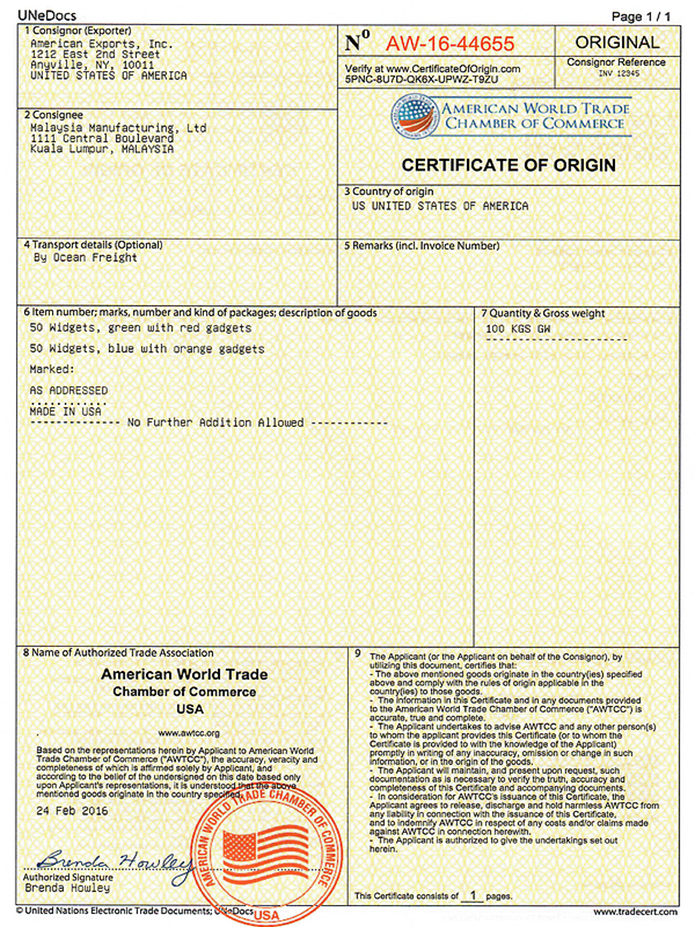
Figure 4: Certificate of Origin
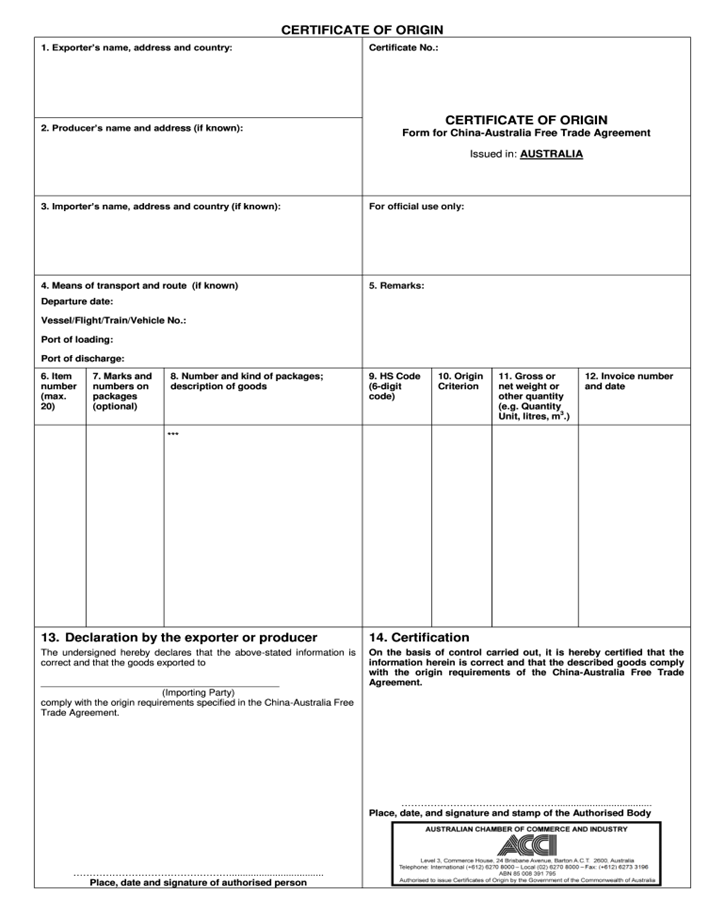
Figure 5: China-Australia Certificate of Origin
Compliance verification
In many countries, Customs operates in a self-assessment environment, where information provided to it is treated in the first instance as true and correct. Underpinning this self-assessment environment are risk management strategies to identify cargo that may require further attention, and a number of compliance management tools including real-time checking of entries and post-entry audits.
Customs’ compliance monitoring may take place at the time of entry, or after the goods are delivered into home consumption. Customs may require an importer to produce supporting information to confirm that the criteria for eligibility for preference rates of duty have been met. This information should be requested from the overseas manufacturer.
If Customs subsequently finds that the goods do not meet the relevant terms and conditions to qualify for preferential treatment, they will demand any duty short-paid and may impose penalties. Additional action may be taken where fraud is involved, including prosecution.
6. Case Study: The Australia - United States Free Trade Agreement
Case study: the Australia-United States Free Trade AgreementTo qualify as an originating good, and therefore become eligible for preferential tariff treatment into the US under the AUSFTA, the product must be:
The change of tariff classification concept used in the Annexes means that inputs sourced from outside Australia or the US must not come from the same HS Code as the goods in question, and not from a defined set of related HS codes. This ensures that sufficient transformation has occurred within Australia to justify the claim that the product is a legitimate product of Australia. Verifying the origin of goods imported under the AUSFTAArticle 5.12.1 of the Agreement allows a claim for preferential treatment based on the importer's knowledge or on information in the importer's possession that the good qualifies as an originating good, although the importer may be required to submit, on request, a statement setting forth the reasons that the good so qualifies. This may include relevant cost and manufacturing information. Article 5.14 requires that importers maintain, for up to 5 years after the date of importation, records relating to the importation of the relevant goods, and may require that an importer provide, on request, records necessary to demonstrate that a good qualifies as an originating good. Finally, in Article 5.15:
A Party may deny preferential tariff treatment to a good where the importer, exporter, or producer fails to provide information that the Party requests in a verification conducted in accordance with paragraph 1 demonstrating that the good is an originating good. When a customs entry states that a US preference rate of duty applies, this will be taken to indicate that the importer of the goods possesses information, or knowledge as required in Article 5.12.1, that this declaration is correct. The criteria for eligibility are set out in Division 1C of Part VIII of the Australian Customs Act 1901. A Certificate of Origin is not required. The information can be in any form the manufacturer wishes to provide, as long as it shows that the imported good meets the rules of origin requirements of AUSFTA.
|
7. Bibliography
■ Australia-United States Free Trade Agreement, Guide to Navigating the AUSFTA Tariff Schedules and Rules of Origin Annexes, http://www.dfat.gov.au/trade/negotiations/us_fta/final-text/chapter_5.html
■ Cadot, Olivier (Editor), Estevadeordal, Antoni (Editor), Suwa-Eisenmann, Akiko (Editor), Verdier, Thierry (Editor) 2006, Rules of Origin in Regional Trade Agreements, https://mddb.apec.org/documents/2006/cti/fta-rta/06_fta-rta1_005.pdf
■ International Chamber of Commerce, Origin, http://www.iccwbo.org/wcf/id2808/index.html
■ Islam M.R., 1999, International Trade Law, LBC Information Services, Sydney.
■ Pryles, Waincymer and Davies 2004, International Trade Law, Lawbook Co, Sydney.
■ TAXUD EU and Non-Preferential Origin, http://ec.europa.eu/taxation_customs/customs/customs_duties/rules_origin/non-preferential/index_en.htm
■ TAXUD EU and Preferential Origin, http://ec.europa.eu/taxation_customs/customs/customs_duties/rules_origin/preferential/index_en.htm
■ United Nations Centre for Trade and Development 2004, Forum on Multilateralism and Regionalism: The new interface, Geneva. Available on UNCTAD website: http://www.unctad.org/en/docs//tdl369_en.pdf
■ United States Department of Agriculture Economic Research Service 2003, Multilateralism and Regionalism: Dual Strategies for Trade Reform, Washington DC. Available on the Economic Research Service's website: http://www.ers.usda.gov/Amberwaves/September03/Features/Multilateralism.html
■ World Customs Organization, 1999, Revised Kyoto Convention on the simplification and harmonisation of Customs procedures, General Annex, WCO Brussels.
■ World Customs Organization, 1999, Revised Kyoto Convention on the simplification and harmonisation of Customs procedures, Specific Annex K, WCO Brussels.
■ World Trade Organization, 1994, Agreement on Rules of Origin, Geneva.
■ World Trade Organization, 1994, Marrakesh Agreement Establishing the World Trade Organisation, Geneva.