Study Guide
| เว็บไซต์: | Centre for Customs and Excise Studies |
| รายวิชา: | DHL International Customs Program 2026: Cohort 1 |
| Book: | Study Guide |
| Printed by: | Guest user |
| Date: | วันเสาร์, 17 ตุลาคม 2026, 3:32AM |
สารบัญ
- 1. Introduction
- 2. Part 1: The Harmonized System
- 3. Harmonized System (HS) Convention
- 3.1. Significant articles
- 3.2. Article 3: Obligations of Contracting Parties
- 3.3. Article 4: Partial application by developing countries, and Article 5: Technical assistance for developing countries
- 3.4. Article 6: Harmonized System Committee (see also the section: Harmonized System Committee (HSC))
- 3.5. Article 7: Functions of the Committee
- 3.6. Article 10: Settlement of disputes
- 4. Harmonized System Nomenclature
- 5. Harmonized System Committee (HSC)
- 6. Harmonized System Explanatory Notes (HSEN)
- 7. Harmonized System Sixth Review Changes
- 8. Part 2: The Classification structure
- 9. Heading list
- 10. Structure of a chapter - legal notes
- 11. Structure of a chapter – Headings, subheadings and the dash system
- 12. Part 3: The classification process
- 13. Identifying the goods
- 14. The Interpretation Rules
- 14.1. Interpretation Rule 1
- 14.2. Part 1: Titles are for ease of reference only
- 14.3. Part 2: Classify by the terms of headings and legal notes
- 14.4. Case Study Continued
- 14.5. Part 3: Regard is to be had to the other Interpretation Rules
- 14.6. Interpretation Rule 6
- 14.7. Part 1: Classify by the terms of subheadings and subheading notes
- 14.8. Part 2: Mutatis mutandis to the Interpretation Rules
- 14.9. Part 3: Only compare subheadings at the same level
- 14.10. Part 4: Relative legal notes apply, unless the context otherwise requires
- 14.11. Case Study Continued
- 14.12. Interpretation Rules 2 to 5
- 14.13. Interpretation Rule 2
- 14.14. Interpretation Rule 2(a)
- 14.15. GIR Rule 2(a) Case study: Toyota’s HS misclassification in Thailand
- 14.16. Interpretation Rule 2(b)
- 14.17. Summary
- 14.18. Interpretation Rule 3
- 14.19. Introduction
- 14.20. Interpretation Rule 3(a): the most specific description
- 14.21. Interpretation Rule 3(b): essential character
- 14.22. Interpretation Rule 3(c): last in numerical order
- 14.23. Summary
- 14.24. Interpretation Rule 4
- 14.25. Electricity and the use of GIR 4
- 14.26. Interpretation Rule 5
- 14.27. Interpretation Rule 5(a): specially shaped or fitted cases
- 14.28. Interpretation Rule 5(b): packing materials and packing containers
- 14.29. Harmonized System Explanatory Notes
- 15. Part 4: The classification of parts and accessories
- 15.1. Distinction between parts and accessories
- 15.2. Key rules
- 15.3. What is a part, what is an accessory?
- 15.4. Parts and accessories: examples compared
- 15.5. Classification of parts and accessories
- 15.6. Identification
- 15.7. Parts Classified with the complete good
- 15.8. Provision 1: classification by virtue of the terms of the heading
- 15.9. Provision 2: classification by virtue of a legal note provision
- 15.10. Parts not classified with the complete good
- 15.11. Parts described in their own right within the terms of a heading
- 15.12. Generic parts headings
- 15.13. Parts described within headings that cover parts for complete goods that are classified within a particular chapter
- 15.14. Parts classified within the materials related areas of the Nomenclature
- 15.15. Summary
- 15.16. Legal note provisions: Note 2 to Section XV and Note 2 to Section XVI
- 15.17. Note 2 to Section XV — parts of general use
- 15.18. Note 2 to Section XVI — parts of machinery (Chapters 84 and 85)
- 15.19. Summary of Note 2
- 15.20. Parts of parts
- 15.21. How to apply the rule
1. Introduction
Welcome to the Principles of Tariff Classification. The aim of this session is to:
|
✓ |
Introduce you to the body that is responsible for the international nomenclature on which most tariff documents are based |
|
✓ |
Provide you with an overview of the structure of the international nomenclature |
|
✓ |
Provide you with an introduction to the classification rules that are contained within the international nomenclature. |
The study guide is in four parts.
|
Part 1 |
The Harmonized System Part 1 provides an overview of the international classification order on which nearly all national or common (in the case of a Customs union) tariff documents are based. It covers the following topics: ■ The Harmonized System ■ History of the nomenclature ■ Development of the Harmonized System ■ Harmonized System (HS) Convention ■ Harmonized System Nomenclature ■ Harmonized System Committee (HSC) ■ Review Sub-Committee (RSC) ■ The Secretariat ■ Harmonized System Explanatory Notes (HSEN) ■ Sixth review |
|
Part 2 |
The Classification Structure Part 2 covers the structure of the headings, subheadings and legal notes, which are the components that make up the Harmonized System Nomenclature. Part 2 contains the following topics: ■ Sections and chapters of the nomenclature ■ Heading list ■ Structure of a chapter – Legal notes ■ Structure of a chapter – Headings/subheadings ■ Significance of the dashes |
|
Part 3 |
The Classification Process Part 3 explains the classification process. It focuses on the identification of goods and the Interpretation Rules by which goods are classified under the Harmonized System. Part 3 contains the following topics: ■ Identification of Goods ■ Interpretation Rule 1 ■ Interpretation Rule 6 ■ Interpretation Rules 2 to 5 |
|
Part 4 |
The classification of parts and accessories Part 4 explains the classification of parts and accessories. It concentrates on distinguishing parts from accessories and on the classification principles and legal note provisions that apply to such goods under the Harmonized System. Part 4 contains the following topics.
Part 4 explains the classification process. It focuses on the identification of goods and the Interpretation Rules by which goods are classified under the Harmonized System. Part 4 contains the following topics: ■ Distinction between Parts and Accessories ■ What is a Part? What is an Accessory? ■ Classification of Parts and Accessories ■ Legal Note Provisions |
2. Part 1: The Harmonized System
Learning objectives
|
✓ |
Describe the purpose, structure, and governance of the Harmonized System |
|
✓ |
Explain the obligations and rights of Contracting Parties under the HS Convention |
|
✓ |
Identify the components of the HS Nomenclature and the role of the Explanatory Notes |
The Harmonized System (HS) is the common name for an international goods classification system called the Harmonized Commodity Description and Coding System. It entered into force on 1 January 1988, under the auspices of the Customs Co-operation Council (renamed the World Customs Organization in 1994), an international customs body located in Brussels.
How the Harmonized System is structured (see also the section: Harmonized System Nomenclature → How an HS code is built)
|
Component |
Description |
|
Chapters (2-digit) |
Broad product category. Chapters are generally groupings of similar or related headings. |
|
Headings (3- and 4-digit) |
The primary level of classification. Headings group related goods together. The first two digits indicate the chapters. |
|
Subheadings (5- and 6- digit) |
Subdivisions of most headings. They give separate treatment or identification to the more commonly traded goods within each heading. |
The essence of the Harmonized System (HS) is to provide the world with a single, internationally standardised six‑digit code that identifies a commodity consistently throughout its economic life. One of the core objectives of the HS is to replace the many different product‑coding systems previously used across commercial sectors, thereby creating a common language for the naming and classification of goods.
A word you will often encounter in the context of international trade is “nomenclature.” In simple terms, a nomenclature is a structured system for naming things in a consistent and organised way. The HS is exactly that: a global nomenclature for goods, designed to ensure that every product can be classified, described, and understood in the same way by Customs administrations, traders, and statistical agencies worldwide.
2.1. Aims of the Harmonized System
The aims of the Harmonized System are to:
|
01 International uniformity Achieve international uniformity in the classification of goods. |
02 Trade statistics Provide for the collection, analysis and comparison of world trade statistics. |
|
03 Common coding system Provide one international system for coding, describing and classifying goods that can be used by freight forwarders, insurance institutions, transport associations, importers and exporters. |
04 Ongoing adaptability Provide an updated document that can be readily amended to respond to technological and environmental protection developments and changes in international trade patterns. |
Unlike its predecessors, which included the Brussels Tariff Nomenclature, which was designed solely for tariff purposes, and the Customs Cooperation Council Nomenclature, the Harmonized System was conceived as a genuinely multi-purpose nomenclature. Its authors intended it to provide a common structural basis for a wide range of regulatory, statistical, and commercial functions, including:
|
01 Customs tariff determination ensuring goods are classified correctly so that duties and taxes are accurately assessed. |
02 International trade statistics providing a consistent global framework for collecting and analyzing trade data used in policymaking and economic planning. |
|
03 Regulatory compliance supporting the application of trade-related laws, including environmental, health, and phytosanitary controls. |
04 Rules of origin helping determine whether goods qualify for preferential duty rates under trade agreements or meet national anti-dumping requirements. |
|
05 Trade negotiations offering a standardized reference point for resolving classification disputes and structuring tariff commitments. |
06 WTO tariff schedules forming the basis for countries’ bound tariff commitments under the multilateral trading system. |
Despite the central importance of the Harmonized System in international trade, a lack of understanding of its structure and legal rules continues to result in frequent errors. Misclassification is widely recognized as a major compliance risk and is consistently identified as one of the top causes of customs delays, declaration queries, and post clearance adjustments worldwide.
|
|
Example: Misclassification as a major compliance risk The Auditor General of Canada reported that roughly 20% of goods imported during the 2015–16 fiscal year were misclassified — a reminder that even well-resourced administrations face significant challenges in this area. For logistics providers, these errors have obvious consequences: delays, added costs, and the potential erosion of reputational integrity and client trust. |
Although the Harmonized System is used as a basis for the compilation of trade statistics, its current prime function is to form the basis for national tariff documents. About 80 per cent of users of the Harmonized System may be characterized as developing or in transition to a market economy. Many of these countries depend heavily on customs duties for national revenue, so goods need to be properly classified to ensure correct revenue collection. Today, the issue of correct tariff classification has taken on even greater significance due to the rapid growth of preferential and free trade agreements. Under such agreements, only certain goods and not others qualify for reduced or zero‑per‑cent duty rates making accurate HS classification essential for determining eligibility. For businesses trading across borders, this clarity - and the ability to classify goods correctly - is vital for ensuring compliance, avoiding delays, and applying the correct duties and trade preferences.
The Harmonized System at a glance
|
200+ Countries plus the EU using the HS |
98% of world trade covered |
163 Contracting Parties to the HS Convention |
The Harmonized System forms the basis of the customs tariffs of more than 200 countries and the European Union (EU). This represents some 98 per cent of world trade. On 16 July 2025, Jamaica deposited its instrument of accession and became the 163rd Contracting Party to the Harmonized System Convention.
2.2. History of the nomenclature
Early efforts (pre-1945)
Efforts to simplify and standardize tariff classification began in the early twentieth century, including technical work undertaken under the auspices of the League of Nations, but these initiatives did not produce a universally adopted international tariff or classification system. Prior to the Second World War, no formal global nomenclature existed.
Post-war renewal: the 1949 Brussels draft
Following the war, the need for economic reconstruction and the rapid expansion of international trade renewed interest in creating a standardized Customs tariff. In 1949, in Brussels, the European Customs Union Study Group prepared a draft tariff nomenclature intended to provide a common basis for classifying goods in international trade.
The three Brussels Conventions of 15 December 1950
The broad acceptance of this draft led to further development, and on 15 December 1950, three international conventions were signed in Brussels:
|
01 Brussels Tariff Nomenclature Established the Brussels Tariff Nomenclature (BTN) as a common framework for the classification of goods. |
02 Customs valuation Set out an international convention concerning the valuation of goods for Customs purposes. |
03 Customs Co-operation Council Established the Customs Co-operation Council (CCC), the organization that would later become the World Customs Organization (WCO). |
From BTN to CCCN
The BTN evolved into the Customs Co-operation Council Nomenclature (CCCN), which became the core structural foundation for the next generation of international classification systems.
As global trade expanded and diversified, the CCCN was increasingly supplemented by other classification systems. Some drew on the CCCN, others were independent:
|
Relationship to CCCN |
Example system |
Note |
|
Based on CCCN |
Japanese Customs Tariff |
Built using CCCN as its structural basis. |
|
Independent |
United States Tariff Schedule |
Developed separately from the CCCN framework. |
|
Independent |
Standard Transportation Commodity Code |
Developed separately from the CCCN framework. |
|
Influential |
Standard International Trade Classification (SITC) |
Shaped the emerging need for a more harmonized global system. |
Building the Harmonized System

Recognizing the proliferation of divergent systems and the growing complexity of international trade, the CCC initiated work on a new, universally applicable nomenclature. The Harmonized Commodity Description and Coding System (Harmonized System or HS) drew on several sources:
|
01 The CCCN , which provided the structural core of the new nomenclature. |
02 The Standard International Trade Classification (SITC) , which contributed structural and statistical elements. |
03 Various national and sector‑specific classification systems , which provided additional input and practical detail. |
From draft to global standard
By May 1983, after 13 years of technical work, the Harmonized System Committee and its Working Party completed the draft HS. The Customs Co‑operation Council approved the Harmonized System Convention and opened it for signature in June 1983. The HS entered into force in 1988 and has since become the global standard for the classification of goods in international trade.
3. Harmonized System (HS) Convention
The HS Convention consists of 20 Articles and an Annex. The Articles govern the procedures for running the Convention. The Annex has more relevance for everyday use by customs administrations.
The two parts of the HS Convention
|
Part |
What it contains |
|
20 Articles |
The procedures for running the Convention. |
|
Annex (the Nomenclature) |
Headings and subheadings (goods' descriptions and numerical codes), legal notes, and rules for the classification of goods. |
While it is not the intention to examine the entire 20 Articles, it is worth having a brief look at a few.
3.2. Article 3: Obligations of Contracting Parties
On signing the Convention, Contracting Parties are bound to adopt the HS as-is. The table below summarizes what is and is not permitted.
|
Area |
Rule |
|
Texts & codes |
May not be amended in any way that changes scope or order of headings/subheadings |
|
Domestic law amendments |
Permitted only where necessary to give effect to HS. It must not affect scope |
|
Additional subdivisions |
Allowed in its domestic tariff for goods that are not given separate status in the HS Nomenclature, but only below the existing HS subheading level (e.g. 7th/8th digit) |
|
HS itself |
Cannot be changed by a Contracting Party — only the HS Committee may amend |
3.3. Article 4: Partial application by developing countries, and Article 5: Technical assistance for developing countries
These articles recognize that developing countries may face practical limitations in adopting the full HS Nomenclature at once. They provide flexibility and support.
|
Article |
Provision |
|
Article 4 |
Developing countries may initially participate at 4-digit level only |
|
Article 5 |
Developed country Contracting Parties must provide technical assistance when able |
These provisions were incorporated in the Convention because research indicated that practical domestic limitations in many developing countries would restrict their capacity to absorb all the details of the HS Nomenclature at once. In such instances, it is considered unreasonable to require such countries to fully commit themselves to use the complete system at the initial application phase. Therefore, they may decline, at least initially, to apply all or some of the subheadings and yet fulfill the obligations arising out of Article 3.
Minimum requirements for developing-country signatories
|
01 All 4-digit headings Apply every 4-digit heading in the Nomenclature, at minimum. |
02 All level 4 texts Apply all Section Notes, Chapter Notes, and Interpretation Rules 1 to 5. |
|
03 Best-efforts undertaking Commit to making best efforts toward applying the full system. There is no obligation to complete this within a fixed period. |
04 Five-year target Aim to apply the complete System within five years of the Convention entering into force for them. |
Partial application does not limit a country to the 4-digit headings only. A country may elect to use only some of the 5- and 6-digit subheadings, but those that do are obliged to apply the complete hierarchical 5-digit subheading structure within a particular 4-digit heading, and/or the complete hierarchical 6-digit subheading structure within a particular 5-digit subheading. Developing countries may also create their own domestic subheadings below the international 6-digit level.
|
Note: Where a developing country chooses not to apply a 5-digit subheading, that digit must be designated '0'. Where a 6-digit subheading is not applied, those digits must be designated '00'. |
By virtue of Article 5, contracting parties that are developed countries are obliged — when they are so able — to provide technical assistance to developing countries. This assistance may be in the form of training of personnel, translating local tariff systems into HS format and maintaining an up to date document.
3.4. Article 6: Harmonized System Committee (see also the section: Harmonized System Committee (HSC))
Article 6 provides for the establishment of the Harmonized System Committee and its associated sub-committees or working parties, under the auspices of the World Customs Organization (WCO). Under this article the Harmonized System Committee (HSC) administers the general running of the HS, while the Review Sub-Committee conducts a systematic review of the structure of the Nomenclature on a regular basis, to ensure that the document keeps up to date in respect of technological development and responds to changes in trading patterns.
3.5. Article 7: Functions of the Committee
Article 7 authorizes the Committee to:
· Amend HS documents
· Prepare and amend the Harmonized System Explanatory Notes
· Prepare and amend the Compendium of Classification Opinions
3.6. Article 10: Settlement of disputes
Article 10 sets out a four-step escalation path for resolving classification disputes between Contracting Parties, beginning with direct negotiation between administrations, escalating to the HSC Secretariat, then to the Harmonized System Committee, and finally to the Council as a last resort. This process is applied in practice by the HSC and is covered in detail under Settlement of classification disputes in the Harmonized System Committee (HSC) section below.
|
Note: Classification Divergences Where classification divergences are brought directly to the attention of the Secretariat, the facts will be confirmed by consulting the Member administration(s) concerned. If it is found that there is a divergence of opinion, the matter may be referred to the Committee in accordance with the normal procedure. |
4. Harmonized System Nomenclature
The HS Nomenclature is the Annex to the Convention. Under Article 1 of the Convention, the Nomenclature comprises four components:
· Heading: 4-digit classifications and their goods descriptions
· Subheadings: specific 5- and 6-digit classifications and their goods descriptions
· Legal notes: Notes applicable to headings and subheadings
· Interpretation or Interpretative rules: rules for the classification of goods
The headings and subheadings of the HS are grouped into 97 two digit chapters (01–97), which are further arranged into 21 sections. The legal notes are located at the beginning of nearly all the chapters and some of the sections.
How HS headings were derived from the CCCN
During HS development in the 1970 and early 80s, the CCCN headings were revised, amended and updated in line with international trading patterns, technological developments as well as broader regulatory and statistical needs such as improving visibility of agricultural and fisheries products and distinguishing emerging industrial goods (e.g. plastics, electronics) more clearly.
|
Goods relegated ↓ Under the CCCN: Described within their own headings. Under the HS: Moved into residual headings. Why: Overtaken by new technology; no longer a major contributor to reporting patterns within international trade. |
|
Goods elevated ↑ Under the CCCN: Usually classified within residual headings. Under the HS: Given their own specific descriptive heading or subheading. Why: Became a more regular feature within international trading circles. |
Subheadings: a new feature of the HS
Subheadings are a feature of the HS that was absent in the CCCN. During HS development, the structure of these subheadings was aligned with the third revision of the Standard International Trade Classification (SITC), a statistical classification maintained by the United Nations. It is important to note that although the SITC is related to the HS for statistical comparability, it remains a separate and distinct system and is not used by customs administrations for tariff classification purposes.
The subheadings also consider the requirements of those bodies that were involved in the development of the HS. Apart from the already mentioned US and Japanese Customs departments and the International Air Transport Association, others included the Customs administrations of Australia, Canada, the Customs administrations of countries that are members of the European Union, the Latin America Free Trade Association, the International Chamber of Commerce, the International Chamber of Shipping, and the International Union of Railways.
The scale of the HS
The subheadings have made the HS a more detailed and descriptive document than its predecessor. The CCCN had about 1,200 headings; the HS retains a similar number of headings but adds nearly 4,000 subheadings on top, meaning more goods are described in the legal texts.
More descriptions mean more goods being classified by Interpretation Rules 1 and 6 (discussed in Part 3), the more straightforward of the classification rules. This leads to greater accuracy in the classification of goods and more accurate data recording for statistical purposes.
|
Note: 2022 version The Nomenclature comprises some 5,000 groups of goods identified by a 6-digit code. We will go into greater detail of the structure of the Nomenclature in Part 2. |
From customs documents to multipurpose trading document
The involvement of many non-Customs authorities emphasizes an important feature of the HS — it is a multipurpose document. The CCCN was a customs document; the HS is a document for the overall movement of goods.
|
CCCN |
HS |
|
Essentially a customs document. |
A document for the overall movement of goods. |
|
Developed by customs administrations, for customs purposes. (e.g. for the determination of import duties, taxes and quotas, etc.) |
A trading document for use by all parties involved in the movement of goods. |
|
Single audience: customs. |
Customs administrations use it as the basis for their national tariff documents and it also supports the needs of other border agencies involved in regulating cross border trade. |
4.1. How a HS code is built
A specimen Nomenclature page is provided below that shows an example of legal notes and classification numbers/descriptions for HS Chapter 18 – Cocoa and Cocoa Preparations. At this point, a useful rule of thumb is that the fewer digits used, the more general the product grouping; the more digits used, the more specific the product description is – working from the 2‑digit chapter level through to the 6‑digit subheading level.
HS Nomenclature - specimen page
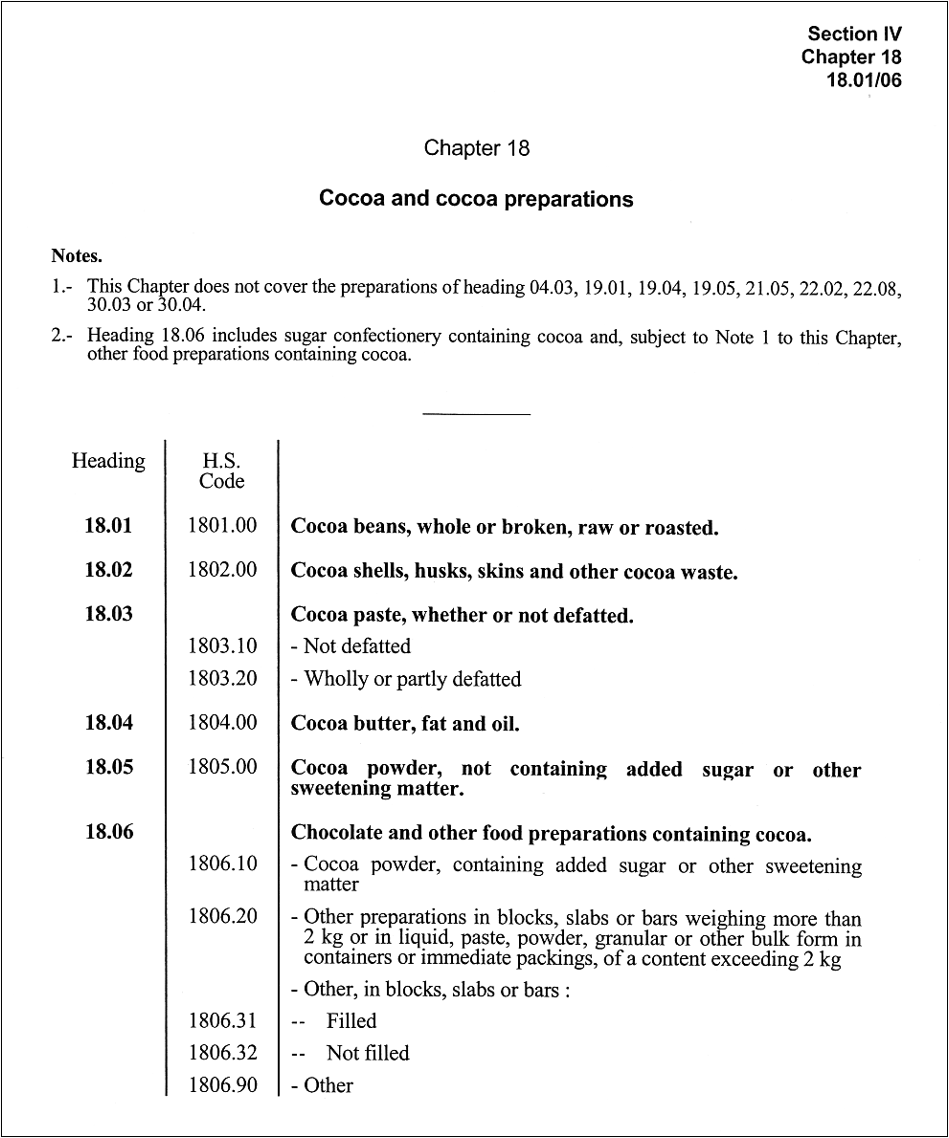
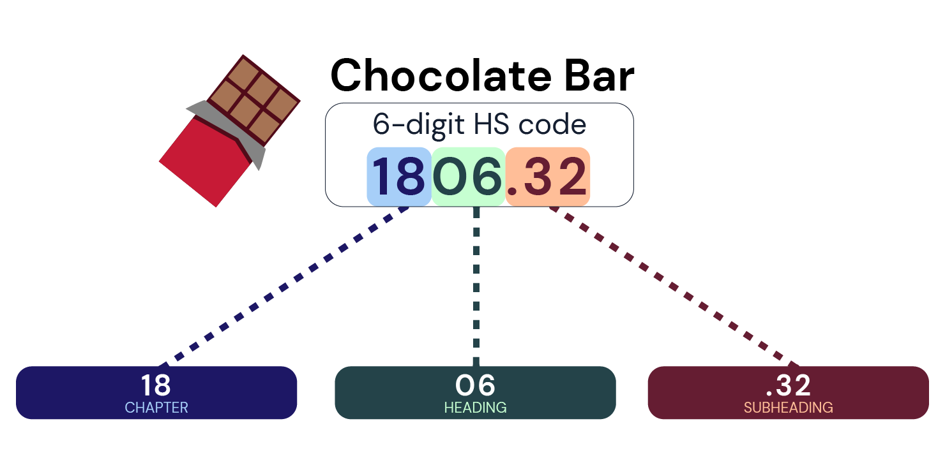
The above diagram illustrates how a product’s Harmonized System (HS) code is built. The six-digit HS code is organized into three levels:
|
1806.32 |
Chapter |
First two digits — broad product category (here: Cocoa and Cocoa Preparations). |
|
1806.32 |
Heading |
Next two digits — more specific product grouping within the chapter. |
|
1806.32 |
Subheading |
Final two digits — the most detailed international classification. |
In this example, 1806.32 identifies a chocolate bar. Because the HS subheading level differentiates between plain chocolate and filled chocolate, this structure allows Customs administrations to distinguish unfilled bars from those containing fillings such as nuts, caramel, or creams.
5. Harmonized System Committee (HSC)
Article 6 of the Convention provides for the establishment of a committee and sub-committees to administer the HS. Of these the Harmonized System Committee is the prime administrative body, and it is the Committee with which national customs administrations have the most contact.
The HSC is responsible for the uniform interpretation and application of the HS. To achieve this, it may take any measures it sees fit, or it may make proposals to the Customs Co-operation Council.
Who sits on the Committee and who can vote
|
Who can attend |
Voting rights |
|
Contracting Parties |
One vote each. |
|
Contracting Parties that are EU members |
One single vote between them, cast in the name of the European Union. |
|
WCO members that are not Contracting Parties |
Attend as observers. May take part in discussions but may not vote. |
5.1. Responsibilities of the Harmonized System Committee
1. Ensuring uniform interpretation and application of the HS
The Harmonized System Committee takes measures and makes proposals to the Council to ensure the uniform interpretation and application of the HS. It carries out this responsibility through three main activities.
|
01 Guidance documents Prepares Explanatory Notes, Classification Opinions, and individual formal advice as a guide to the interpretation of the HS. |
02 Recommendations Prepares recommendations that secure uniformity and transparency in the HS's interpretation and application. |
03 Information sharing Collates and circulates information on the application and maintenance of the HS. |
5.2. 2. Settlement of classification disputes
The Harmonized System Committee is also the arbitrator of classification disputes between Contracting Parties. Disputes follow an escalation path below.
|
Step 1 — Direct negotiation between parties |
Parties are encouraged to reach agreement among themselves in the first instance. Members that resolve issues in this manner should advise the HSC Secretariat accordingly.
|
Step 2 — Referral to the Committee |
Disputes that cannot be settled by direct negotiation are referred to the Committee for adjudication at its bi-annual meetings. After examination, the Committee makes recommendations for their solution.
|
Step 3 — Referral to the Council (rare) |
In the unlikely situation that the Committee is unable to settle a dispute, it may refer the matter to the Council for a recommendation.
|
Step 4 — Right of appeal |
A member unsatisfied with the result may appeal by lodging a reservation with the HSC Secretariat, on or before the last day of the two full subsequent calendar months after the Committee meeting ends.
5.3. 3. Continuous updating of the HS
Unlike its predecessor, the HS has a built-in system of continual amendment. Goods that are traded change constantly, whether as the result of varying demand or as the result of the progress of technology. A product classification nomenclature is of use only if its structure — the headings, subheadings and legal notes — keeps in step with technical progress.
Amendments can take two forms, depending on whether the scope of a heading needs to change.
Two ways to amend the HS
|
Amend Explanatory Notes only |
Amend the legal texts |
|
Aid to interpretation; the official interpretation of the HS. |
The legal texts themselves: headings, subheadings, and legal notes. |
|
Sometimes enough on its own to achieve the desired objective. |
Required where the scope of a heading or subheading needs to change. |
|
Does NOT alter the scope of the headings or subheadings concerned. |
DOES alter the scope of the headings or subheadings concerned. |
To keep pace with change, the HS runs on a five-year review cycle. Review cycles may look at the Nomenclature as a whole, or address particular sectors — heavy machinery, computer equipment, renewable energy power generation, rare earth elements and so on. The process is intensive, involving detailed submissions and consultation between the HSC and its sub-committees.
Since its inception the HS has undergone six major reviews. The Sixth Review was implemented on 1 January 2022. Work on the Seventh Review is currently underway, and it is scheduled for implementation on 1 January 2028. The cycle was extended from five to six years because of the COVID-19 pandemic.
HS 2028 amendments
The HS 2028 Review introduces significant structural changes across a wide range of product areas. Two themes stand out:
|
01 Public health visibility New and revised subheadings make critical health emergency supplies easier to identify in the nomenclature. |
02 Environment and circular economy Amendments aligned with the Basel, Rotterdam, and Stockholm (BRS) Conventions sharpen distinctions for hazardous waste and support sustainable materials management. |
Public health visibility
A major focus of this edition is the improvement of public health visibility within the nomenclature. New and revised subheadings enhance the identification of critical health emergency supplies, including ambulances, PPE (Personal Protective Equipment), ventilators, diagnostic devices, and other essential medical equipment.
|
|
Example: Vaccine structure overhaul
Splitting human vaccines into their own heading improves clarity and supports global supply-chain control and health-response mechanisms. |
Environment and circular economy
In addition to public health, HS 2028 places strong emphasis on environmental protection and the circular economy (i.e. an economic model that keeps materials and products in use for as long as possible through reuse, repair, recycling and reduced waste). Amendments aligned with the Basel, Rotterdam and Stockholm (BRS) Conventions introduce clearer distinctions for hazardous plastic and electronic waste, waste requiring prior informed consent, and other waste streams.
|
|
Example: e-waste under heading 85.49 New and revised subheadings under heading 85.49 now differentiate between electrical and electronic waste containing hazardous components and other e-waste, reflecting Basel Convention controls on transboundary and traceability movements of such materials. Further changes improve transparency for plastic products, including single use items, supporting pollution reduction policies and sustainable materials management. |
Correlation Tables Between HS Versions
Not all countries implement the same edition of the Harmonized System at the same time, owing to factors such as legislative cycles, IT system readiness and capacity constraints in some administrations, particularly in developing economies. When two trading partners use different HS versions (e.g., HS 2017 vs HS 2022), the same product may appear under different headings or subheadings. This can create confusion, inconsistent declarations, and misclassification risks.
What correlation tables do
The World Customs Organization (WCO) publishes official correlation tables for each HS revision cycle. They show:
|
01 Structural changes Where headings or subheadings have been split, merged, deleted, or renumbered. |
02 Code correspondence How a code in an older HS edition corresponds to a code in the new edition. |
03 Change type Whether changes are structural (affecting classification) or editorial (no change in scope). |
Correlation tables are advisory, not legally binding, but they are essential tools for ensuring continuity and accuracy during transition periods.
|
|
Example 1: Drone (HS 2017 → HS 2022) A Jamaican exporter ships a consumer drone (unmanned aerial vehicle) to Dominica. Both states are CARICOM members, but while the CARICOM Common External Tariff (CET) is officially based on HS 2022, several member states, including Dominica, have not yet transitioned from HS 2017. Exporter A (Jamaica — HS 2022) Jamaica uses HS 2022. The drone is correctly classified as 8806.22 (unmanned aircraft with a maximum take-off weight exceeding 250 g but not exceeding 7 kg). This code appears on the commercial invoice, airway bill, and CARICOM certificate of origin. Importer B (Dominica — HS 2017) Dominica still uses HS 2017. Heading 88.06 does not exist in that edition, so the same drone must be classified under a code that was available at the time. Two options are defensible: 8802.20 (aeroplanes and other aircraft, unladen weight not exceeding 2,000 kg), or 8525.80 (television cameras, digital cameras and video camera recorders), if the drone’s camera function is considered primary. The correct choice depends on how Dominica’s customs authority interprets the product’s essential character. Where importers may get caught out
Quick comparison
The real issue here is HS edition misalignment, not an error by either party. WCO correlation tables allow the importer to identify the correct HS 2017 successor code and resolve the mismatch at clearance. |
||||||||||||
|
|
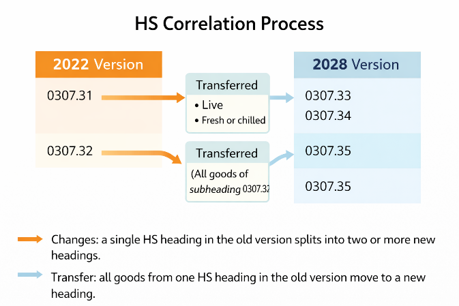
Example 2: Mussels (HS 2022 → HS 2028) Under HS 2022, subheading 0307.31 covers mussels (Mytilus spp., Perna spp.) that are live, fresh or chilled, while 0307.32 covers frozen mussels. In HS 2028, these are reorganized:
This shows how a single subheading in one HS edition can split into multiple new subheadings in the next, reflecting finer distinctions in product condition.
This example shows how HS 2022 subheadings for mussels (live, fresh/chilled, frozen) are reorganized in HS 2028. Subheading 0307.31 (live, fresh or chilled) splits into two new subheadings (0307.33 and 0307.34), while subheading 0307.32 (frozen) transfers entirely to 0307.35. This illustrates how correlation tables track splits, transfers and structural changes between HS editions. |
|
Key point Correlation tables help explain why a supplier’s HS code may differ from the importing country’s tariff and why DHL staff must always classify using the HS version in force in the country of importation. |
5.4. 4. Administration and maintenance of general HS matters
In addition to the technical aspects of the HS Nomenclature, the Harmonized System Committee also examines general issues and questions that are not directly related to the HS Nomenclature but rather aim toward the uniform application and maintenance of the HS.
Such issues/questions include:
|
01 Usage surveys Surveys to assess how HS documents such as the Explanatory Notes are being used. |
02 Transparency surveys Surveys to assess how widely HSC classification decisions are applied, gauging the transparency of decision-making. |
|
03 Publishing decisions Using the WCO website to publish classification decisions and disseminate information. |
04 Inter-committee work Co-operation with bodies such as the Technical Committee on Rules of Origin on HS-aligned rules of origin. |
|
05 HS training The application and delivery of HS training. |
|
5.5. Review Sub-Committee (RSC)
In line with the principle of continuous amendment, the Review Sub-Committee is responsible for the systematic review of the Nomenclature on an ongoing basis. It also assists the HSC to ensure that the HS is kept up to date.
Beyond reviewing the HS itself, the Review Sub-Committee prepares any consequential amendments to the Explanatory Notes for the HSC to consider.
|
Note: The Review Sub-Committee operates by consensus. If consensus cannot be reached on a particular issue, the differing views (together with their rationales) are forwarded to the Harmonized System Committee. |
The secretariat
Because the various committees meet at most twice a year, there needs to be a means by which HS matters are continually processed. This is the role of the WCO Secretariat, specifically, the Nomenclature and Classification Sub-Directorate of the Policy and Standard Directorate, which handles Nomenclature and classification matters.
It performs the secretarial work in connection with meetings of the Committee and sub-committees: circulating communications to delegates concerning items on the agenda, preparing working documents, taking on the function of scribe, and drawing up meeting reports.
6. Harmonized System Explanatory Notes (HSEN)
The HSC writes and publishes several publications that complement the legal text of the Harmonized System Nomenclature. Of these the HS Explanatory Notes are the largest and most important. Although they do not form an integral part of the HS Nomenclature, they are the official interpretation of the HS structure and follow the systematic order of the HS chapters.
The 2022 edition of the Explanatory Notes comprises five volumes.
What the Explanatory Notes provide
|
01 Scope of headings Commentary on what each heading (and where relevant, subheading) covers. |
02 Meaning of legal notes Commentary on what the legal notes mean and how to apply them. |
03 Meaning of Rules Commentary on what each Interpretation Rule means and how to apply it. |
|
04 Included / excluded products Lists the main products covered by each heading and those that are excluded. |
05 Technical descriptions Describes the appearance, characteristics and uses of goods. |
06 Identifying goods Provides guidance for identifying goods in trade. |
How each chapter of the Explanatory Notes is laid out
|
Order |
What appears |
|
1 |
The chapter title (reproduced). |
|
2 |
The legal notes, with any explanation. |
|
3 |
The legal text of the heading, together with any subheadings. |
|
4 |
The corresponding explanations. |
|
Note: Every heading in the HS has a corresponding Explanatory Note. Where Explanatory Notes also exist for subheadings, a (+) sign appears after the text of the heading. |
7. Harmonized System Sixth Review Changes
The HSC implemented the Sixth Review on 1 January 2022. Some 350 changes were made during the Sixth Review; major features include the recognition of new product streams and the addressing of environmental and social issues of global concern.
New headings include:
|
Heading |
Goods covered |
|
03.09 |
Flour, meals and pellets of fish, crustaceans, molluscs and other aquatic invertebrates, fit for human consumption. |
|
24.04 |
Products containing tobacco, reconstituted tobacco, nicotine, or tobacco or nicotine substitutes, intended for inhalation without combustion; other nicotine-containing products intended for the intake of nicotine into the human body. |
|
84.85 |
Machines for additive manufacturing, commonly referred to as 3D printers. |
|
85.24 |
Flat panel display modules. |
|
85.49 |
Electrical and electronic waste and scrap. |
|
88.06 |
Unmanned aircraft, commonly referred to as drones. |
New subheadings include:
|
Heading |
Goods covered |
|
03.09 |
Flour, meals and pellets of fish, crustaceans, molluscs and other aquatic invertebrates, fit for human consumption. |
|
24.04 |
Products containing tobacco, reconstituted tobacco, nicotine, or tobacco or nicotine substitutes, intended for inhalation without combustion; other nicotine-containing products intended for the intake of nicotine into the human body. |
|
84.85 |
Machines for additive manufacturing, commonly referred to as 3D printers. |
|
85.24 |
Flat panel display modules. |
|
85.49 |
Electrical and electronic waste and scrap. |
|
88.06 |
Unmanned aircraft, commonly referred to as drones. |
New subheadings include:
|
Subheading |
Goods covered |
|
0410.10 |
Edible insects (separate provision). |
|
0709.52–0709.55 |
Certain mushrooms. |
|
0709.56 |
Truffles. |
|
4403.42 |
Tropical wood teak (separate provision). |
|
4412.41–4412.49 |
Certain types of laminated veneered lumber. |
|
4421.20 |
Coffins. |
|
8428.70 |
Industrial robots. |
|
8543.40 |
Electronic cigarettes and similar personal electric vaporizing devices. |
|
8708.22 |
Front windscreens, rear windows and other windows complying with Subheading Note 1 to Chapter 87. |
|
9406.20 |
Modular building units, of steel. |
New legal notes include:
|
Note |
What it covers |
|
Note 3 to Chapter 3 |
Headings 03.05 to 03.08 do not cover flours, meals and pellets fit for human consumption. They are classified within heading 03.09. |
|
Note 6 to Chapter 4 |
Defines "insects" for heading 04.10: edible non-living insects (whole or in parts, fresh, chilled, frozen, dried, smoked, salted or in brine) and flours and meals of insects, fit for human consumption. Edible non-living insects otherwise prepared or preserved are excluded (generally Section IV). |
|
Note 5 to Chapter 7 |
Heading 07.11 applies to vegetables treated solely to ensure provisional preservation during transport or storage (e.g. sulfur dioxide gas, brine, sulfur water or other preservative solutions), provided they remain unsuitable for immediate consumption. A similar note applies to heading 08.12 for fruit in Chapter 8. |
|
Notes 2 and 3 to Chapter 24 |
Relate to the goods of heading 24.04 and the meaning of "inhalation without combustion". |
|
Note 4 to Section VI |
Where a product fits one or more Section VI headings by name or function and also fits heading 38.27, classify under the name/function heading, and not under 38.27. |
|
Note 15 to Section XI |
Subject to Note 1 to Section XI, textiles and garments incorporating chemical, mechanical or electronic components for additional functionality (built-in or within the fiber or fabric) are classified in their respective Section XI headings, provided they retain the essential character of Section XI goods. |
|
Note 3 to Chapter 58 |
For heading 59.03, defines "textile fabrics laminated with plastics". |
|
Note 6 to Section XVI |
Defines "electrical and electronic waste and scrap". |
|
Note 5 to Chapter 84 |
For heading 84.62, defines "slitting line" and "cut-to-length line" for flat products. |
|
Note 10 to Chapter 84 |
For heading 84.85, defines "additive manufacturing" (3D printing). |
|
Note 5 to Chapter 85 |
For heading 85.17, defines "smartphones". |
|
Note 7 to Chapter 85 |
For heading 85.24, defines "flat panel display modules". |
|
Note 11 to Chapter 85 |
For heading 85.39, defines "light-emitting diode (LED) light sources". |
|
Subheading Note 1 to Chapter 87 |
Describes the vehicle windscreens and windows covered by subheading 8708.22. |
|
Note 1 to Chapter 88 |
For Chapter 88, defines "unmanned aircraft". |
|
Subheading Note 2 to Chapter 88 |
For subheadings 8806.21–8806.24 and 8806.91–8806.94, defines "maximum take-off weight". |
|
Note 6 to Chapter 95 |
For heading 95.08, defines "amusement park rides", "water park amusements" and "fairground amusements". |
|
Note 2 to Chapter 97 |
Restricts the coverage of heading 97.01 in respect of mosaics. |
7.1. Advance Rulings for HS Classification
It should be noted that many Customs administrations offer an Advance Ruling service that provides importers with a time bound, often legally binding decision on the HS classification of a specific product before it is imported. Some countries also issue non-binding “information rulings” or “tariff opinions”.
The concept of advance rulings is embedded in major international trade and customs instruments, including the WCO Revised Kyoto Convention and the WTO Trade Facilitation Agreement.
Why Advance Rulings matter to traders
Advance rulings give traders five concrete advantages:
|
01 Certainty on correct HS code |
02 Predictable duty and tax outcomes |
03 Reduced clearance delays |
|
04 Fewer disputes with Customs |
05 Smoother repeat shipments |
|
Understanding that an advance ruling procedure exists in many jurisdictions is important because customers may:
· already hold a ruling that must be applied to their shipments
· ask staff involved in the shipping process for help interpreting a ruling
· benefit from being advised to obtain one when recurring classification issues arise
|
|
Example: A customer repeatedly ships a specialized electronic sensor. Each shipment runs into the same Customs friction. An advance ruling breaks the cycle.
Key message: Advance rulings are a trade facilitation tool. When used correctly, they reduce friction, improve predictability, and protect manufacturers and exporters from unnecessary disputes. |
8. Part 2: The Classification structure
|
✓ |
Navigate the structure of the Harmonized System Nomenclature using sections, chapters, headings, subheadings, and legal notes |
|
✓ |
Identify goods for classification using samples, descriptive literature, and industry inquiries to locate candidate areas of the Nomenclature |
Part 1 introduced the Harmonized System (HS). Part 2 builds on that foundation and shows you how the Nomenclature is actually used to classify goods. Part 2 covers the classification structure: how sections, chapters, headings, and subheadings fit together, and how legal notes interpret each level.
8.1. Sections and chapters of the Nomenclature
As previously mentioned, the HS contains around 5,000 headings and subheadings, grouped within 97 chapters. Examining every one for each consignment is not practical. To make the document workable, the authors grouped similar goods together: related headings form a chapter, and related chapters form a section. The 97 chapters are divided into 21 sections.
Chapters are generally groupings of similar or related headings. Sections are overall groupings of related chapters. The first step in any classification is to use the section titles to narrow the search to the right area of the Nomenclature.
|
|
A listing of Sections and chapters of the Nomenclature is available in the Study Guide Supplement. |
Section II is titled 'Vegetable Products'. It covers Chapters 6 to 14, all of which deal with vegetable products. For example, Chapter 7 covers edible vegetables, Chapter 8 covers edible fruit and nuts, Chapter 10 covers cereals, and so on. The relationship between sections and chapters provides a useful way into the document, even for users who are not yet familiar with the headings.
|
|
Example: classifying fresh apples To classify fresh apples, the classifier: · examines the 21 sections of the Nomenclature · decides the goods are classified somewhere within Section II, as they are a vegetable product · examines the chapters within Section II · decides if the goods are classified within Chapter 8, as they are edible fruit. |
|
Note: Chapter 77 is not an operating chapter. It contains no goods descriptions, classifications, or legal notes. The chapter resulted from an amalgamation of chapters that previously existed within the CCCN Nomenclature, and the Harmonized System Committee has reserved it for future use. |
8.2. ‘Type’ chapters and ‘Materials’ chapters
The chapters are generally arranged into two broad classes.
|
'Type' chapters |
'Materials' chapters |
|
Also called 'specific description' chapters. The product to be classified is specifically covered or mentioned in its own right within a particular chapter. |
Each chapter deals with a particular material and its products, or related groups of materials or substances and their products. |
|
Headings describe particular or specific machinery or articles. |
Products derived from a particular raw material are listed in the same chapter with that material. |
|
Classifications of similar types of articles are normally grouped together. |
Headings progress from raw materials at the beginning, through intermediate forms, to the finished product at the end. |
|
Prime example: Chapter 84 (machinery and mechanical appliances). |
Prime example: Chapter 39 (plastics and articles thereof). |
|
|
Example ‘Type’ chapter: Chapter 84 (machinery and mechanical appliances)
Why this matters for classifiers If you are looking for the classification of, for example, machine tools for working metal, and you find heading 84.65 (machine tools for working wood or plastics), you may be assured that you are reasonably close to the classification you are looking for. |
|
Note: It is established classification practice to look for an answer within the "type" chapters before considering the "materials" chapters. In other words, classify a product by what it is, rather than by what it is made of. For example, carbon electrodes are specifically mentioned in heading 85.45. They are classified within that heading rather than in the headings of Chapter 68 or Chapter 25, even though those chapters in part cover the material the electrodes are made of. |
9. Heading list
Once the section and chapter list has been used to identify a particular chapter, the next step is to locate the appropriate heading within that chapter.
The Nomenclature itself contains neither a chapter/section list nor a list of headings within each chapter.
However, some administrations, Australia for example, have incorporated heading lists within their national tariff structures. Together with the chapter and section list, the heading lists give classifiers a fast way into a document that otherwise feels overwhelming.
|
|
Example: classifying fresh apples Step 1. Use the chapter/section list to identify the chapter → Chapter 8. Step 2. Examine the headings list for Chapter 8 → fresh apples appear at heading 08.08. A listing of all the headings is available in the Study Guide Supplement. |
10. Structure of a chapter - legal notes
A chapter has several structural components. The first is the legal notes, which appear immediately after the chapter title.
Rule 1 of the General Rules for the Interpretation of the Harmonized System, from now on called the ‘Interpretation Rules’, directs:
|
...for legal purposes, classification shall be determined according to the terms of the headings and any relative Section or Chapter Notes... |
This Rule, together with Interpretation Rule 6, requires that the legal notes be taken into account when applying headings and subheadings. (Interpretation Rules 1 and 6 will be discussed in Part 3.)
Legal notes are also located at the beginning of some sections and are usually referred to as section notes. They interpret the Nomenclature at section level, that is, they apply to all of the chapters that are contained within the boundaries of the particular section.
Some sections have legal notes, as do all chapters except 50, 53 and 81.
What legal notes do
Legal notes interpret legislation at the section, chapter, heading and subheading level. They:
|
01 Give direction Direct goods into or out of particular areas of the Nomenclature. |
02 Define scope Set what headings and subheadings cover. |
03 Interpret terms Explain the meaning of particular words or phrases. |
The Harmonized System Nomenclature contains two types of legal notes. Both form part of the Nomenclature, so both must be applied.
10.1. Notes and subheading notes
The Nomenclature contains two formal types of legal notes:
|
Type |
Scope and effect |
|
Notes |
Apply at section or chapter level. They guide the classification of goods at the heading level. |
|
Subheading notes |
Apply at the level of subheadings within a section or chapter. They guide the comparison of subheadings. |
|
|
Example: Where to find notes and subheading notes – Chapter 85 Chapter 85 currently contains 12 Notes and 5 Subheading Notes. For example, · Note 1 relates to the complete chapter. · Note 4 begins ‘Heading 85.09 covers only…’ · Note 12 begins ‘For the purposes of headings 85.41 and 85.42…’ · Subheading Note 1 begins ‘Subheading 8525.81 covers only…’ Both Notes and Subheading Notes may also be found at the beginning of sections. |
10.2. Additional notes
Whilst there are only two types of legal notes in the Nomenclature, some administrations have found it necessary to incorporate domestic or national notes.
Australia, for example, has incorporated domestic notes into its national tariff document, and being part of its tariff legislation, they have just as much force as the Notes and Subheading Notes of the HS.
Additional Notes, as they are often called, are permitted under the articles of the HS and may apply to any part of the classification hierarchy. They must not, however, interfere with or contradict the scope of the international structure.
|
Note: Regardless of whether they are Notes or Subheading Notes, or whether they are located at the beginning of chapters or sections, legal notes perform two important functions. They: · provide or give directions · define terms. |
10.3. Directional notes
Directional notes require that certain goods be classified in a particular way. They direct that goods be treated in a certain way, and they extend or restrict the scope of headings. They are often referred to as notes of exclusion, inclusion, extension, or restriction, but all four can be grouped under the term 'directional'.
The four kinds of directional notes
|
01 Notes of exclusion The most common. Prevent access to areas of the Nomenclature and point the classifier to where the goods actually belong. |
02 Notes of inclusion Less common. Bring goods into a heading where the inclusion may not be obvious from the heading text alone. |
|
03 Notes of extension Widen the scope of a heading to cover additional goods that fit its purpose. |
04 Notes of restriction Second most common after exclusion. Limit the scope of a heading or chapter to only specified goods. |
Let’s examine them in detail.
10.4. Notes of exclusion
By far the most common of the directional notes are the notes of exclusion. They prevent access to various areas of the Nomenclature and thus have the effect of denying access to certain areas where goods may prima facie fall, thereby minimizing the number of classification possibilities.
Notes of exclusion are normally introduced by the phrase ‘This section (or chapter) does not cover…’
|
|
Example: Note of exclusion
They point you to where the goods do belong. A feature of exclusion notes is the reference in brackets, usually at the end of the sub note. Example. Note 1(h) to Section XVI reads ‘Drill pipe (heading 73.04)’. The bracketed reference is normally a heading, but it may also be a section, a chapter, or a direction to classify the product according to its constituent material. |
10.5. Notes of inclusion
Notes of inclusion are not as common as notes of exclusion. They extend the scope of areas of the Nomenclature. They are often used to include goods within a heading, when on the initial reading of the heading, the inclusion may not necessarily seem apparent.
|
|
Example: Note of inclusion – Note 2 to Chapter 8 Note 2 to Chapter 8 directs that chilled fruits and nuts are to be classified within the same headings that cover fresh fruit and nuts. |
10.6. Notes of extension
Notes of extension widen the scope of headings.
|
|
Example: Note of extension – Note 2 to Chapter 6 Note 2 to Chapter 6 relates to the scope of headings 06.03 and 06.04. Both headings already cover goods that are ‘…of a kind suitable for bouquets or for ornamental purposes…’. Note 2 extends the scope of the two headings to include complete bouquets, floral baskets or wreaths. |
10.7. Notes of restriction
After notes of exclusion, notes of restriction are the next most common. As their name suggests, they restrict the scope of headings or chapters.
They are normally introduced by the phrases ‘This heading (or chapter) applies only…’ or ‘Heading… applies only to the following…’
|
|
Example: Note of restriction
|
10.8. Definitional notes
As the name implies, definitional notes are legal notes that define terms. They amplify and explain terms.
Most notes of this type normally commence:
The opening phrases to watch for definitional notes
|
Opening phrase |
Where it applies |
Example |
|
‘Throughout this Nomenclature…’ |
Across the entire Nomenclature. |
Note 3 to Section XV directs ‘Throughout this Nomenclature, the expression “base metals” means…’ |
|
‘In this Chapter [or Section] …’ |
Only within the specified chapter or section. |
Note 1 to Section II directs ‘In this Section the term “pellets” means…’ |
|
‘For the purposes of heading…’ |
Only within the named heading. |
Note 4 to Chapter 70 directs ‘For the purposes of heading 70.19, the expression “glass wool” means…’ |
The notes then proceed to give a definition or special meaning for the purpose of the Nomenclature. This definition must be followed, even though it may differ in some way from the understanding of the ordinary meaning.
It is important to realize that in some instances this definition or meaning may be contrary to the word’s recognized meaning or trade meaning.
|
|
Example: Definitional notes – how a “suit” is defined For example, Note 3 to Chapter 61 (and 62) defines a suit. The trade meaning and the Nomenclature meaning are not the same.
Legal notes have only that meaning, which is expressed in them, no other. |
10.9. Legal notes having application throughout the Nomenclature
Although located at the beginning of a section or chapter, some legal notes read ‘In this Nomenclature...’, or ‘Throughout this Nomenclature...’:
For example, Notes 1 and 5 to Chapter 43.
This means they have application throughout the entire Nomenclature.
|
Note: There are many instances of legal notes having nomenclature-wide coverage, and some tend to be hidden away. The Subheading Note 1 to Section XI is one example. If you are unaware of their existence, you may encounter problems. As classifiers, you should familiarize yourselves with all legal notes. |
11. Structure of a chapter – Headings, subheadings and the dash system
The second component of a chapter is the classification structure: the descriptions of the goods and their classification numbers. The system is based on a six-figure code made up of headings and subheadings. This numbering system forms the basis of national tariff documents.
Each six-figure code represents a description of goods. The numbering system is hierarchical. The four-figure description must be determined before classification at the five-figure level can be considered. The five-figure description must be determined before the six-figure level can be considered.
The six-figure description
|
Heading |
→ |
5-figure subheading |
→ |
6-figure subheading |
|
09.01 Chapter (09) + heading number (01) |
→ |
0901.1 One-dash subdivision of the heading |
→ |
0901.11 Two-dash subdivision of the 5-figure code |
Consider the specimen Nomenclature page that follows. It lists the initial classifications contained within Chapter 9.
11.1. HS Nomenclature - Specimen Headings 09.01 To 09.04
09.01 Coffee, whether or not roasted or decaffeinated; coffee husks and skins; coffee substitutes containing coffee in any proportion.
- Coffee, not roasted:
0901.11 - - Not decaffeinated
0901.12 - - Decaffeinated
- Coffee, roasted:
0901.21 - - Not decaffeinated
0901.22 - - Decaffeinated
0901.90 - Other
09.02 Tea, whether or not flavoured.
0902.10 - Green tea (not fermented) in immediate packings of a content not exceeding 3 kg
0902.20 - Other green tea (not fermented)
0902.30 - Black tea (fermented) and partly fermented, in immediate packings of a content not exceeding 3 kg
0902.40 - Other black tea (fermented) and other partly fermented tea
09.03 0903.00 Maté.
09.04 Pepper of the genus Piper; dried or crushed or ground fruits of the genus Capsicum or of the genus Pimenta.
- Pepper:
0904.11 - - Neither crushed nor ground
0901.12 - - Crushed or ground
- Fruits of the genus Capsicum or of the genus Pimenta:
0904.21 - - Dried, neither crushed nor ground
0901.22 - - Crushed or ground
11.2. Headings
There are four 4-figure classifications and their respective goods descriptions. They are called headings.
Each heading is derived from the previous Nomenclature, the CCCN. Heading 09.03 is a direct take. Headings 09.01, 09.02 and 09.04 have been revised and modified from that which was contained in the CCCN.
Within these headings, the first two numbers denote the chapter. The third and fourth figures denote the number of the heading within the chapter.
|
Note: Heading 09.03 has not been subdivided. For now, the Harmonized System Committee has seen no reason to require more detailed subdivision of the heading. Because the HS is a 6-figure system, the code is written as 0903.00. |
11.3. Subheadings
The Harmonized System Committee has seen a need to subdivide headings 09.01, 09.02 and 09.04. In so doing, the Committee must observe a number of structural principles.
|
1 |
Stay within scope A subdivision cannot accommodate products outside the scope of the parent text. · the content of the 5-figure subheadings cannot exceed the scope of the heading that has been subdivided · the content of the 6-figure subheadings cannot exceed the scope of the 5-figure subheading that has been subdivided. |
|
2 |
Exhaust the parent The subdivisions must exhaust the parent heading (and/or subheading where appropriate). Hence the requirement in many subheadings for a residual classification, usually referred to as ‘Other’. |
|
3 |
Mutually exclusive Each subdivision at the same level must be mutually exclusive of the others. |
|
|
Example: Heading 09.01 broken down (coffee) Heading 09.01 has been subdivided into 5- and 6-figure subheadings. The 5- and 6-figure subheadings are largely based on the Standard International Trade Classification (SITC). Reading the format · Heading 09.01 contains three 5-figure subheadings (0901.1, 0901.2 and 0901.90) for coffee that is not roasted, roasted coffee and other. · The subheading 0901.90 is a residual subheading. It picks up everything that is classified within heading 09.01 that is not classified within the two previous 5-figure subheadings, (that is, 0901.1 and 0901.2). The normal drafting protocol is to signify the residual subheading with the number ‘9’ (or ‘99’). However, there are exceptions. · Note that neither 5-figure subheadings 0901.1 nor 0901.2 are set out in that format, but are left blank, whereas subheading 0901.90 is listed as such and has a zero (‘0’) as the sixth figure. Examination of these subheadings reveals that both subheadings 0901.1 and 0901.2 are further subdivided into 6-figure subheadings, whereas subheading 0901.90 is not. · The HS is an international six-figure classification system. The final figure in any particular classification hierarchy is always expressed as six figures. |
In classification structures such as this, it is very important for the classifier to work their way down the classification hierarchy:
1. first select the heading
2. then the 5-figure subheading
3. then the 6-figure subheading.
Do not merely select a 6-figure classification at random.
|
|
Example continued: Heading 09.01 broken down (coffee) In heading 09.01, both subheadings 0901.1 and 0901.2 are further subdivided into: · subheadings 0901.11 and 0901.12 · subheadings 0901.21 and 0901.22 for goods being ‘not decaffeinated’ and ‘decaffeinated’. Choosing 0901.12 (decaffeinated) just because the word “decaffeinated” appears there would ignore the fact that the coffee may be roasted. Roasted decaffeinated coffee belongs at 0901.22. |
11.4. Scope of the HS and national subdivision
|
Item |
Detail |
|
Total headings & subheadings |
Approximately 5,000. |
|
Mandatory use |
Contracting Parties are required to use all headings and subheadings, subject to the conditions in Article 4. |
|
Exception |
Heading 27.16 is an optional heading. |
|
Authority to amend |
Only the Harmonized System Committee can make amendments. |
In addition to having the HS structure as a base, Contracting Parties may also have domestic subdivisions in their national tariff document. Members that opt to do so must ensure their national structures do not interfere with the HS structure. They must not interfere with or change the scope of the first six figures and their accompanying product descriptions, even if there is no subdivision at the 5- or 6-figure level.
|
|
Example: Heading 09.03, which relates to mate (a traditional South American plant (Ilex paraguariensis) used to make a caffeinated infusion similar to tea), is not further subdivided. If a Contracting Party wished to subdivide the heading, the classification number within their national structure would be 0903.00.[XX], with the ‘XX’ signifying the national eight-digit subheading structure. |
11.5. Significance of the Dashes
Understanding the hierarchical structure of the Harmonized System (HS) is essential for accurate classification. To help users compare subheadings correctly, the HS uses a dash system to show the relationship between levels of subdivision. This visual structure guides the classifier step by step toward the correct subheading.
|
– 5-digit subheading A single dash marks the first level of subdivision within a heading. |
- - 6-digit subheading Two dashes mark the next level down, belonging to a single-dash parent. |
|
Note: Watch out for “other” Because the HS provides a classification for all goods in international trade, many headings include residual subheadings, normally denoted by the word “other”. As the word “other” appears frequently, care must be taken to ensure that the correct “other” is selected within the correct part of the structure. Classification into an “other” subheading should only occur once all more specific descriptions have been systematically considered and excluded. “Other” is the final outcome of a structured, step by step classification process, not a default option. Misclassification often occurs when an “other” subheading is selected prematurely, before the specific alternatives have been properly assessed. |
When working through subheadings, apply this sequence in order:
|
1 |
Within a heading, compare only the one-dash subheadings as these form the first level of subdivision. |
|
2 |
Once you have identified the correct one-dash subheading, check whether it is further subdivided into two-dash subheadings. |
|
3 |
If it is, compare only the two-dash subheadings that fall under that specific one-dash subheading. |
|
4 |
Do not compare two-dash subheadings belonging to a different one-dash group. |
This hierarchical approach keeps the classifier within the correct part of the structure and avoids selecting the wrong “other”.
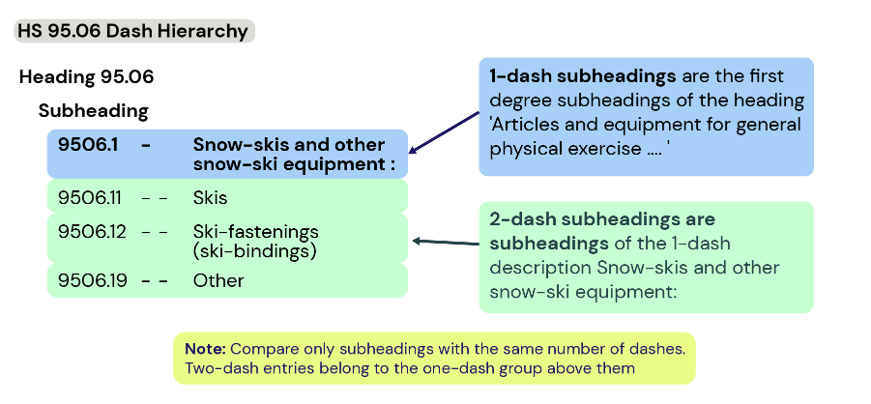
The next two examples show this in heading 95.06. Example 1 shows the dash structure visually. Example 2 then uses that structure to classify a baseball bat.
|
|
Example 1: How the dash hierarchy looks in heading 95.06
This diagram illustrates how the Harmonized System uses dashes to show the relationship between subheadings. A single dash (–) identifies a 5‑digit subheading, while two dashes (- -) identify a 6‑digit subheading that belongs only to the one‑dash group directly above it. In heading 95.06, the subheading 9506.1 is subdivided into 9506.11 and 9506.19, both shown with two dashes to indicate their dependent relationship. The separate one‑dash subheading 9506.9 forms a different group and must not be compared with the two‑dash entries under 9506.1. This hierarchical structure is essential for accurate classification. It ensures that comparisons are made only within the correct level and prevents the common error of selecting the wrong residual “other” subheading. The diagram visually reinforces this rule by grouping the two‑dash entries under their parent one‑dash subheading and separating the unrelated one‑dash “other” subheading. |
|
Example 2: Applying the dash hierarchy to classify a baseball bat HS Nomenclature - Specimen Heading 95.06
Now apply the structure shown in Example 1. A baseball bat is classified within heading 95.06 as an article or equipment for sports or outdoor games. Work down the hierarchy one dash level at a time.
A baseball bat does not fit any of the named categories, so the only option is the residual subheading 9506.9.
A baseball bat is not equipment ‘for general physical exercise, gymnastics or athletics’, so the answer is subheading 9506.99. Classification. Baseball bat → 9506.99 |
||||||||||||||||||||||||||||
12. Part 3: The classification process
Introduction
Part 2 covered the structure of the Nomenclature. In this Part, we examine how that structure is used to classify goods in practice by means of, the Interpretation Rules.
Learning objectives
|
✓ |
Apply the identification process to describe goods independently of the Nomenclature using appropriate information sources. |
|
✓ |
Identify all relevant sections, chapters, and headings within the Nomenclature where goods may be classified. |
|
✓ |
Apply Interpretation Rule 1 to determine a 4-digit heading using the terms of headings and relevant Section or Chapter legal notes. |
|
✓ |
Apply Interpretation Rule 6 to determine a 5- or 6-digit subheading using the terms of subheadings and relevant Section or Chapter legal subheading notes. |
|
✓ |
Acquire an understanding of Interpretation Rules 2 to 5. |
Six Interpretation Rules govern classification. Around 95 percent of traded goods are classified using Rules 1 and 6, so we focus on those in detail. We cover Rules 2 to 5 more briefly.
Over the years, the World Customs Organization, national customs administrations, and courts and tribunals have built principles and precedents. After all of that, the mechanics of classification still come down to two steps:
1. Identifying the goods.
2. Applying the Interpretation Rules.
Having established this overriding principle, the two steps may be further broken into five stages or processes. They are:
|
01 Identify the goods Describe the goods independently of the Nomenclature, based on what they actually are. |
02 Locate areas Identify sections and chapters where the goods may be covered. |
|
03 Select headings Identify and select appropriate headings within those areas. |
04 Classify at heading level Apply Interpretation Rule 1 and any relevant legal notes. |
|
05 Classify at subheading level Apply Interpretation Rule 6 and any relevant subheading notes. |
|
Although there is some overlap between the stages, the first three processes form the identification phase. Process four is governed by Interpretation Rule 1. Process five is governed by Interpretation Rule 6.
13. Identifying the goods
Identification is the process of describing goods so they can be classified correctly. It is the most important step in classification, and arguably the most difficult, because it is subjective and depends on the classifier's view of the goods.
In national tariff documents, arguments may often be influenced by the information that is set out in the rate of duty column.
|
Note: Why identification matters If the goods are not correctly identified, the classifier cannot reach the correct classification answer. Everything in this Part depends on getting identification right. |
13.1. Identify the goods independently of the Nomenclature
Manufacturers and exporters often provide an HS code on invoices or in sales contracts. Large multinationals like BMW or IKEA maintain in-house customs classification teams for this purpose. But these classifications are commercial opinions — they may not reflect the legal requirements of the importing country, even when the supplier is trying hard to be compliant.
For this reason, classifiers must identify the goods in their condition as imported and should not rely solely on invoice descriptions or supplier provided HS codes. Physical examination or sampling remains the most reliable basis for accurate classification.
Key steps
The first step of identifying the goods is a layman’s (or ordinary person’s) identification/assessment based on the characteristics which the goods themselves present.
In doing this, classifiers should look at the goods independently of the Nomenclature. To find out as much as possible about the goods they should ask questions such as:
|
Question |
What it tells you |
|
What are the goods? |
The basic description and identity of the article. |
|
What function do the goods perform? |
What the goods do or what they are used for. |
|
How do the goods perform their function? |
The mechanism, process, or method of operation. |
|
What are the goods made of? |
Materials, which may point to 'materials' chapters. |
|
Who sells, buys or uses the goods? |
The market, end-user, or commercial context. |
The goal is to identify the goods in their condition as imported. Descriptions of goods can vary widely, but that does not change what the goods actually are. The goods themselves must be identified.
|
Note: Always work from samples where you can Classifiers should never rely solely on invoice descriptions. Always try to obtain a sample of the goods. |
13.2. Samples/descriptive literature
If obtaining a sample of the goods first-hand is not feasible because, for example, of the size of the goods, classifiers should be provided with Illustrative Descriptive Material (IDM) to assist with classification. The best IDM is usually a brochure or some other form of illustrated literature that describes what the goods are, how they work, what they are used for, etc.
When examining IDM, be wary of trade catalogs or other specialist promotional publications. They are often designed to highlight particular features or aspects of the goods and do not always give a complete description. Although they are of some use, they should be used only as a guide or an aid in identification. In most instances additional information will be required.
In some cases, manufacturers or exporters may also hold independent product certification or conformity assessment reports issued by accredited testing bodies. These documents, such as laboratory analyses, safety certifications or technical data sheets, can provide reliable, objective information about the composition and performance of the goods. While useful, they should still be treated as supporting material rather than a substitute for identifying the goods in their condition as imported.
Information sources at a glance
|
Source |
What it offers |
How to treat it |
|
Physical sample |
First-hand examination of the goods in their condition as imported. |
Most reliable basis for classification, always seek this first. |
|
Illustrative Descriptive Material (IDM) |
Brochures or illustrated literature describing what the goods are, how they work, and what they are used for. |
Use when a sample is not feasible (e.g., due to size). Must be adequate to base an assessment on. |
|
Trade catalogs / promotional material |
Highlights of particular features or aspects of the goods. |
Use only as a guide or aid. Do not rely on them alone; additional information is usually required. |
|
Independent certifications / lab reports |
Reliable, objective information about composition and performance from accredited testing bodies. |
Treat as supporting material, not a substitute for identifying the goods as imported. |
|
Note: The important thing to remember is that classifiers must be able to identify the goods that are to be classified. Guesswork has no place in the HS classification process; decisions must be based on objective characteristics and adequate information. If a sample cannot be obtained, the IDM must be sufficient to support an accurate assessment. If you are not satisfied that you can make a reliable determination, it may be necessary to go back to the importer or manufacturer to request further information. |
13.3. Online HS and national tariff classification tools
Classifiers may also consult government-maintained online tariff resources, many of which now include explanatory notes, classification guidance, and access to national tariff measures. These tools can help confirm understanding and provide context, but they should be used only as an aid; the classifier must still base the final assessment on the actual goods in their condition as imported.
These tools matter today because, in an age of increasing digitalization of international trade, many Customs administrations and Ministries of Economy and Trade now provide readily accessible and easy-to-navigate online tariff platforms as a public service. Common features include:
|
01 Searchable HS databases Look up Harmonized System codes by keyword, description, or product category. |
02 National tariff schedules View duty rates and tariff structures applicable in a specific country. |
03 Explanatory notes Access official guidance that clarifies how headings and subheadings apply. |
|
04 Classification guides Worked examples of how common goods have been classified by authorities. |
05 Binding rulings access Search prior decisions such as EU Binding Tariff Information(BTI) and US CROSS rulings issued on past importations. |
06 AI-assisted search In some cases, machine-learning search functions help locate likely classifications. |
These tools are increasingly used by traders and logistics staff to understand tariff structures and explore possible classifications. The European Union's TARIC platform is one widely used example.
European Union – TARIC Online Tariff
Online tools can help users:
- navigate headings and subheadings
- compare national tariff treatments
- understand duty rates and national measures
- view examples of previously classified goods
- generate preliminary classification ideas
|
Note: AI tools Artificial intelligence tools are increasingly being developed to assist with tariff classification. These systems typically analyze product descriptions, technical specifications, or historical classification data to suggest possible HS codes. While such tools can be useful for initial orientation, their maturity and reliability vary significantly across providers. Most AI systems are still dependent on the quality of the input data, and many struggle with ambiguous descriptions, multi-material goods, or items requiring technical interpretation under the General Rules of Interpretation. AI classification tools may therefore provide a helpful indication or time‑saving starting point, but they are no substitute for a human classifier who retains ultimate responsibility for correctly applying the HS rules and following due process on each occasion. |
|
|
Example: A shipment arrives described only as “plastic fittings.” Using a national or supra‑national online tariff tool, for example, the EU’s TARIC to compare headings and legal notes, or the US CROSS ruling database to review how similar goods have been classified, the classifier can see the types of information Customs has relied upon in previous cases. This helps them ask the right questions and narrow down the correct classification. |
|
Note: Online tools are aids, not authorities. They support classification, but must always be used alongside the HS structure, the Interpretation Rules, and the physical characteristics of the goods themselves and the condition in which they are imported. |
13.4. Industry inquiries
Sometimes, especially for machinery, you may be able to inspect similar goods that may have been imported previously and that are already installed in factories. This is often called a trade inquiry. It is an excellent way to obtain information.
An advantage of conducting trade inquiries is that it is often possible to talk to people who are experts in that particular field.
How to use expert input
|
✔ Use experts to... |
✘ Do not |
|
• Gather information about how the goods work in their operating environment. • Understand the function, materials, and use of similar goods already installed. • Treat what experts say as an aid to your own assessment. |
• Rely on experts without recognizing they may have their own biases. • Expect experts to describe goods in Nomenclature terms; in some cases, even trade experts lack sufficient knowledge of the Nomenclature. • Ask experts whether goods fall within a particular classification. |
The aim is an objective inspection and appraisal of the goods in the condition in which they are imported.
13.5. Identify/locate areas within the Nomenclature
Once the classifier has determined as much as possible about the subject goods, the next step is to translate that identification into Nomenclature terminology. Taking this step, the classifier should list all possible areas in the Nomenclature where the goods may fall.
Useful questions at this stage
• What are the goods?
• How do they perform their task?
• What are the goods made of? (This may point to materials chapters.)
Keep an open mind and locate all possible areas where the goods may be classified. Do not just concentrate on one particular area that you consider is the obvious answer. Experience has shown that the most successful classifiers are those who can “think outside the circle” and can “cast their net wide”.
When locating areas of the Nomenclature, classifiers need to be mindful of the terminology that is contained in the document. There’s no point, for example, identifying something as a “souvenir” or a “promotional item” because those words are not contained in the document.
Three chapters to always check
Chapters 42, 83 and 96 cover a range of largely unrelated goods. Check them every time, at least until their contents are familiar.
|
42 Chapter 42 Articles of leather, saddles, harness, travel goods, handbags, and articles of animal gut. |
83 Chapter 83 Miscellaneous articles of base metal: padlocks, safes, buckles, electrodes, paper clips, bells, filing cabinets. |
96 Chapter 96 Miscellaneous manufactured articles: pens, smoking pipes, brushes, combs, stamp pads, tailors' mannequins. |
It is good classification practice to ensure nothing is hiding in these areas.
13.6. Case Study
At this point in the process in our case study, the identification phase is complete. We have covered the first three processes which are:
|
01 Identify the goods Describe the goods independently of the Nomenclature, based on what they actually are. |
02 Locate areas Identify sections and chapters where the goods may be covered. |
|
03 Select headings Identify and select appropriate headings within those areas. |
|
Classifiers are then required to use the directives of the Interpretation Rules to determine the correct classification. Initially we will concentrate on:
• determining the correct heading by way of Interpretation Rule 1; then
• determining the correct subheading by way of Interpretation Rule 6.
14. The Interpretation Rules
The full name is the General Rules for the Interpretation of the Harmonized System, often shortened to the Interpretation Rules or GIR. The six Rules form part of the Harmonized System Nomenclature and ensure that any given product is always classified in the same heading or subheading, to the exclusion of any other heading or subheading that might at some stage merit consideration. Together, they narrow every classification down to a single, defensible answer.
The step-by-step classification path
The Rules provide a step-by-step basis for the classification of goods.
|
Level |
What happens at this level |
|
4-digit heading |
First. A product must be classified at this level before moving down. |
|
5-digit (1-dash) subheading |
Only after the heading is determined. Compared only with other 5-digit subheadings in the same heading. |
|
6-digit (2-dash) subheading |
Only after the 5-digit subheading is determined. Compared only with other 6-digit subheadings under the same 5-digit subheading. |
|
Note: No peeking down the hierarchy At each step in the classification process, no account is taken of the terms of any lower level subdivisions. This principle applies without exception throughout the Harmonized System. |
The Rules are applied in hierarchical fashion, that is, Rule 1 takes precedence over Rule 2, Rule 2 over Rule 3, and so on. There is an explanation and commentary of the Rules at the beginning of Volume 1 of the Harmonized System Explanatory Notes.
14.1. Interpretation Rule 1
Rule 1 directs:
|
1. The titles of Sections, Chapters and sub‑Chapters are provided for ease of reference only; for legal purposes, classification shall be determined according to the terms of the headings and any relative Section or Chapter Notes and, provided such headings or Notes do not otherwise require, according to the following provisions. |
The vast majority of goods are classified using the Rule 1 and 6 combination. Rule 1 is the easiest of all the Rules and may be divided into three parts:
The three parts of Rule 1 at a glance
|
01 Titles are for reference only Section, chapter, and sub-chapter titles are a guide. They have no legal bearing on classification. |
02 Classify by headings and legal notes Classification is determined by the terms of headings and any relative Section or Chapter notes, the primary classification factors. |
03 Then look at the other Rules Unless prevented by the headings or notes, regard must be had to the other Interpretation Rules. |
14.2. Part 1: Titles are for ease of reference only
The first part directs:
|
The titles of Sections, Chapters and sub-Chapters are provided for ease of reference only;... |
Rule 1 begins by establishing that the Section, Chapter and sub-Chapter titles are provided for ease of reference only. These titles appear immediately after the Section, Chapter or sub-Chapter number. Their purpose is to give an indication of the coverage of that area of the Nomenclature.
The Harmonized System groups goods into broad categories. The variety and number of products in international trade is so wide that titles cannot cover or cite them all. Titles are a guide, they give an indication of the coverage of the sections/chapters, but they have no legal bearing on classification.
|
|
Example: “Base metals and articles of base metals" The title of Section XV is: 'Base metals and articles of base metals.' This title does not mean that every article of base metal is classified in the headings of Chapters 72 to 83 and nowhere else. Many articles of base metal are classified in other sections, machinery in Section XVI, transport equipment in Section XVII, furniture and toys in Section XX. Consider the classification of a magnet. A magnet is an article of iron or steel, so prima facie, it could fall within the headings of Chapter 73. But magnets are classified within heading 85.05, which covers: Electro-magnets, permanent magnets, and articles intended to become permanent magnets after magnetisation, along with electro-magnetic or permanent magnet chucks, clamps, brakes, and similar holding devices. Similarly, the title of Chapter 85 does not mean every piece of electrical machinery sits in Chapter 85, much of it falls in Chapters 84, 85, and 90. The titles are merely a good hint. They are not to be used for interpreting the Nomenclature. |
14.3. Part 2: Classify by the terms of headings and legal notes
The second part of Rule 1 directs:
|
...for legal purposes, classification shall be determined according to the terms of the headings and any relative Section or Chapter Notes... |
|
Key point The classification of goods in the Nomenclature, and in any national tariffs based thereon, is to be determined by reference to the 4-digit headings and the Section or Chapter Notes. They are the primary classification factors. This is the key point to Rule 1 and the key point to all classifications. |
Terms of the heading
The terms of headings are self-explanatory. If for example, the goods are ball or roller bearings, they are classified within heading 84.82. That’s what the heading covers.
The importance of punctuation
When examining a heading, read the punctuation carefully. In the Nomenclature, a semicolon has the same effect as a full stop. Each grouping of words on either side of a semicolon is independent of the other.
|
|
Example: read past the first words of heading 84.22 Heading 84.22 reads: Dish washing machines; machinery for cleaning or drying bottles or other containers; machinery for filling, closing, sealing or labelling bottles, cans, boxes, bags or other containers; machinery for capsuling bottles, jars, tubes and similar containers; other packing or wrapping machinery (including heat-shrink wrapping machinery); machinery for aerating beverages. Five semicolons divide this heading into independent groups. There is no relationship between machinery for aerating beverages and the machinery that precedes it, even though both sit in heading 84.22. Someone looking for the classification of aerating machines could miss this heading because the first words do not relate to those goods. Examine the entire text of a heading. Do not disregard a heading just because the initial product descriptions are not what you are looking for. |
|
|
Example: heading 42.02 and material qualifiers Heading 42.02 reads: Trunks, suit-cases, vanity-cases, executive-cases, brief-cases, school satchels, spectacle cases, binocular cases, camera cases, musical instrument cases, gun cases, holsters and similar containers; travelling-bags, insulated food or beverages bags, toilet bags, rucksacks, handbags, shopping bags, wallets, purses, map-cases, cigarette-cases, tobacco-pouches, tool bags, sports bags, bottle-cases, jewellery boxes, powder-boxes, cutlery cases and similar containers, of leather or of composition leather, of sheeting of plastics, of textile materials, of vulcanised fibre or of paperboard, or wholly or mainly covered with such materials or with paper. The heading relates to a variety of containers and is part of the structure of Chapter 42, which relates essentially to leather goods. On the third line, after the words 'similar containers,' there is a semicolon. • The containers described after the semicolon must be made of certain materials (leather, plastic sheeting, textile, vulcanised fibre, paperboard). • The containers described before the semicolon have no such material qualifier. What this means is that although goods such as travelling bags, shopping bags and sports bags, must be made of certain materials to be classified in heading 42.02, goods such as suitcases, spectacle cases and binocular cases, may be made of any material. For example, an aluminium briefcase is classified within heading 42.02, not in the headings of Chapter 76, because briefcases sit in the first group, where material is not a constraint. |
These examples show why reading the words and punctuation carefully is so important. Read what is there, not what you think is there. Many classification mistakes come from misreading the Nomenclature.
Residual headings
Residual headings operate at the 4‑digit level and may or may not use the word “other”. They are different from the ‘other’ subheadings found within a heading (as already covered in the study guide) which operate at the 6‑digit level.
Many chapters in the Nomenclature contain residual headings. They exist because although the Nomenclature has provision for some 5,000 classifications, the number of different types of commodities being traded throughout the world far exceeds 5,000, and the majority of headings/subheadings of the document, that is, those that describe goods in their own right, reflect those commodities that are traded the most. Residual headings are required to accommodate the vast array of other products that are traded to a lesser extent and do not merit individual recognition within the document.
|
Note The Harmonized System Committee uses a threshold to decide whether a commodity is described in its own right in the Nomenclature. To merit heading status, its value of trade must exceed US$100 million per annum. To merit subheading status, its value of trade must exceed US$50 million per annum. |
How residual headings are described
|
Heading |
Wording |
|
21.06 |
'Food preparations not elsewhere specified or included.' |
|
44.21 |
'Other articles of wood.' |
|
84.79 |
'Machines and mechanical appliances having individual functions, not specified or included elsewhere in this Chapter.' |
Regardless of how they are described, residual headings are an integral part of the Nomenclature and have the same status as any other classification. Classifiers should not attempt to fit goods in the preceding headings - “at all costs” - with a view to avoiding classifying goods within these “other/residual” headings.
|
Note: How to test against a residual heading The classification of goods within residual headings is dependent upon those goods not being classified in headings that more specifically describe goods. The correct procedure to classify goods involving consideration of residual headings is not to compare residual headings with other more specific headings, but rather to ask the question, ‘Are the goods classified in the more specific heading?’ If the answer is ‘yes’, the goods are so classified, and there is no need to proceed to the residual heading. If the answer is ‘no’, the goods are classified within the residual heading. |
Section and chapter notes
The other primary classification factor is the legal notes. They appear at the front of some sections and all but three chapters. The different types of legal notes are covered in Part 2. Two functions of legal notes deserve attention here.
Two functions of legal notes
|
01 They define terms Legal notes can fix the meaning of a term for the purposes of a heading, for example, the dimensions of "pocket-size" for heading 84.70. |
02 They direct classifiers Legal notes point classifiers towards or away from particular areas of the Nomenclature. |
|
|
Example: “pocket-size" is defined in Note 9 to Chapter 84 Note 9 to Chapter 84 directs: For the purposes of heading 84.70, "pocket-size" applies only to machines the dimensions of which do not exceed 170 mm x 100 mm x 45 mm. An examination of heading 84.70 will reveal that the term ‘pocket-size’ relates to data recording, reproducing and displaying machines that have calculating functions. Therefore, a data recording machine that incorporates a calculating function, for example, has to comply with the dimensions that are set out in Note 9, irrespective of any claim that the goods are ‘pocket-size’. If the product exceeds those dimensions, it will not fall within heading 84.70. |
|
|
Example: Note 1(s) to Chapter 95 directs classifiers elsewhere Heading 95.06 covers amongst other goods: ...equipment...for...sports...or outdoor games... However, Note 1 to Chapter 95 excludes certain goods, which at first consideration, may have been thought classified within heading 95.06. Consider the classification of sports whistles, for example. Whilst heading 95.06 seems a logical classification, Note 1(s) excludes these goods from Chapter 95 and points to heading 92.08. The correct classification is therefore automatic. |
14.4. Case Study Continued
Importance of Rule 1
Because Rule 1 accounts for about 95 per cent of all classifications, the terms of headings and the provisions of legal notes are the essence of the classification process.
When classifying goods, you must consider the terms of the headings and the provisions that are set out in the legal notes. While this may seem straightforward, it is of paramount importance that headings and legal notes are interpreted correctly.
Experience has shown that although classifiers pay attention to the terms of headings, they do not have the same regard for legal notes.
|
Note: Standard practice for every heading When considering a particular heading, go to the beginning of the relevant chapter and section and check whether any legal notes relate to the goods. If classifiers do not do this, and there are legal notes relating to the goods being classified, the goods will almost certainly be incorrectly classified. |
14.5. Part 3: Regard is to be had to the other Interpretation Rules
The third part of Rule 1 directs:
|
...and, provided such headings or Notes do not otherwise require, according to the following provisions: |
It is more appropriate to discuss this after an examination of Interpretation Rules 2 to 5, which we will not be doing in any detail on this course. For now: when classifying goods, unless prevented by the wording of the headings or legal notes, you must have regard to all of the Interpretation Rules. Do not just stop at Rule 1.
Summary
Interpretation Rule 1 applies at 4-figure heading level only. The terms of the headings and the Section or Chapter notes are the prime classification factors. Section and chapter titles provide guidance only. Where Interpretation Rule 1 does not give a clear answer, recourse should be had to the remaining Rules.
14.6. Interpretation Rule 6
A 4-figure classification is not the end of the exercise. The Harmonized System is a 6-figure system. A complete international classification involves reaching that level.
Rule 6 came in with the HS Nomenclature. It was introduced specifically to ensure uniform classification of goods at subheading level, covering both the 5-figure and 6-figure subheadings.
Rule 6 directs:
|
6. For legal purposes, the classification of goods in the subheadings of a heading shall be determined according to the terms of those subheadings and any related Subheading Notes and, mutatis mutandis, to the above Rules, on the understanding that only subheadings at the same level are comparable. For the purposes of this Rule the relative Section and Chapter Notes also apply, unless the context otherwise requires. |
Rule 6 also covers any national subheadings that customs administrations have inserted into their tariff documents to meet domestic requirements, that is, subheadings below the international 6-figure structure.
|
01 Terms and notes Classify by the terms of subheadings and any related subheading notes. |
02 Mutatis mutandis Apply the other Interpretation Rules at subheading level, with 'headings' read as 'subheadings.' |
|
03 Same-level comparison Compare only subheadings at the same level: 5-digit with 5-digit, 6-digit with 6-digit. |
04 Section and chapter notes apply Relative Section and Chapter notes also apply, unless the context otherwise requires. |
14.7. Part 1: Classify by the terms of subheadings and subheading notes
The first part directs:
|
For legal purposes, the classification of goods in the subheadings of a heading shall be determined according to the terms of those subheadings and any related Subheading Notes… |
Rule 6 directs classifiers to work at subheading level the same way they do at heading level. Once a 4-digit heading has been selected, examine the terms of the subheadings within that heading, and consider any subheading notes.
|
|
Example: lead crystal wine glasses The goods are classified within heading 70.13 (glassware of a kind used for table purposes) by Rule 1. The next step is to resolve the subheading. Heading 70.13 has five 5-digit subheadings: 7013.10 - Of glass-ceramics 7013.2 - Stemware drinking glasses, other than of glass-ceramics 7013.3 - Other drinking glasses, other than of glass-ceramics 7013.4 - Glassware of a kind used for table (other than drinking glasses) or kitchen purpose other than of glass-ceramics 7013.9 - Other glassware Wine glasses normally have stems, so the goods sit at 7013.2. That subheading breaks down to 7013.22 (Of lead crystal) and 7013.28 (Other). 7013.22 - - Of lead crystal 7013.28 - - Other On face value the goods fall within 7013.22. But that subheading is subject to Subheading Note 1 to Chapter 70, which directs:
Regardless of any claim that the goods are lead crystal, the lead monoxide threshold must be met. Otherwise the goods are classified within 7013.28. |
Residual subheadings
Just as most chapters have residual headings near the end, the structure below heading level normally includes a 'catch all' subheading described as "Other".
|
|
Ask the question Are the goods classified in the more specific subheading? |
|||
|
↓ |
|
|||
|
|
YES Classify the goods within the more specific subheading. Stop. |
|
NO Classify the goods within the residual subheading. |
|
14.8. Part 2: Mutatis mutandis to the Interpretation Rules
Continuing with the breakup of Rule 6:
|
…and, mutatis mutandis, to the above Rules,… |
The literal meaning of mutatis mutandis is “with things changed that must be changed”. This means one is to take the circumstances that are relevant to one particular issue and apply them (in total) to another issue.
What this means in practice
Read any reference to "headings" in the other Interpretation Rules as a reference to "subheadings."
The directives of the Interpretation Rules, which in their normal form relate only to classifying goods at heading level, may also apply at subheading level.
This is what allows the other Interpretation Rules to apply to any national subheadings that customs administrations have inserted into their own tariff documents to satisfy domestic requirements.
14.9. Part 3: Only compare subheadings at the same level
The remaining part of the first sentence of Rule 6 directs:
|
…on the understanding that only subheadings at the same level are comparable... |
A 5-digit subheading may only be compared with another 5-digit subheading within the same heading. It cannot be compared with a 6-digit subheading. A 6-digit subheading may only be compared with another 6-digit subheading that is part of the same 5-digit subheading hierarchy.
The hierarchy in one picture
|
4-digit heading Compared only with other headings (Rule 1) |
||||
|
↓ |
||||
|
|
5-digit (1-dash) subheading Compared only with other 5-digit subheadings in the same heading |
|
||
|
↓ |
||||
|
|
6-digit (2-dash) subheading Compared only with other 6-digit subheadings under the same 5-digit parent |
|
||
|
Note: Work down the hierarchy Heading first, then 5-digit subheading, then 6-digit subheading, then any national subheadings. Do not choose a set of words just because they look like a fit; consider the context in which they appear at each level. |
|
|
Example 1: a 12 kg laundromat washing machine Consider the classification of a fully automatic washing machine, having a dry linen capacity of 12 kg, for use in laundromats [laundries]. The goods are classified within heading 84.50 (household or laundry-type washing machines) by Rule 1. The next step is to resolve the subheading situation. Heading 84.50 includes the following subheading structure:
On first reading the goods look like they belong in 8450.11 (fully automatic machines). However, this classification is not correct. Although 6-figure subheading 8450.11 relates to ‘fully automatic machines’, that subheading is qualified by 5-figure subheading 8450.1, which relates to machines having a dry linen capacity not exceeding 10 kg. The subject goods are classified within subheading 8450.20, which covers ‘machines, each of a dry linen capacity exceeding 10 kg’. Subheading 8450.20 is to be compared with subheading 8450.1, both being 5-figure subheadings, not subheading 8450.11. Only descriptions at the same level may be compared. |
|
|
|
Example 2: a domestic water filter You are classifying a domestic water filter. A keyword search of the Nomenclature returns two places where filters are mentioned: · Heading 84.21 mentions “filtering...apparatus...” · Subheading 9002.20 mentions “filters” Which classification is correct for the goods? The answer is heading 84.21, which covers ‘…filtering and purifying machinery and apparatus for liquids…’ Subheading 9002.20 is qualified by the terms of heading 90.02, which covers ‘Lenses, prisms, mirrors and other optical elements,…’ Only compare at the same level. Subheading 9002.20 cannot be compared with heading 84.21. They are at different levels. Heading 84.21 may only be compared with other headings, such as heading 90.02. |
Classification at subheading level is only possible after the goods have been confirmed within their 4-digit heading. This matters especially where subheading descriptions repeat across the Nomenclature.
|
|
Example: the word "suits" appears in multiple places The word ‘suits’ is mentioned in a number of classifications within Section XI. One such example is subheading 6104.1. Consider the classification of a shipment of suits. May they be classified within subheading 6104.1? The answer is: only if they are women’s and are knitted or crocheted, because that is what heading 61.04 allows for. May those goods be classified within subheading 6203.1? The answer is: only if they are men’s and are not knitted or crocheted, because that is what heading 62.03 covers. |
14.10. Part 4: Relative legal notes apply, unless the context otherwise requires
The last sentence of Rule 6 directs:
|
…For the purposes of this Rule the relative Section and Chapter Notes also apply, unless the context otherwise requires. |
When determining a classification below heading level, both the section and chapter notes and the information at subheading level must be considered. However, precedence is to be given to the terms of the subheadings and any subheading notes, should there be any conflict between them and the section and chapter notes.
14.11. Case Study Continued
Summary
The essential message of Rule 6 is that classifiers should treat the classification exercise at subheading level the same way they do at heading level. There are some provisos:
|
Proviso |
What it means |
|
Only same-level comparisons |
5-digit subheadings only compare with 5-digit subheadings in the same heading. 6-digit subheadings only compare with 6-digit subheadings under the same 5-digit parent. |
|
Subheading text takes precedence |
Where the terms of subheadings or subheading notes conflict with headings or with section and chapter notes, the former take precedence. |
14.12. Interpretation Rules 2 to 5
The preceding section covered the classification process by which the vast majority of goods (an estimated 95 per cent) are classified. It:
· explained the principles of the identification of goods
· explained the directives of Interpretation Rules 1 and 6.
Interpretation Rules 1 and 6 are the more straightforward of the Rules. Essentially, Rule 1 directs that the prime classification factors are the terms of the headings and the legal notes. Rule 6 extends this philosophy to below heading level.
This section is also about the classification process. It will examine the remaining, and in some instances, the more complex Interpretation Rules: Rules 2 to 5. Some of these Rules concern the treatment of goods that are imported in a condition that is not immediately recognizable within the structure of the Nomenclature.
Interpretation Rules 2 and 3 deal with classification situations in which the imported goods may not be identifiable within the text of the Nomenclature. Classifications of this type are open to subjective interpretations.
Due to their subjective nature, the classification issues concerning Rules 2 and 3 are often labeled “grey” or “cloudy” areas, the inference being that there is no definitive solution. It is not possible to provide straightforward or simple answers for every classification that is determined under the directives of these Rules.
14.13. Interpretation Rule 2
Rule 2 directs:
|
2.(a) Any reference in a heading to an article shall be taken to include a reference to that article incomplete or unfinished, provided that, as presented, the incomplete or unfinished article has the essential character of the complete or finished article. It shall also be taken to include a reference to that article complete or finished (or failing to be classified as complete or finished by virtue of this Rule), presented unassembled or disassembled. (b) Any reference in a heading to a material or substance shall be taken to include a reference to mixtures or combinations of that material or substance with other materials or substances. Any reference to goods of a given material or substance shall be taken to include a reference to goods consisting wholly or partly of such material or substance. The classification of goods consisting of more than one material or substance shall be according to the principles of Rule 3. |
Rule 1 limits classification to what is in a heading and its legal notes. Rule 2 extends or broadens the scope of headings to include goods imported in a condition that is not specifically recognized in the wording. Rule 2 comes into play when no exact heading covers the subject goods in their condition as imported.
Rule 2 is divided into two sub-rules: 2(a) and 2(b). Each is examined in turn.
14.14. Interpretation Rule 2(a)
Rule 2(a) broadens the scope of a heading. It allows the classification within a heading of an article that is incomplete or unfinished, or presented unassembled or disassembled, or a combination of these.
Two principles inside Rules 2(a)
|
01 Incomplete or unfinished article Treated as a complete article, provided it has the essential character of the complete article. |
02 Unassembled or disassembled article Classified as if it were assembled. |
First principle
|
Any reference in a heading to a material or substance shall be taken to include a reference to mixtures or combinations of that material or substance with other materials or substances... |
The first part of Rule 2(a) is directing that a heading, that normally describes goods in terms of their being complete or in the finished state, may also be available for consideration of the classification of those goods when those goods are presented - and that means imported - in a condition that is not complete or in the finished state.
The next part is the important phrase:
|
...provided that as presented the incomplete or unfinished article has the essential character of the complete or finished article. |
Here the terms of Rule 2(a) are calling for the classifier to make a judgment.
|
|
Essential character The term 'essential character' appears in the terminology of Interpretation Rules 2(a), 3(b), and 5(a). Essential character is one of the most important aspects of classification. It is also one of the most difficult. It is subjective. It depends on the person doing the assessment and can be influenced by that person's biases and experience. This makes essential character a less predictable element in classification, and one of the main reasons for classification disputes. The first principle of Rule 2(a) lets incomplete or unfinished goods be classified under the heading for the complete article, provided those goods are recognizable or identifiable as having the essential characteristics of the complete or finished product. |
Second principle
The second part of Rule 2(a) directs:
|
...It shall also be taken to include a reference to that article complete or finished (or falling to be classified as complete or finished by virtue of this rule), presented unassembled or disassembled. |
This means that goods imported in an unassembled or disassembled condition are still classified as though they are assembled. Classification should not change simply because goods are imported in pieces.
Unassembled vs disassembled
|
Term |
Meaning |
|
Unassembled |
Goods that have never been assembled, a collection of parts that must be put together to form the article. |
|
Disassembled |
Components that were once together and have since been taken apart, for example, for ease of transportation. |
Rule 2(a) considers the fact that many goods are traded in an unassembled or disassembled form to meet packing, handling or transport requirements. A completely knocked down (CKD) car is still a motor vehicle. Bulky or fragile goods such as bridges, industrial machinery, and lamps and lighting fittings are frequently imported unassembled or disassembled. These goods should not be treated differently from their assembled counterparts.
Rule 2(a) broadens the scope of the heading to allow it to include goods, that on a strict interpretation of the description of the goods of the heading, it would not seem to provide for. In effect, it extends the coverage of the headings. The important words are ‘unassembled’ or ‘disassembled’ and ‘incomplete’ or ‘unfinished’, provided they have the essential character of the finished or complete article.
14.15. GIR Rule 2(a) Case study: Toyota’s HS misclassification in Thailand
GIR Rule 2(a) Case study: Toyota’s HS misclassification in ThailandMisclassification under GIR 2(a) can expose traders to severe financial and reputational harm. When goods are imported unassembled or disassembled, but retain the essential character of the finished product, they must be classified as the complete article. Failure to do so can result in substantial back duties, penalties, and legal disputes, as well as damage to commercial relationships and brand integrity. The following case illustrates how costly non-compliance with GIR 2(a) can be in practice. Background In 2022, the Thai Supreme Court imposed significant penalties on Toyota Motor Thailand for misclassifying imported parts for its Prius model. This case exemplifies the compliance challenges and financial implications of HS misclassification. Details of the misclassification Toyota classified the imported parts under HS code 8708, covering automobile parts, to leverage reduced tariff rates under the Japan-Thailand Economic Partnership Agreement (JTEPA). However, Thai Customs determined the parts should have been classified under HS code 8703.23.51, applicable to complete vehicles.
Thai Customs applied General Rule of Interpretation (GIR) 2(a), which states that unassembled or disassembled products should be classified as complete products if they retain the essential character of the finished item. Financial implications
|
14.16. Interpretation Rule 2(b)
Rule 2(b) directs:
|
(b) Any reference in a heading to a material or substance shall be taken to include a reference to mixtures or combinations of that material or substance with other materials or substances. Any reference to goods of a given material or substance shall be taken to include a reference to goods consisting wholly or partly of such material or substance. The classification of goods consisting of more than one material or substance shall be according to the principles of Rule 3. |
Like Rule 2(a), this Rule contains separate principles.
Three principles inside Rules 2(b)
|
01 Mixtures and combinations A heading referring to a material includes mixtures or combinations of that material with other materials or substances. |
02 Goods made of given material A reference to goods of a given material includes goods consisting wholly or partly of that material or substance. |
03 Resolve under Rule 3 The classification of goods consisting of more than one material or substance shall be according to the principles of Rule 3. |
First principle: heading reference includes mixtures
|
Any reference in a heading to a material or substance shall be taken to include a reference to mixtures or combinations of that material or substance with other materials or substances... |
This part of Rule 2(b) directs that any reference in a heading to a particular good can be expanded to include mixtures or combinations of that good with other goods.
|
|
Example: chicken feed of wheat and oats Consider a chicken feed mix comprising only of a mixture of wheat and oats. There is no heading that covers mixtures of these goods. if there were, the classification would be resolved by virtue of Interpretation Rule 1. Although there is no heading that covers mixtures of wheat and oats, there is a heading that covers wheat (10.01) and there is a heading that covers oats (10.04).
Let’s substitute the ingredients of the mix for the words ‘material or substance’ in Rule 2(b):
And conversely:
If Rule 2(b) didn’t exist, there would be nowhere to classify mixtures such as this. So this part of Rule 2(b) directs that, because there is a heading for wheat (10.01) and a heading for oats (10.04), it is possible to classify this wheat and oats mixture in one of those headings.
|
Second principle: goods of a material include partial-material goods
The second part of Rule 2(b) directs:
|
...any reference to goods of a given material or substance shall be taken to include a reference to goods consisting wholly or partly of such material or substance… |
Like the first part of Rule 2(b), this is extending the scope of headings, in this instance to include goods that are made out of different materials.
As with the sentence concerning mixtures, this part of Rule 2(b) is not providing a classification answer.
Third principle: when two or more headings apply, use Rule 3
When applying either of the first or second principles of Rule 2(b), the result will be a situation where two or more headings will be made available for consideration in determining where a product is to be classified. In determining which heading is to apply, the classifier is required to proceed as directed by the final sentence in Rule 2(b). It directs:
|
...The classification of goods consisting of more than one material or substance shall be according to the principles of Rule 3. |
The final sentence confirms that mixtures, combinations of materials or substances, and goods consisting of more than one material or substance cannot be classified by virtue of the provisions of Rule 2(b). If mixtures/combinations/goods are considered to potentially fall within two or more headings, they must be classified according to the principles set out in Interpretation Rule 3.
From Rule 2(b) to Rule 3 at a glance
|
Rule 2(b) Extends heading scope to mixtures and composite goods |
→ |
Two or more headings apply Multiple potential classifications now exist |
→ |
Rule 3 Resolves which heading applies |
|
Note: Rule 2(b) extends the terms of the headings. It does not provide a classification answer. |
14.17. Summary
Interpretation Rule 2 does not provide a tariff classification answer. What it does is extend the scope of headings to include goods that are imported in a condition that is not normally recognized within the structure of the headings and subheadings of the Nomenclature.
The types of goods it relates to are:
|
01 Unassembled goods Goods imported in an unassembled or disassembled condition. |
02 Unfinished goods Goods imported in an incomplete or unfinished condition. |
|
03 Mixtures Goods that are mixtures of two or more materials or substances. |
04 Composite goods Goods composed of different materials. |
14.18. Interpretation Rule 3
Interpretation Rule 3 directs:
|
3. When by application of Rule 2(b) or for any other reason, goods are, prima facie, classifiable under two or more headings, classification shall be affected as follows: (a) The heading which provides the most specific description shall be preferred to headings providing a more general description. However, when two or more headings each refer to part only of the materials or substances contained in mixed or composite goods or to part only of the items in a set put up for retail sale, those headings are to be regarded as equally specific in relation to those goods, even if one of them gives a more complete or precise description of the goods. (b) Mixtures, composite goods consisting of different materials or made up of different components, and goods put up in sets for retail sale, which cannot be classified by reference to 3(a), shall be classified as if they consisted of the material or component which gives them their essential character, insofar as this criterion is applicable. (c) When goods cannot be classified by reference to 3(a) or 3(b), they shall be classified under the heading which occurs last in numerical order among those which equally merit consideration. |
14.19. Introduction
The introduction sets the circumstances under which Rule 3 may be used.
|
When by application of Rule 2(b) or for any other reason, goods are, prima facie, classifiable under two or more headings, classification shall be affected as follows: |
If goods are capable of falling within two or more headings, Rule 3 provides three methods by which a classification answer may be obtained.
Goods may fall within two or more headings for any number of reasons.
|
01 Mixtures Goods covered by Interpretation Rule 2(b). |
02 Made from different materials Also covered by the provisions of Rule 2(b). |
|
03 Sets For example, a gift pack of soap, bath salts, and a flannel or wash cloth. |
04 Composite goods Goods composed of two or more other goods, for example, a pen that incorporates a small calculator. |
|
05 Multiple heading matches Goods that meet the terms of descriptions set out in more than one heading. |
|
14.20. Interpretation Rule 3(a): the most specific description
The main thrust of Rule 3(a) is in the first sentence:
|
The heading which provides the most specific description shall be preferred to headings providing a more general description. |
It is difficult to lay down hard and fast criteria on which to determine whether one heading describes goods more specifically than another heading. However, there are two general guidelines that may be followed.
|
# |
Guideline |
Example |
|
1 |
A description by name is more specific than a description by class or genus. |
Base metal filing cabinets are classified within heading 83.04 (which specifically describes the goods) rather than in heading 94.03 (which covers 'Other furniture…'). |
|
2 |
A heading description that identifies goods clearly and precisely is more specific than a general one. |
A driver's seat for use in a motor vehicle is considered to be classified within heading 94.01 (which covers 'Seats…') rather than in heading 87.08, which covers parts of motor vehicles. |
As a general rule, not many goods are classified using the criteria set out in Rule 3(a).
14.21. Interpretation Rule 3(b): essential character
By far the more widely used part of Rule 3 is Rule 3(b). It directs:
|
Mixtures, composite goods consisting of different materials or made up of different components, and goods put up in sets for retail sale, which cannot be classified by reference to Rule 3(a), shall be classified as if they consisted of the material or component which gives them their essential character, insofar as this criterion is applicable. |
Rule 3(b) covers the classification of:
|
01 Mixtures For example, the chicken feed mix of wheat and oats. |
02 Goods of different materials For example, a glass fruit bowl with an ornamental pewter rim. |
|
03 Composite goods (joined) Components are not designed to be separated, for example, a pen incorporating a small calculating machine. |
04 Composite goods (separable) Components are mutually complementary and together form an entity not normally sold separately, for example, an ashtray with a metal stand and removable glass bowl. |
|
05 Retail sets Sets put up for retail sale, for example, soap, bath salts, and a flannel. |
|
Rule 3(b) directs that goods of these kinds shall be classified according to the component that gives the entity its essential character. The entity is classified as if it consisted entirely of that material or component.
This is the second occurrence of 'essential character' in the Interpretation Rules. Determining essential character for the purposes of Rule 3(b) is no easier than it is for Rule 2(a).
Continuing with the chicken feed mix: a relevant factor may be the proportion or weight of wheat to oats. If the mixture contains twice as much wheat as oats, there is some justification in arguing that wheat gives the mixture its essential character. The classification of the mixture would then fall within heading 10.01.
It is important to realize that the factor that determines essential character will vary between different types of goods. What is required is a consistent and rational approach by the classifier.
|
|
Essential character can be undeterminable On many occasions essential character cannot be determined. This is not necessarily a problem; it is not an absolute necessity to always determine essential character. Indeed, it may not be always possible to determine the essential character. If this exercise requires more than a reasonable amount of deliberation, the answer may be that no one factor gives the goods that character. For a chicken feed mix of equal quantities of wheat and oats, all other factors being equal, neither grain imparts more essentiality than the other. In such cases, Rule 3 provides a further solution: Interpretation Rule 3(c). |
14.22. Interpretation Rule 3(c): last in numerical order
Rule 3(c) directs:
|
When goods cannot be classified by reference to 3(a) or 3(b), they shall be classified under the heading which occurs last in numerical order among those which equally merit consideration. |
If classification cannot be determined by specific description or essential character, if the answer is not obvious, the goods shall be classified within the last occurring heading applicable to the material or component, among those that equally merit consideration.
For the container of equal quantities of wheat and oats, the materials are classified separately:
· The wheat: heading 10.01
· The oats: heading 10.04
Oats occur later in the Nomenclature than wheat. By Rule 3(c), the classification of the mixture falls within heading 10.04.
14.23. Summary
Rule 3(c) is considered the end of the mechanics of the classification process. In the normal course of events, all classification issues will be solved at or before Rule 3(c).
The cascade through Rule 3
|
Apply this |
When |
|
Rule 3(a) |
Two or more headings appear to apply, prefer the most specific description. |
|
Rule 3(b) |
Rule 3(a) does not resolve the matter, classify by the material or component that gives the essential character. |
|
Rule 3(c) |
Neither 3(a) nor 3(b) resolves the matter, classify under the heading that occurs last in numerical order. |
14.24. Interpretation Rule 4
Interpretation Rule 4 directs:
|
4. Goods which cannot be classified in accordance with the above Rules shall be classified under the heading appropriate to the goods to which they are most akin. |
Rule 4 was developed to classify products for which there seemed to be no apparent heading available in the Nomenclature. Rule 4 is also used as a safeguard to ensure that new technologies do not make the Nomenclature obsolete.
Although Rule 4 has been in existence since the inception of the Customs Co-operation Council Nomenclature, it is rarely applied because most Harmonized System (HS) chapters incorporate residual headings (for example, headings 39.26 or 84.79) that cover goods that are not specifically included elsewhere. In the 40 or so years since the inception of the HS Nomenclature and its predecessor, all but a handful of classification issues have been resolved by the time the provisions of Rule 3(c) have been exhausted.
14.25. Electricity and the use of GIR 4
When the HS was first implemented, electricity posed a genuine classification problem:
· It is a traded commodity.
· It crosses borders.
· It is bought and sold commercially.
· But it is not a tangible good and no heading explicitly covered it at the time.
Several customs administrations — including the UK, France, Germany, the United States and Canada — encountered the same classification gap during the early 1980s as cross‑border electricity trading expanded. Because electricity could not be classified under Rules 1–3, these administrations relied on GIR 4, assigning it to the heading most akin to it: the energy products of Chapter 27.
Before heading 2716 was introduced in HS 1988/89, national tariff schedules contained no heading for electrical energy, and several administrations had to classify cross‑border electricity flows by analogy. Although no formal rulings were published, the absence of a suitable heading is well documented in pre‑HS national tariffs and academic commentary, and this gap contributed to the creation of heading 2716.
The electricity case therefore shows GIR 4 functioning exactly as intended: temporary, exceptional, used only when the HS genuinely lacked a heading, and followed by a formal amendment to incorporate the product properly.
|
Note: The overriding message regarding Rule 4 is “do not use it”. |
14.26. Interpretation Rule 5
Rule 5 relates to cases, containers and packing materials. It directs:
|
5. In addition to the foregoing provisions, the following Rules shall apply in respect of the goods referred to therein: (a) Camera cases, musical instrument cases, gun cases, drawing instrument cases, necklace cases and similar containers, specially shaped or fitted to contain a specific article or set of articles, suitable for long-term use and presented with the articles for which they are intended, shall be classified with such articles when of a kind normally sold therewith. This Rule does not, however, apply to containers which give the whole its essential character; (b) Subject to the provisions of Rule 5(a) above, packing materials and packing containers presented with the goods therein shall be classified with the goods if they are of a kind normally used for packing such goods. However, this provision is not binding when such packing materials or packing containers are clearly suitable for repetitive use. |
14.27. Interpretation Rule 5(a): specially shaped or fitted cases
Rule 5(a) directs:
|
(a) Camera cases, musical instrument cases, gun cases, drawing instrument cases, necklace cases and similar containers, specially shaped or fitted to contain a specific article or set of articles, suitable for long-term use and presented with the articles for which they are intended, shall be classified with such articles when of a kind normally sold therewith. This Rule does not, however, apply to containers which give the whole its essential character; |
This refers to cases specifically shaped or fitted to contain a specific article. It mentions cases for cameras, musical instruments, guns, drawing instruments, and necklaces, and includes containers that are similar in nature.
Conditions a case or container must meet
|
01 Sold with the article Normally sold with the article they are designed to contain. |
02 Keep and protect Keep and protect the article when it is not in use. |
|
03 Specific to the article Of no real use for articles other than those for which they are designed. |
04 Suitable for long-term use At least as durable as the article they contain, not goods to be disposed of once the contents are taken out. |
Rule 5(a) refers to cases presented with the article for which they are intended. The cases are therefore required to be imported with the article, even though the article and the case may be packed separately for ease of transport.
Where the case meets these conditions, classify the case or container in the same heading as the article it is designed to contain.
|
|
When Rule 5(a) does not apply If the cases or containers are imported without their contents, they are classified according to their own characteristics.
Rule 5(a) also does not apply to containers which give the whole its essential character. A case of unusually high value or ornamental nature, especially where the contents are not commensurate with the status or quality of the container, would not be subsumed into the classification of the contents. The classification would most likely follow the container. For example, an ornately decorated wooden jewelry box imported containing only an inexpensive necklace would not be classified with the necklace under heading 7117 (imitation jewelry). The box is not of a kind normally used for packing such goods, and its design, durability and higher value give the whole its essential character. It would therefore be correctly classified under heading 4420 (wooden articles of furniture) rather than following the contents. |
14.28. Interpretation Rule 5(b): packing materials and packing containers
Rule 5(b) directs:
|
Subject to the provisions of Rule 5(a) above, packing materials and packing containers presented with the goods therein shall be classified with the goods if they are of a kind normally used for packing such goods. However, this provision is not binding when such packing materials or packing containers are clearly suitable for repetitive use. |
Rule 5(b) governs the classification of packing materials and packing containers of a kind normally used for packing the goods to which they relate.
What Rule 5(b) covers
|
Type |
Examples |
|
Outside containers |
Crates; cardboard boxes; poly bags (that shirts are often packed in); all varieties of flexible containers, bags, and sacks. |
|
Inner packing materials |
'Loose' material used for shock absorbing purposes (foam pellets, felt, scrap textile); cardboard stiffeners (for shirt collars); cardboard dividers. |
As with the general thrust of Rule 5(a), the goods covered by Rule 5(b) are classified within the heading applicable to the article for which the packing is required. Unlike Rule 5(a), where the goods could be packed separately within the one importation, the packing materials of Rule 5(b) must contain the goods, "presented with the goods therein", to be classified with them.
|
|
When Rule 5(b) does not apply The second sentence directs:
The provisions of Rule 5(b) do not apply to goods such as pressurized gas bottles or oil barrels. These goods are clearly suitable for repetitive use, and as such, they are classified in their respective headings. "Suitable for repetitive use" means goods designed specifically to be re-used for the same purpose as that originally intended. Containers and packing materials that are not designed for repetitive use, but which may be used for other purposes, are classified with the goods they contain at the time of importation. |
14.29. Harmonized System Explanatory Notes
An important aid in classification is the use of the Harmonized System Explanatory Notes, often simply called the Explanatory Notes. They were referred to in the case study to help determine the correct subheading, but they were deliberately kept in the background during the examples. They are not always readily available, and the priority was to focus on interpreting the words of the Nomenclature, the legal part of the Harmonized System.
Nevertheless, the Explanatory Notes are the official interpretation of the HS Nomenclature structure, and although they are not legally binding, they are the backbone of the HS reference material. They should be used to ascertain the correct interpretation and scope of the texts of the Nomenclature.
15. Part 4: The classification of parts and accessories
In Part 3 we discussed the Harmonized System (HS) classification process of goods in general. This part covers a specific genus of goods: parts and accessories.
Learning objectives
|
✓ |
Distinguish between parts and accessories in HS legal texts and apply that distinction to heading and note scope. |
|
✓ |
Identify the correct classification pathway for a part, including when it is classified with the complete good versus in its own right. |
|
✓ |
Apply the two provisions that allow parts to be classified with complete goods and navigate subheading hierarchies correctly. |
|
✓ |
Gain an understanding of two important legal notes that relate to parts - Note 2 to Section XV and Note 2 to Section XVI. |
15.1. Distinction between parts and accessories
The HS makes a deliberate legal distinction between parts and accessories. Classifiers must respect this distinction when determining the correct heading or subheading. The HS uses the two terms differently in its legal texts, and this has direct consequences for classification.
|
Headings/legal notes covering PARTS only |
Headings/legal notes covering PARTS AND ACCESSORIES |
|
Heading 84.31 Parts suitable for use solely or principally with the machinery of headings 84.25 to 84.30. |
Heading 87.14 Parts and accessories of the vehicles of headings 87.11 to 87.13. |
|
Note 1 to Chapter 83 Relates to parts only. |
Note 3 to Chapter 95 Covers parts and accessories. |
15.2. Key rules
If the legal text refers only to parts, accessories are excluded, even if used with the same machine. For example, there is no point considering the effect of Note 2 to Chapter 82 if the goods have been identified as accessories, because that Note applies only to parts.
There have been occasional proposals to the Harmonized System Committee to remove this distinction and treat "parts" as automatically including "accessories". The Committee has not yet addressed this issue. The distinction remains legally significant.
15.3. What is a part, what is an accessory?
The HS provides no formal definition of "parts" or "accessories". Their meaning has been shaped by Customs practice, WCO guidance, and court decisions in different jurisdictions.
Two broad approaches have emerged:
|
01 Component approach A part is a constituent or component of the whole. Used in Australia and Commonwealth jurisdictions. |
|
02 Essential function approach A part may be something essential to the functioning of the whole. Used in the United States and Canada. |
Many Customs administrations apply a combination of both principles. A part is generally understood as a component that forms part of the whole and contributes to its essential function.
|
"It is a well-established rule that a “part” of an article is something necessary to the completion of that article. It is an integral, constituent, or component part, without which the article to which it is to be joined, could not function as such article." United States v Willoughby Camera Stores, 1933 |
An accessory, by contrast, is an optional add-on that enhances convenience, performance, or usability, but is not essential to the basic operation of the parent article.
|
01 Direct relationship "an 'accessory' must bear a direct relationship to the primary article that it accessorizes." (Rollerblade, Inc., 24 Ct.) |
|
02 Secondary importance "accessories are of secondary importance," but must "somehow contribute to the effectiveness of the principal article" (HQ 960950, Jan. 16, 1998) |
|
03 Subsidiary devices "accessory" includes subsidiary devices that modify the machine to perform a wider range of operations, increase precision, or perform a service relative to the main function. (EN Heading 8466 (B)) |
15.4. Parts and accessories: examples compared
|
PARTS |
ACCESSORY |
|
Automotive brake pads Essential component of the braking system • A vehicle cannot safely operate without functioning brakes. Brake pads are essential components of the braking system. |
Car roof rack Optional carrying attachment • The vehicle can be driven without a roof rack. Adds optional carrying capacity; does not affect the vehicle's essential function. |
|
Pump impeller Core internal component • The pump cannot move fluid without the impeller. It performs the machine's primary function. |
Printer dust cover Optional protective item • The printer operates without it. The cover protects the machine but is not essential to printing. |
|
Laptop keyboard (built-in) Core input component Without a keyboard, the laptop cannot be operated normally. |
Mobile phone protective case Optional protective item • The phone functions fully without the case. Enhances durability or appearance but is not required for operation. |
|
|
Camera tripod Optional stability device • The camera can take photos without a tripod. Improves stability and enables certain types of photography but is not essential. |
|
|
Example: Parts and accessories for bicycle items Let's look at bicycle items and whether they are classified as parts or accessories. A bicycle chain is • essential for propulsion; without it the bicycle cannot function. • a core mechanical component forming part of the bicycle's drive system. Therefore, it is classified as a part. In the HS, it is classified under HS 7315.11 – Roller chain for bicycles. A bicycle water-bottle holder, on the other hand, • enhances convenience but is not essential to riding, • and the bicycle operates fully without it, as it adds only optional functionality. Therefore, it is classified as an accessory. In the HS, it falls under HS 8714.99 – Other parts and accessories of bicycles and other cycles. Note: Water-bottle holders fall under 8714 because this heading explicitly covers parts and accessories of bicycles. An accessory can only be classified under a provision that expressly includes accessories. |
Because some HS headings and legal notes apply to parts only, correctly identifying whether an item is a part or an accessory determines which classification provisions are available.
15.5. Classification of parts and accessories
To avoid confusion, the remainder of this study guide will mainly address the classification of parts. The following principles apply equally to parts and accessories.
|
01 Grouped by genus The HS attempts to group similar articles that are important in international trade within similar headings. |
02 Grouped by function Groupings may be by how goods operate, or by the industry in which they belong. |
|
03 Own-right headings exist Separate headings describe goods in their own right, even where those goods are specifically regarded as parts for use with other products. |
04 Dedicated parts If a part is highly specific to one good and belongs to no larger genus, it will likely be classified with the complete good for which it is a part. |
That said, it is necessary to read the terms of headings and legal notes carefully.
15.6. Identification
As with any other product, classifying a part involves two steps:
|
Step 1 — Identify the part |
Determine a heading or subheading in accordance with the Interpretative Rules, based on the goods in their imported condition.
|
Step 2 — Describe within the Nomenclature |
Assess the goods independently of the Nomenclature, then describe them within its terms. Do not automatically describe the part in terms of its complete entity or end use.
|
|
Example: Water pump Although a particular water pump may be specific to a washing machine and therefore considered to be a part of that washing machine, ‘liquid pumps’ are a genus of goods that have great importance in international trade and are described in their own right, under their own heading. |
When addressing the treatment of parts, classifiers need to be aware of both the larger entity and the immediate entity, to ensure all possible areas of the Nomenclature have been considered.
|
Key Point The overriding rule when classifying parts is that there is no one rule that allows the automatic classification of parts with the complete good. In fact, the reverse is to apply. Parts are to be classified in their own right — without regard to the whole goods for which they are a part — unless specific provision has been made. Provision to classify parts with their complete (or parent) good is made in two distinct ways: · by the terms of a heading, or · by the direction of a legal note. |
15.7. Parts Classified with the complete good
There are two provisions that allow a part to be classified with its complete good rather than in its own right.
|
Provision 1 Heading terms The heading text itself specifies ‘…and parts thereof’. Parts are automatically included at the heading level. |
Provision 2 Legal notes A Section or Chapter note specifically directs that parts are to be classified with the complete goods, covering all levels of the classification hierarchy. |
15.8. Provision 1: classification by virtue of the terms of the heading
Where a heading specifies ‘…and parts thereof’, parts of any goods in that heading are automatically included.
For example, heading 73.21 text provides for:
|
‘Stoves, ranges, grates, cookers (including those with subsidiary boilers for central heating), barbecues, braziers, gas-rings, plate warmers and similar non-electric domestic appliances, and parts thereof, of iron or steel’ |
The phrase ‘and parts thereof’ means parts of any of those appliances are automatically included. A steel gas burner for a gas stove is therefore classified within heading 73.21.
|
Key Point ✓ The heading terms only operate at heading level. If the heading is divided into subheadings, the ‘…and parts thereof’ phrase does not automatically flow through to every subheading. ✓ Specific provision for parts must be made at each subheading level. If the subheading does not say ‘and parts thereof’, parts cannot be classified there. ✓ If the heading includes parts but no subheading specifically provides for them, the parts fall to a separate ‘parts’ subheading. If there is no parts subheading, they fall to the residual ‘other’ subheading. |
|
|
Worked Example: heading 73.21 Continuing with the steel gas burner example, having established that stoves fall within heading 73.21, the next step is to find the correct subheading.
At the 5-figure subheading level, although stoves are classified within subheading 7321.1 as they are cooking appliances, parts are not mentioned. Thus, although the gas stove is ultimately classified within 6-figure subheading 7321.11, there is no provision within the structure of subheading 7321.1 to admit parts. The next 5-figure subheading is 7321.8. It covers ‘other appliances’, but there is no mention of parts. Parts are in fact covered by 5-figure subheading 7321.90. Subheading 7321.90 may well have read ‘other’ or ‘other, including parts’. In either instance, parts would still have been classified there. |
In activities of this kind, it is very important to take heed of the dash system. Only 5-figure subheadings 7321.1, 7321.8, and 7321.90 need to be compared, the 6-figure subheadings within 7321.1 (e.g. 7321.11 ‘for gas fuel’) are not relevant to classifying parts because parts are not mentioned within that 5-figure hierarchy.
15.9. Provision 2: classification by virtue of a legal note provision
A legal note provision also permits parts to be classified with the complete goods. Unlike heading terms, a legal note provision does not require the headings or subheadings to mention ‘parts’ explicitly.
|
Key Point Unlike the terms of a heading provision, a legal note provision does not require those headings — and/or subheadings — to specifically mention ‘parts’ in their texts for parts to fall within the heading or subheading. Under the terms of a legal note provision, parts are included with the whole goods at all levels within the heading/subheading hierarchy. |
The five legal note provisions
There are five legal notes in the Nomenclature that direct parts to be classified with the complete goods:
|
Legal note |
Scope |
|
Note 2 to Chapter 82 |
Parts only |
|
Note 1 to Chapter 83 |
Parts only |
|
Note 2 to Section XVI |
Parts only (Chapters 84 and 85) |
|
Note 2 to Chapter 90 |
Parts and accessories |
|
Note 3 to Chapter 95 |
Parts and accessories |
|
|
Example: Note 3 to Chapter 95 — coin-receiving mechanism for a pinball machine
Consider for example Note 3 to Chapter 95. It covers the treatment of parts of the goods of Chapter 95 and it directs:
Consider also, the application of Note 3 in the context of the structure of heading 95.04.
Note 3 to Chapter 95 governs the treatment of parts for the heading and the subheadings. It directs that provided the goods are not excluded from Chapter 95 by virtue of Note 1 to Chapter 95, parts for the goods so described within heading 95.04 are classified with those goods at each level in the classification hierarchy — providing those parts are for use solely or principally for the complete goods. Thus a coin receiving mechanism that activates a coin operated pinball machine, is classified with the complete machine at all levels of the classification hierarchy, that is within heading 95.04 and within subheading 9504.30. |
It is also common practice in the Nomenclature to have dedicated subheadings for parts. For example, although the classification of parts of the goods of Section XVI is governed by the terms of Note 2 to that section, many headings within Chapters 84 and 85 contain a dedicated subheading for parts, normally the last 5-figure subheading.
15.10. Parts not classified with the complete good
If a particular part cannot be classified with the complete good by either of these two ways, the part will be classified:
|
1 |
within headings that describe the part in its own right |
|
2 |
within headings that cover parts for complete goods that are classified within a number of headings |
|
3 |
within headings that cover parts for the complete goods that are classified within a particular chapter, or |
|
4 |
within headings that cover materials-related areas of the Nomenclature. |
15.11. Parts described in their own right within the terms of a heading
Many parts are simple devices — ball bearings, valves, liquid pumps — that are almost always components of a more complex machine, yet the HS describes them in their own right under their own headings. Regardless of what the part will eventually become a component of, it is classified in that own-right heading.
|
Ball bearings Heading 84.82 — described in their own right; classified there regardless of the machine they will be fitted to. |
Valves Heading 84.81 — classified as valves even though they are almost always part of a larger system. |
Liquid pumps Heading 84.13 — classified as pumps even where they are specifically designed for a particular machine. |
|
|
Example: 73.22 — Radiator fan (a trap for the unwary) A fan imported separately for a radiator classified within heading 73.22 might seem to be a part of that radiator. Heading 73.22 does say ‘…and parts thereof’. However, fans are classified within heading 84.14 by virtue of the terms of that heading — the goods are mentioned in their own right. Further, Note 1(f) to Section XV excludes goods of Section XVI (including Chapter 84) from Chapter 73. Conclusion: The fan is classified in heading 84.14, not in 73.22. The own-right heading, in combination with the exclusion note to Section XV, takes precedence. |
There are many headings throughout the Nomenclature that describe parts in their own right. They are often referred to as ‘respective headings’ — that term being mentioned in a number of areas in the document. For example, Note 2(a) to Chapter 90 directs that where parts are described in any of the headings in Chapters 84, 85, or 90, those parts are to be classified ‘in their respective headings’.
15.12. Generic parts headings
A generic parts heading covers parts for complete goods that are themselves classified across a number of headings. These parts belong to a similar genus or group of goods, and the HS gives them their own dedicated heading rather than splitting them across the headings of each individual machine type.
Why the HS creates generic parts headings
|
Similar machines, similar parts Cranes and other lifting machines share many of the same components. Classifying all such parts under one heading is more practical than separate headings for each machine type. |
Hard to isolate sole/principal use Determining whether a part is solely or principally for one particular machine can be difficult when machines have similar functions. A shared heading resolves the ambiguity. |
Reflects growth in parts trade Standalone parts are increasingly traded internationally. The HS groups important traded goods within the same headings — a dedicated parts heading reflect that commercial reality. |
|
|
Example: Heading 84.31 — generic parts heading Heading 84.31 covers the parts of the machines that are classified within headings 84.25 to 84.30
The machines of headings 84.25 to 84.30 are somewhat similar: lifting, handling, digging, boring, and excavating machines. The HS has rationalized that similar machines will normally have similar parts. Therefore, rather than assigning parts for cranes to heading 84.26, parts for fork-lifts to 84.27, and so on, the HS consolidates all similar machine parts into a single generic heading. |
There are a number of these types of parts headings throughout the Nomenclature.
15.13. Parts described within headings that cover parts for complete goods that are classified within a particular chapter
These headings have a somewhat similar format to those described immediately above, however they relate to the complete goods of a particular chapter, rather than only selected headings.
An example of this type of heading is 62.17. It covers the parts of the garments that are classified within the headings of Chapter 62.
15.14. Parts classified within the materials related areas of the Nomenclature
If a part cannot be classified in any specific area of the Nomenclature by any of the methods that are described above, the part will be classified in an area that describes the part in the terms of what it is made of. In other words, the part will be classified according to its constituent material, and unless the contrary intention applies, usually in the residual headings.
For example, if the part is made of steel, it will probably be classified within heading 73.26; if the part is made of aluminium, within heading 76.16; if the part is made of plastic, within heading 39.26.
|
|
Example: heading 73.11 — no parts provision Consider the terms of heading 7311.00.
Unlike heading 73.21, heading 7311.00 does not allow for parts. Therefore, a part for a steel gas container (a steel end cap, for instance) cannot fall to heading 7311.00, but is classified within heading 73.26, as an article of steel not elsewhere specified or included. |
15.15. Summary
|
Scenario |
Classify within... |
|
Part classified with complete good by heading terms |
The heading that says "...and parts thereof" |
|
Part classified with complete good by legal note |
As directed by the relevant chapter/section note |
|
Neither heading terms nor legal note applies |
Headings that describe the part in its own right |
|
Part not described in own right |
Headings covering parts for goods classified within a number of headings |
|
Part not covered above |
Headings covering parts for goods classified within a particular chapter, or Headings covering materials-related areas of the Nomenclature |
15.16. Legal note provisions: Note 2 to Section XV and Note 2 to Section XVI
A complete treatment of parts would not be possible without examining two particularly important sets of legal notes: Note 2 to Section XV and Note 2 to Section XVI. They interact with each other.
15.17. Note 2 to Section XV — parts of general use
‘Parts of general use’ are defined by Note 2 to Section XV. The term appears in a number of “exclusion type” legal notes across the Nomenclature, such as Note 1(g) to Section XVI.
This means that although Note 2 to Section XVI provides for many parts of the goods of Chapters 84 and 85 to be classified within those chapters, that provision does not extend to parts of general use.
|
Key Point What Note 2 to Section XV does is identify certain parts and, working in conjunction with a number of “exclusion type” legal notes, exclude them from being classified as parts of whole goods. |
The reason for this approach is that:
· these parts are general-purpose goods
· most may be used in any number of machines, appliances, or apparatus
· classifying them otherwise would result in the same - or similar - parts being classified in different areas of the Nomenclature simply because they were imported for use with different machines
This principle is related to the basic concept of classification that was mentioned earlier; that is that the HS attempts to group similar articles that are important in international trade within the same headings.
What are parts of general use?
Note 2 to Section XV directs:
|
2.Throughout the Nomenclature, the expression “parts of general use” means: (a) Articles of heading 73.07, 73.12, 73.15, 73.17 or 73.18 and similar articles of other base metal, other than articles specially designed for use exclusively in implants in medical, surgical, dental or veterinary sciences (heading 90.21); (b) Springs and leaves for springs, of base metal, other than clock or watch springs (heading 91.14); and (c) Articles of heading 83.01, 83.02, 83.08, 83.10 and frames and mirrors, of base metal, of heading 83.06. In Chapters 73 to 76 and 78 to 82 (but not in heading 73.15) references to parts of goods do not include references to parts of general use as defined above. Subject to the preceding paragraph and to Note 1 to Chapter 83, the articles of Chapter 82 or 83 are excluded from Chapters 72 to 76 and 78 to 81. |
The first thing to be aware of is that Note 2 has application throughout the Nomenclature. When the words “parts of general use” are encountered, you must have recourse to this Note to see whether the goods you are examining comply with the definition of parts of general use.
|
(a) Articles of heading 73.07, 73.12, 73.15, 73.17 or 73.18 and similar articles of other base metal, other than articles specially designed for use exclusively in implants in medical, surgical, dental or veterinary sciences (heading 90.21); |
|
Heading |
Description |
|
Heading 73.07 |
Tube or pipe fittings (e.g. elbows, couplings) of iron or steel |
|
Heading 73.12 |
Stranded wire, ropes, and cables of iron or steel |
|
Heading 73.15 |
Iron or steel chain |
|
Heading 73.17 |
Nails, tacks, pins, and staples of iron or steel |
|
Heading 73.18 |
Iron or steel screws, bolts, nuts, rivets, and washers |
The effect of Note 2 on the treatment of these parts is quite dramatic.
|
|
Example: Steel bolts — impact of Note 2 to Section XV A consignment of steel bolts is imported for use in assembling food-manufacturing machinery classified within heading 84.38. Note 2(a) to Section XV: steel bolts of heading 73.18 are parts of general use. They are therefore excluded from Section XVI (Chapters 84 and 85) by Note 1(g) to Section XVI. Conclusion: The bolts are classified within heading 73.18, not as parts of the food-manufacturing machinery, regardless of their ultimate use. |
Similar goods of base metal
Although Chapter 73 contains goods of iron or steel, Note 2(a) to Section XV also includes similar articles of other base metal corresponding to headings 73.07, 73.12, 73.15, 73.17, or 73.18. The term 'base metals' is defined in Note 3 to Section XV and includes copper, nickel, aluminium, lead, and other listed metals.
Continuing the bolt example: if the bolts were made of aluminium (heading 76.16), they are also parts of general use. They are excluded from Section XVI and classified within heading 76.16 according to their constituent material.
The remaining categories of parts of general use under Note 2 to Section XV are:
|
(b) Springs and leaves for springs, of base metal, other than clock or watch springs (heading 91.14); and (c) Articles of heading 83.01, 83.02, 83.08, 83.10 and frames and mirrors, of base metal, of heading 83.06. |
Springs are classified within heading 73.20 if they are made of iron or steel, within heading 74.19 if made of copper, and within heading 76.16 if made of aluminium.
Clock or watch springs are not parts of general use.
|
Heading |
Description |
|
Heading 73.20 / 74.19 / 76.16 |
Springs and leaves for springs, of base metal (other than clock or watch springs of heading 91.14) - classified by constituent material |
|
Heading 83.01 |
Padlocks, locks, clasps, keys of base metal |
|
Heading 83.02 |
Mountings and fittings for furniture, doors, windows, trunks; hat racks, castors, of base metal |
|
Heading 83.08 |
Clasps, buckles, hooks, and eyelets for use with clothing, footwear, handbags, travel goods of base metal |
|
Heading 83.10 |
Sign plates, name plates, numbers, and letters of base metal |
|
Heading 83.06 |
Frames and mirrors of base metal |
|
Key Point ✓ All these goods are considered general-purpose parts. They are excluded from other areas of the Nomenclature because they are listed in Note 2 to Section XV. Once a good is deemed a part of general use, this takes precedence over any other classification. ✓ One key issue: parts do not have to be general-purpose in function to be covered by Note 2 to Section XV. Apart from the medical/surgical/dental/veterinary implants exception in Note 2(a), as long as the parts are described in one of the headings listed in Note 2, they cannot be classified with their complete goods. |
|
|
Example: Steel bolts — Locking mechanism Consider a specially designed locking mechanism for a unique piece of machinery, designed for use with that particular machine only. If the locking mechanism is imported separately and identified as a lock, it is covered by Note 2(c) to Section XV. It is excluded from being classified with the complete good and is classified within heading 83.01 - regardless of how specialized the lock is. Similarly, when imported separately, all steel nuts, bolts, and screws are parts of general use and are classified within heading 73.18, regardless of their degree of specialization (apart from the medical/surgical implants exception). |
Note 2 to Section XV contains additional provisions that will not be addressed at this stage. The key points are:
· Whenever the term 'parts of general use' is encountered, classifiers should refer to Note 2 to Section XV to determine whether the goods meet the criteria.
· The expression 'parts of general use' is not confined to general-purpose parts only.
15.18. Note 2 to Section XVI — parts of machinery (Chapters 84 and 85)
There are five legal notes that allow for the classification of parts with their complete goods. Note 3 to Chapter 95 has already been discussed. The only other one addressed here is Note 2 to Section XVI.
Note 2 to Section XVI is lengthy and somewhat complex. If you can work through Note 2 to Section XVI, the other parts legal notes will present no difficulty.
|
Note Note 2 to Section XVI relates to parts only. Some notes cover both parts and accessories (for example, Note 3 to Chapter 95). Care must be taken: unless accessories are specifically mentioned in a legal note, that note cannot be used to classify accessories. In Section XVI, unless accessories are specifically mentioned within the terms of any headings, they cannot be classified in Chapters 84 or 85. |
Note 2 to Section XVI is made up of an introduction and three sub-notes. The full text is:
|
2.- Subject to Note 1 to this Section, Note 1 to Chapter 84 and to Note 1 to Chapter 85, parts of machines (not being parts of the articles of heading 84.84, 85.44, 85.45, 85.46 or 85.47) are to be classified according to the following rules: (a) Parts which are goods included in any of the headings of Chapters 84 or 85 (other than headings 84.09, 84.31, 84.48, 84.66, 84.73, 84.87, 85.03, 85.22, 85.29, 85.38 and 85.48) are in all cases to be classified in their respective headings; (b) Other parts, if suitable for use solely or principally with a particular kind of machine, or with a number of machines of the same heading (including a machine of heading 84.79 or 85.43) are to be classified with the machines of that kind or in heading 84.09, 84.31, 84.48, 84.66, 84.73, 85.03, 85.22, 85.29 or 85.38 as appropriate. However, parts which are equally suitable for use principally with the goods of headings 85.17 and 85.25 to 85.28 are to be classified in heading 85.17, and parts which are suitable for use solely or principally with the goods of heading 85.24 are to be classified in heading 85.29; (c) All other parts are to be classified in heading 84.09, 84.31, 84.48, 84.66, 84.73, 85.03, 85.22, 85.29 or 85.38 as appropriate or, failing that, in heading 84.87 or 85.48. |
Introduction
Before applying sub-notes (a), (b), or (c), classifiers must satisfy certain prior conditions. The Note begins:
|
2.- Subject to Note 1 to this Section, Note 1 to Chapter 84 and to Note 1 to Chapter 85, parts of machines (not being parts of the articles of heading 84.84, 85.44, 85.45, 85.46 or 85.47) are to be classified according to the following rules: |
Note 1 to Section XVI lists goods excluded from the section. For example, Note 1(a) means that a rubber belt for a conveyor, if imported separately, cannot be treated as a part for classification purposes within Chapter 84, as it is excluded from the section. Similarly, Notes 1 to Chapters 84 and 85 contain exclusion provisions. Classifiers must confirm the part under consideration is not excluded before proceeding.
Note 2(a) to 2(c) a step-by-step hierarchy
Note 2 establishes a cascade of rules applied in order. Work through each step until the part finds a classification.
|
Step |
Classification rule |
Example |
|
2(a) |
Is the part described in its own right in a heading of Chapter 84 or 85? If yes, classify it in that heading. This takes precedence in all cases. |
Example A valve (heading 84.81) or transmission shaft (heading 84.83) is always classified in its own heading, regardless of its end use. |
|
2(b) |
Is the part covered by a 'generic parts' heading, or is it used solely or principally with a particular machine or group of machines in the same heading? If a generic parts heading exists (e.g. 84.09, 84.31, 84.48, 84.66, 84.73, 85.03, 85.22, 85.29, 85.38), classify it there. If no such heading applies, classify the part with the complete machine, provided it is used solely or principally with that machine. |
Example A mounting bracket specifically designed for leather-working machinery (heading 84.53) is not described in its own right anywhere in Chapters 84 or 85, so Note 2(a) does not apply. Also there is no generic parts heading that covers these goods. Because it is used solely or principally with machinery of heading 84.53, Note 2(b) directs classification within subheading 8453.90 (Parts). |
|
2(c) |
All other parts not covered by 2(a) or 2(b). If goods cannot be classified by either 2(a) or 2(b) then classify in the residual headings: 84.87 (Chapter 84) or 85.48 (Chapter 85). These cover parts of machines that cannot be attributed to any particular machine. |
Example: Oil seal rings — Note 2(c) to Section XVI Oil seal rings may be used in a variety of machines classified in Chapter 84. They are rubber rings housed in metal reinforcement, used to prevent leaks. They are not excluded from Chapter 84 by Note 1 to Section XVI or Note 1 to Chapter 84. They are not described in any one heading, so Note 2(a) to Section XVI does not apply. They are not covered by a generic parts heading and are not designed solely or principally for one particular machine, so Note 2(b) does not apply. Therefore, Note 2(c) to Section XVI directs that the goods are classified within heading 84.87. |
15.19. Summary of Note 2
Note 2 establishes a hierarchy for the classification of parts within Section XVI:
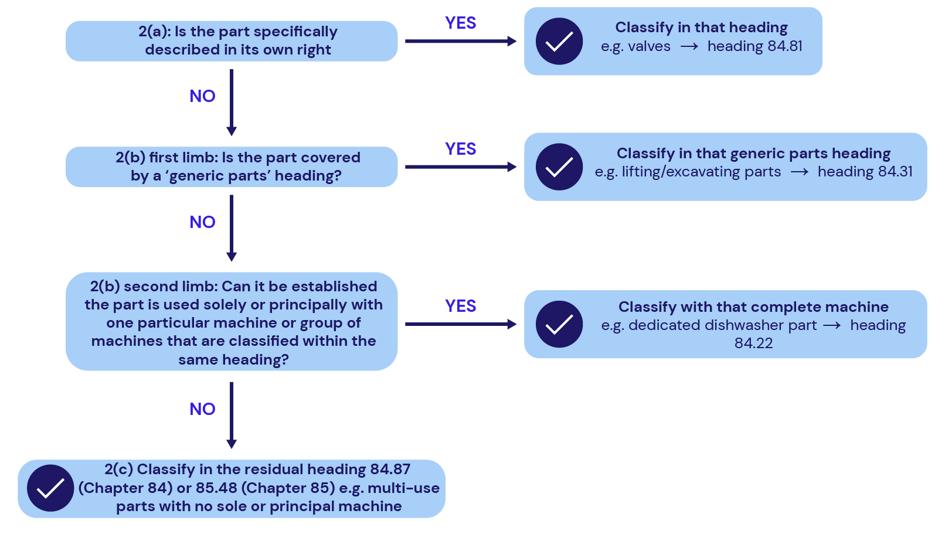
15.20. Parts of parts
A part of a part is an item that does not form part of the final machine or vehicle directly, but instead forms part of a sub assembly or component that itself forms part of the final article. The HS requires you to classify such items at the first complete article for which they are a part, not at the level of the final machine.
This rule prevents classifiers from ‘jumping ahead’ and treating every small component as a part of the ultimate end product. It reflects two legal realities:
|
The HS is structured around complete articles first The Nomenclature organizes goods by what they are, not by where they will ultimately end up. |
A part cannot skip levels An item cannot be classified with a more general article if it already forms part of a more specific one. |
15.21. How to apply the rule
|
1 Identify the part What is it directly a part of? |
→ |
2 Classify at first complete article Use that heading — not the final machine |
→ |
3 Do not skip levels Never jump to the ultimate end product |
|
|
Example 1: Distributor cap for a motor vehicle A distributor cap is: • a part of a distributor • the distributor is classified in heading 85.11 (electrical ignition equipment) • the distributor is itself a part of an engine · the engine is a part of a motor vehicle But the first entity for which the cap is a part is the distributor. Verdict: Distributor cap → classified as a part of heading 85.11 (electrical ignition equipment), not as a part of an engine (84.09) or a motor vehicle (87.08). This prevents over-classification at a higher level. |
|
|
Example 2: Reclining mechanism for an aircraft seat A reclining mechanism is: • a part of a seat • the seat is classified in heading 94.01 • the seat is installed in an aircraft • the aircraft is classified in Chapter 88 But the first complete article for which the mechanism is a part is the seat, not the aircraft. Verdict: Reclining mechanism → classified as a part of a seat, heading 94.01, not as a part of an aircraft (88.07). The HS requires classification at the most specific, immediate level. |
Both examples follow the same logic: classify at the first complete article, not the ultimate end product. A distributor cap is a part of a distributor; a reclining mechanism is a part of a seat. Where the chain ends does not change where classification begins.