Study Guide
| Site: | Centre for Customs and Excise Studies |
| Course: | DHL International Customs Program 2026: Cohort 2 |
| Book: | Study Guide |
| Printed by: | Guest user |
| Date: | Saturday, 17 October 2026, 12:47 AM |
Table of contents
- 1. Introduction
- 2. Part 1: Administration of Customs valuation
- 3. Background to the WTO Valuation Agreement
- 4. Core administrative concepts of Customs valuation
- 5. Transparency in the administration of Customs valuation
- 6. Administrative obligations conferring rights to the importer
- 7. Part 2: Technical rules of the WTO Valuation agreement
- 8. Method I: Transaction value
- 8.1. Situation 1: No sales for export
- 8.2. Situation 2: Sale must meet four conditions
- 8.3. Case study: WCO Advisory Opinion 21.1
- 8.4. Situation 3: Adjustments lack objective and quantifiable data
- 8.5. Situation 4: Customs right to reject the declared value
- 8.6. Price actually paid or payable
- 8.7. Total payment
- 8.8. Activities on the buyer's own account
- 8.9. Discounts
- 8.10. Additions to the price actually paid or payable
- 8.11. Commissions and brokerage
- 8.12. Containers and packing and transportation costs
- 8.13. Assists
- 8.14. Royalties and license fees
- 8.15. Subsequent proceeds
- 9. Method II and III: Identical and similar goods
- 10. Method IV: Deductive value
- 11. Method V: Computed value
- 12. Method VI: Fallback method
- 13. Useful links
1. Introduction
Customs Valuation is one of the most important functions for Customs administrations worldwide. The Agreement on Customs Valuation of the World Trade Organization (WTO) promotes full cooperation between Customs and the trade and business community.
The Agreement on the Implementation of Article VII (Customs Valuation) was developed during the Tokyo Round of GATT (General Agreement on Tariffs and Trade) negotiations (1973-1979) after Customs valuation was identified as a non-tariff barrier (NTB) to trade. When the WTO was established on 1 January 1995, implementation of the Valuation Agreement became compulsory for all WTO members, along with all individual GATT trade agreements that form the overall WTO Agreement 1994.
The Customs Valuation Agreement establishes a fair, uniform, and neutral system for valuing goods for Customs purposes. It prohibits arbitrary or fictitious Customs values and requires that, to the greatest extent possible, the transaction value of the goods be used. This approach is consistent with commercial reality.
Accurate valuation is essential for Customs because it underpins the efficient and effective collection of duties and taxes, ensures a level playing field for traders, and protects government revenue. It also plays a critical role in compliance management: undervaluation, misclassification, and misuse of exemptions are among the most common forms of non‑compliance which can often involve deliberate error or fraudulent intent. A robust valuation system therefore supports both trade facilitation and enforcement by enabling Customs to identify, analyse, and address irregularities that may signal revenue loss or illicit trade.
This study guide covers the theoretical and practical aspects of Customs Valuation in two parts:
· General administration of Customs Valuation.
· Technical requirements - methods for determining Customs value.
2. Part 1: Administration of Customs valuation
Learning objectives
|
✓ |
Explain the importance of Customs valuation in facilitating international trade. |
|
✓ |
Describe the principles underlying how Customs laws on valuation are administered. |
|
✓ |
Identify the key concepts associated with the modern administration of Customs valuation. |
3. Background to the WTO Valuation Agreement
Principles affecting the governance of international trade
The Agreement on the Implementation of Article VII (Customs Valuation) of the General Agreement on Tariffs and Trade 1994 is one of a number of trade agreements that together make up the World Trade Organization (WTO) Agreement. The WTO Agreement grew out of the General Agreement on Tariffs and Trade (GATT).
GATT is essentially a contract between trading nations. Through multilateral trade negotiations, countries agree to follow the same set of rules when they trade with one another.
GATT was established in 1947. Article VII of GATT covers Customs valuation, and it set out the basic principles for determining the Customs value of goods traded internationally.
3.1. GATT rounds
From 1947 onwards, governments met at regular intervals (known as Rounds) to refine the trading rules under GATT.
During the Tokyo Round (1973–1979), Customs valuation was identified as a barrier to trade, specifically a non-tariff barrier (NTB). The problem was that, over the years, customs administrations had developed different rules and practices for valuing goods, and that inconsistency itself got in the way of trade.
The solution was to build an entirely new system: the GATT Valuation Code, which came into effect in 1981.
The last GATT Round, the Uruguay Round, led to the creation of the WTO in 1995. As part of those final negotiations, the GATT Valuation Code was brought into the WTO Agreement. It is now one of the compulsory agreements that every WTO member must sign up to, and its full title is the Agreement on the Implementation of Article VII of the General Agreement on Tariffs and Trade, or simply the WTO Valuation Agreement.
The WTO Agreement is built on fairness, neutrality, and uniform treatment. It is rules-based and uses simple, equitable criteria designed to facilitate trade.
|
GATT established 1947 |
→ |
Tokyo Round 1973-1979: valuation identified as NTB |
→ |
GATT Valuation Code In effect 1981 |
→ |
Uruguay Round Final GATT round |
→ |
WTO established 1995: Agreement compulsory |
Two committees provide international oversight to make sure the WTO Valuation Agreement is applied correctly:
· The WTO Valuation committee meets at WTO headquarters in Geneva and reviews the broad policy issues around how members implement and apply the Agreement.
· The Technical Committee on Customs valuation meets at the headquarters of the WCO in Brussels (formerly the Customs Cooperation Council, or CCC) and helps customs administrations worldwide apply the Customs valuation rules in a standardized, uniform way.
|
Note: Article 18 sets out the institutions responsible for administering the Customs valuation Agreement. Annex II outlines the specific responsibilities of the Technical Committee. |
4. Core administrative concepts of Customs valuation
|
Self-assessment system for declaring goods and their value for duty |
A core concept under modern Customs procedures is placing greater responsibility on those who use Customs services to declare goods and calculate duties and taxes. Self-assessment enables importers to submit declarations electronically, directly linked to Customs computer systems. This places the responsibility for accuracy with the person who has the information. For self-assessment to work, the importer must be fully aware of their obligations in correctly declaring Customs value.
|
Generally Accepted Accounting Principles (GAAP) |
One principle of WTO Valuation requires that all information needed to determine value must be available in the country of importation. Any financial information used to determine Customs value must be prepared and presented in accordance with Generally Accepted Accounting Principles (GAAP) as recognized in the country of importation. This becomes particularly relevant when an element of value is obtained from a source outside the country of importation.
|
Use of objective and quantifiable data |
This term is fundamental to the proper application of the WTO Agreement. It refers to the evidence that must be available to support and verify all aspects of import declarations, including those relating to the valuation of imported goods. The term is generally defined in the national law of each country.
|
Instruments of the WCO Technical Committee on Customs valuation |
The instruments of the Technical Committee on Customs valuation provide guidelines to ensure uniform interpretation and application of national laws. Although they do not have the force of law, they are persuasive, prepared by officials with long experience in administering the WTO Valuation system, and recommended by the WCO to its members.
The instruments[1] cover a wide range of practical topics. The Technical Committee classifies them as follows:
· Advisory Opinions
· Commentaries
· Explanatory Notes
· Case Studies
· Studies
5. Transparency in the administration of Customs valuation
Transparency Measures
|
What do we mean by transparency? Transparency in Customs Valuation means that the value of imported goods is determined using clear, precise, rules-based methods. The value must have a basis in fact, supported by law, regulation, or procedure, on the basis of "objective and quantifiable data." This is why the WTO system is described as a positive system of valuation. The Customs value is built by adding precise elements, each supported by documentary evidence. |
Key transparency obligations under the WTO Valuation Agreement
|
Article |
Transparency obligation |
|
Article 9 |
Publish exchange rates used to convert amounts expressed in foreign currencies and identify when importation is deemed to occur. |
|
Article 12 |
Publish and make available all laws, regulations, administrative directives, and other legal instruments concerning Customs valuation. |
|
Article 16 |
Provide the importer with a written explanation of how a Customs value was determined, upon request. |
5.1. Currency conversion
Article 9 of the WTO Valuation Agreement includes two key requirements governing currency conversion in Customs valuation.
|
01 Publication of rates Members must publish the exchange rates used to convert values expressed in foreign currencies. |
02 Time of conversion Legislation must identify the exact moment "the act of importation" is deemed to occur. This has legal implications for which rate applies. |
5.2. Publication of Laws
Article 12 of the Valuation Agreement requires governments to publish and/or otherwise make available to interested parties, all laws, regulations, administrative directives and other legal instruments concerning Customs valuation.
Over the more than 30 years of application of the system by many countries, it has been found that following a strategy of openness and full disclosure by a government leads to improved compliance.
5.3. Explanation in writing
Article 16 of the Valuation Agreement states that Customs has an obligation to provide an importer with a written explanation of how a Customs value was determined.
The principle is: the importer declares, and Customs determines. If Customs rejects any part of an importer's declaration, it must provide a written explanation of the decision. This gives the importer a basis to appeal if needed. This procedure should not be confused with Customs asking an importer for supporting evidence. Customs is not required to give reasons for that request, and doing so could compromise any investigation.
5.4. Declaration of value
Many national Customs administrations use a valuation declaration form as an important transparency measure. A Value Declaration is a separate declaration by the importer or their agent covering the facts relating to the imported goods. It gives Customs a complete picture of the terms of sale, including the nature of the transaction, payment terms, costs to be adjusted, and costs to be deducted.
A Value Declaration is also used to obtain information on value elements not shown on the invoice - for example, transport and insurance costs, royalties, and "assists." A key function of the form is to act as a checklist for both Customs and the importer. Advantages include:
|
01 Certified accuracy The importer or agent must certify the truth and accuracy of all information presented. |
02 Faster clearance All transaction facts are at the disposal of Customs, enabling more rapid processing. |
03 Separate supporting data Supporting data may be kept separately and made available for Customs review when required. |
|
04 Evidence of noncompliance The document serves as important evidence where noncompliance is determined. |
05 Self-assessment support Reinforces the self-assessment system by placing accountability with the declarant. |
|
A valuation declaration may not be required in all cases. Some administrations require it for each supplier; others require it only when Customs specifically requests it.
5.5. Valuation advice and Valuation rulings
Valuation Advice and Valuation Rulings are important facilities that contribute to transparency and trade facilitation.
5.6. Valuation Advice
Importers using self-assessment may encounter valuation issues they have not dealt with before and may be uncertain about how to correctly declare the Customs value.
|
Scenario An importer receives complicated machinery as project aid goods, supplied free of charge, and is unsure how to value them for Customs purposes. Or a sample of a new product is imported with no available value information. In such situations, Customs should offer the importer the opportunity to request a Valuation Advice. |
Valuation Advice is not a determination of Customs value before importation. It is an explanation of how to address a specific valuation problem. The importer remains free to decide whether to follow the advice when making the formal Customs declaration.
Many modern Customs Administrations provide valuation guidance as a trade-facilitation service. This may take the form of non-binding advice or, in some jurisdictions, legally binding valuation rulings (e.g. Canada) that give traders certainty before importation under an Advance Ruling facility. Private consultancy firms also advise their clients on customs valuation, but such advice has no legal effect.
Valuation Advice is a complement to the self-assessment system and is provided for goods not yet formally imported. Valuation Rulings go one step further.
5.7. Valuation rulings
A Valuation Ruling is a formal determination of customs value, issued after goods have been imported and duties and taxes paid. It results from a post-entry verification process.
|
Stage 1 Post-entry review |
Customs conducts verification of declared value, reviewing all terms and conditions of the sales transaction. |
|
Stage 2 Detailed examination |
If warranted, a comprehensive audit of the importer's books and records is conducted. |
|
Stage 3 Ruling issued |
Customs presents findings: determined value, method used, and any actions required of the importer. |
|
Stage 4 Ruling applied |
All future imports from same supplier under same conditions use the same valuation method (fast-track eligible). |
|
Stage 5 Risk assessment |
Ruling becomes part of Customs risk criteria, allowing focus on higher-risk declarations. |
6. Administrative obligations conferring rights to the importer
The WTO Valuation Agreement imposes obligations and confers rights on both parties to an import transaction, Customs and the importer. Some provisions address the transparency of the valuation process; others protect importer rights.
Key administrative obligations conferring rights to the importer
|
Article |
Administrative obligation |
|
Article 11 |
Provide the right to appeal, without penalty, to an authority within Customs or to an independent body, including a judicial authority. |
|
Article 10 |
Maintain confidentiality of commercial information obtained in the course of determining Customs value. |
|
Article 13 |
Release imported goods before valuation is finalized, provided sufficient guarantee or surety is furnished. |
6.1. Appeal procedures
Article 11 of the Agreement provides that an importer or any person liable for payment of duty has the right to appeal, without penalty, to an authority within the Customs administration or to an independent body. All WTO members must provide in their law for the right of appeal without penalty to a judicial authority. Because courts and judges are often unfamiliar with business practice, many governments have established specialized courts or tribunals. Examples include:
|
01 Administrative Review Tribunal (Australia) Administrative Review Tribunal (ART) is staffed by specialists in trade and Customs law. |
02 Canadian International Trade Tribunal (Canada) CITT handles trade remedy and Customs value appeals. |
03 Court of International Trade (USA) U.S. Court of International Trade (CIT) provides specialized judicial review of Customs decisions. |
The right of appeal under Article 11 applies to decisions by Customs on the determination of Customs value. Cases involving Customs infractions - such as fraud or deliberate undervaluation - fall outside the scope of Article 11. In such cases, subject to national legislation, Customs may require full payment of any penalty as well as fully assessed duties and taxes before the appeal proceeds. An appeal decision will usually result in a valuation ruling that applies to future importations with the same facts and conditions.
6.2. Release of goods on guarantee
Article 13 of the Agreement allows an importer to withdraw imported goods from Customs before the valuation process is complete. Customs cannot detain goods simply because valuation has not been finalized.
Some of the more common situations where the issue of release might arise include:
|
Situation |
Description |
|
Price undetermined |
The price actually paid or payable cannot be determined. |
|
No sale |
No sale has taken place. |
|
Non-transaction method |
The method declared by the importer is other than transaction value. |
|
Article 8 unavailable |
Elements under Article 8 are unavailable at the time of importation. |
|
Special situations |
Split shipments or price escalation arrangements apply. |
|
Goods on consignment |
Goods are imported on consignment prior to sale. |
|
Test value |
The declarant has submitted a test value. |
Customs must release the goods provided the importer or their agent furnishes sufficient guarantee or surety to cover any duties and taxes that may be owed when the value is finally determined. Once goods are released, the importer has full use of them - in production, for resale, or for export. The importer's only obligation is to maintain and make available any documentation needed for the correct determination of Customs value.
|
Key point: implications of release on guarantee Before releasing goods on guarantee, Customs must have verified the importer's identity as a legal entity: their place of business, address, and registration number. The importer must maintain records and books accessible to Customs and provide the names of officers and managers. Once goods are released, Customs must be able to track and account for all related entry documents and any duties owed. A follow-up system must be in place to ensure each entry is either fully acquitted or the bond or surety is cashed. |
Release on guarantee is one of the main trade facilitation features that distinguishes the WTO valuation system from other valuation systems. Under traditional Customs practice, goods were held until any valuation dispute was resolved which was a significant burden on importers who needed access to their goods.
Not all countries have banking or insurance systems developed enough to support formal guarantee or surety arrangements. Where this is the case, many Customs administrations have introduced interim measures that allow importers to defer full payment of duties and taxes while retaining full use of the goods during the dispute resolution process.
6.3. Treatment of confidential information
Article 10 of the Agreement requires that commercial information obtained by Customs in the course of determining Customs value must be kept confidential, except as may be needed in a court of law.
The confidentiality provision may not apply where there is evidence or suspicion of unlawful activity. Customs administrations regularly share information through international agreements, and most governments also have information-sharing arrangements between government departments. E.g., Customs to Revenue or Trade.
6.4. Burden of proof provisions
Article 17 of the Agreement gives Customs the authority to review and investigate declarations of value. WTO negotiators reinforced this during the Uruguay Round by issuing a decision that clearly places the burden of proof on the declarant; it is the importer's responsibility to demonstrate the truth and accuracy of the declared value.
A practical challenge for Customs is establishing sufficient reason to doubt a declared value. The Agreement sets no specific parameters for this; Customs administrations exercise their own judgment, informed by risk assessment criteria. A common trigger is a significant difference between the declared value and prices observed in previous importations or held in historical databases.
Where such differences exist, further investigation may be warranted. However, Customs must exercise this authority carefully and put forward well-founded reasons before pursuing an enquiry. The intent is not to restrict Customs officers from acting on legitimate professional judgment, it is to ensure that enquiries are based on reasoned grounds rather than arbitrary suspicion.
6.5. Compliance Risks in Customs valuation
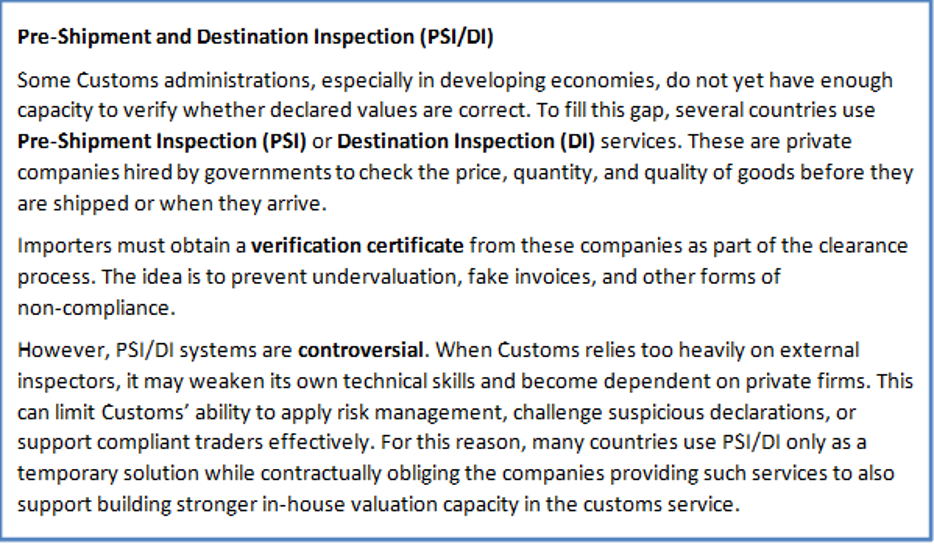
The WTO Valuation Agreement established a fair and uniform system based on transaction value, but its effective implementation depends heavily on the capacity of national Customs administrations. In many countries, limited audit powers, weak post‑clearance controls, and the sheer volume of small consignments - particularly from e‑commerce - have made the system vulnerable to abuse. These vulnerabilities do not arise from the Agreement itself, but from gaps in enforcement, data availability, and institutional capability. Where Customs cannot reliably verify the price actually paid or payable, the valuation system becomes exposed to manipulation.
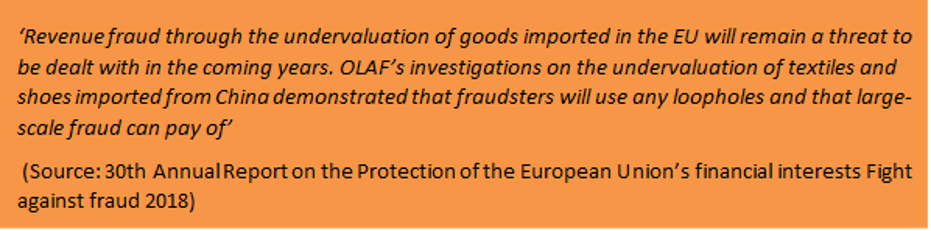
Undervaluation
This is one of the most widespread customs offences globally and has a direct impact on government revenue. When declared values fall significantly below market norms, Customs may suspect revenue loss and initiate checks to verify the true transaction value. These checks can delay clearance, trigger physical examination of cargo, and, depending on national law, may result in administrative fines or seizure of goods. In high‑risk sectors such as apparel, electronics, and e‑commerce parcels, undervaluation is frequently linked to fake invoices, fictitious suppliers, manipulated quantities, or informal payments not reflected in documentation. Such practices undermine the integrity of the valuation system and place additional pressure on already stretched border control resources.
Customs administrations face practical challenges when verifying declared values. Many lack the resources, legal authority and procedures to obtain supplier records or conduct detailed valuation audits. As a result, they rely heavily on risk indicators such as historical import data, valuation databases and price trends through internet searches. Although valuation databases cannot be used to determine customs value under the WTO Agreement, they are routinely used to identify anomalies and establish “reason to doubt” before an enquiry is opened. Where significant discrepancies exist, Customs may suspend release until satisfactory evidence of the true transaction value is provided.
Overvaluation
While less common, remains a significant compliance concern. It occurs when the declared value is higher than the true price actually paid or payable. This practice is often used for transfer pricing manipulation, enabling multinational groups to shift profits out of high‑tax jurisdictions by inflating intra‑company prices. Overvaluation is also used in money‑laundering schemes, where inflated invoices allow illicit funds to be moved across borders under the guise of legitimate trade. In some countries, exporters inflate values to obtain higher VAT refunds, duty drawback, or subsidy payments. Although overvaluation does not reduce customs revenue, it is closely associated with tax evasion, illicit finance, and export fraud and must be recognised as a compliance red flag.
Both undervaluation and overvaluation distort trade data, undermine the effectiveness of customs controls, and complicate the administration of revenue collection. Recognising implausibly low or high declared values and understanding the systemic weaknesses that allow such practices to occur is essential for maintaining the integrity of the valuation system and supporting lawful, transparent international trade.
6.6. Case study: E Commerce and the modern undervaluation challenge
7. Part 2: Technical rules of the WTO Valuation agreement
Learning objectives
|
✓ |
Identify the six methods of Customs valuation and the hierarchical order in which they must be applied. |
|
✓ |
Explain the conditions under which transaction value can be used as the primary basis for Customs value. |
|
✓ |
Apply the rules governing movement from one valuation method to the next. |
Part 2 provides a detailed understanding of the various methods of valuation. It explains how each method is applied, the rules governing movement from one method to the next, how WTO Principles are applied in practice, and which valuation methods are prohibited.
|
|
Further reading: WTO Valuation Agreement · Article VII of the General Agreement on Tariffs and Trade (GATT) · General Introductory Commentary · Articles 1 to 8 · Interpretative Notes to Articles 1 to 8 |
The primary basis for Customs value under the Agreement is the transaction value of the imported goods, the price actually paid or payable for goods sold for export to the country of importation.
Where transaction value cannot be determined, or where those conditions cannot be met, the Agreement provides five alternative methods, applied in strict hierarchical order:
|
Method |
Name |
Basis for Customs value |
|
I |
Transaction Value |
The price actually paid or payable for goods sold for export, adjusted per Article 8. This is the primary method. |
|
II |
Identical goods |
The transaction value of identical imported goods, previously accepted under Method I. |
|
III |
Similar goods |
The transaction value of similar imported goods, previously accepted under Method I. |
|
IV |
Deductive Value |
A unit price at which the imported goods, or identical or similar goods, are sold in the country of importation to an unrelated buyer, with deductions made for costs incurred after importation. |
|
V |
Computed Value |
The sum of the cost of materials and fabrication, plus an amount for profit and general expenses. For the WTO member country chooses to base the customs value on Cost, Insurance, and Freight (CIF), the cost of transportation and insurance to the place of importation is also included. |
|
VI |
Fallback Method |
Where none of the above methods can be applied, Customs value is determined using reasonable means consistent with the principles and general provisions of the Agreement and Article VII of GATT 1994. |
Each method is applied only when the one before it cannot be used. The Agreement does not permit Customs to skip the hierarchy or apply methods out of order.
Because the customs valuation provisions of WTO Members typically replicate the six‑method hierarchy in domestic law, Customs administrations are legally bound to apply the methods in the same strict sequence set out in the Agreement. Skipping methods or applying them out of order is not permitted under either international or national legislation
8. Method I: Transaction value
Introduction
Transaction value is the primary method for determining Customs value and accounts for roughly 85–95% of all import declarations globally. The transaction value is the price actually paid or payable for the goods when sold for export to the country of importation, adjusted in accordance with Article 8. The General Introduction to the Agreement on Implementation of Article VII of the GATT states that Members recognize that the basis for Customs valuation should, to the greatest extent possible, be the transaction value.
The method follows five steps:
|
01 Identify The import sales transaction. |
→ |
02 Determine the price paid or payable. |
→ |
03 Deduct allowable deductions. |
→ |
04 Add Article 8 additions. |
→ |
05 Convert currency if required. |
Article 8 adjustments
|
✔ Added to the price (Article 8) |
✘ Not added to the price |
|
· Commissions and brokerage (except buying commissions) · Containers and packing costs and charges for export preparation · Production and services “assist” costs · Royalties and license fees · Overseas freight and insurance · Proceeds of subsequent resale, use, or disposal that accrue to the seller |
· Financing costs · Assembly, erection, construction, maintenance, or technical assistance after importation · Inland freight and insurance in the country of importation · Duties and taxes of the country of importation · Costs, charges and expenses undertaken by the buyer on the buyer’s own account |
8.1. Situation 1: No sales for export
|
Method 1 can only be applied where the goods are subject to a sale. If there is no sale, there is no transaction value. |
The three requirements that must be met to apply the transaction value of Article 1:
1. There must be a sale for export.
2. The sale must be for export to the country of importation.
3. It must be possible to determine the price actually paid or payable.
If one of the above requirements is not met, transaction value of Article 1 is not applicable, and another method of valuation must be used.
Sales
Generally, a sale involves the transfer of property from one party to another for financial consideration. A valid sale requires four elements:
|
01 A buyer An identifiable party acquiring the goods. |
02 A seller An identifiable party transferring the goods. |
|
03 An agreed price A fixed or determinable amount exchanged. |
04 Transfer of title Legal ownership passes from seller to buyer. |
Title to the goods
To establish whether ownership has transferred, consider whether the buyer has:
· Assumed the risk of loss.
· Liability for goods lost or damaged during shipment.
· Acquired title to, or legally possesses or owns, the imported goods.
Terms of Trade
When no other evidence is available, the terms of sale can indicate who acquired title and when. Common terms under the so-called International Commercial Terms (INCOTERMs) include:
· Ex-Factory
· Free On Board (FOB)
· Cost Insurance Freight (CIF)
· Delivered Duty Paid (DDP)
From the terms of sale, Customs can determine who acquired title, who assumed the risk of loss, and at what point this occurred.
Buyer and seller versus agent and principal
In a buyer-seller relationship, the parties stay independent. In a principal-agent relationship, the principal controls the actions of the agent. The relationship is a buyer-seller relationship if the potential buyer:
· Provided, or could provide, instructions to the seller.
· Was free to sell the goods at any price.
· Selected, or could select, their own customers without consulting the seller.
· Could order the goods and have them delivered for inventory.
If a potential buyer does not carry out such tasks, it is generally a firm indication that the party is acting solely as an agent.
When no sales exist
WCO Advisory Opinion 1.1 identifies situations where imported goods would not be the subject of a sale:
|
01 Gifts, samples, promotions Items furnished free of charge with no commercial transaction. |
02 Consignment goods Shipped for sale after importation for the account of the supplier. |
|
03 Leasing contracts Imported under a lease — title does not transfer. |
04 Loaned goods Goods provided on loan — no sale has occurred. |
|
Key point: sale for export The first step in determining Customs value under transaction value is to establish that a sale for export to the country of importation has occurred. If no such sale exists, the transaction value method is not appropriate. |
|
|
Example 1: identifying a sale for export Seller S in the exporting country X enters a contract to sell electric appliances to importer A in the importing country I at USD 5.75/piece. Manufacturer M (also in country X) produces and ships the goods to A on behalf of S. M's price to S is USD 5/piece. Is there a sale for export? ➡️ Yes. In this case, the transaction between S and A is an actual international transfer of goods and constitutes a sale for export to the country of importation. |
|
|
Example 2: buyer and seller both in the country of importation Buyer B in the importing country I purchases goods from seller S in the same country I. The goods are stocked by S in country X. Necessary arrangements for shipments and export of the goods from country X are completed by S, and the goods are imported by B into country I. Is there a sale for export? ➡️ Yes. The location of the seller is not relevant. The transaction between S and B is a sale for export to the country of importation. |
|
|
Example 3: sale on the high seas Seller S in country X sells goods to buyer A in country I and accordingly ships the goods. While the goods are on the high sea, buyer A is unable to make the payment and take delivery of the goods. S sells to a new buyer B also in country I and arranges the delivery. Accordingly B imports the goods into country I. Which is the sale for export? ➡️ The sale between seller S and buyer B results in the importation of the goods which, in turn, establishes it as being a sale for export. The transaction constitutes an international transfer of goods and would be the basis for valuation of the goods under Article 1 |
8.2. Situation 2: Sale must meet four conditions
|
Even where a sale has occurred, the price cannot be accepted automatically as Customs value. The sale and price must meet all four conditions in Article 1 of the Agreement:
|
|
Key point: Where a sale for export has occurred, the existence of one or more of the four conditions above constitutes the ONLY reason(s) for not using Transaction Value. This reinforces the Agreement's principle that Customs valuation should, to the greatest extent possible, be based on transaction value. |
Condition 1: Restrictions on disposition or use
Sellers sometimes restrict how a buyer may dispose of or use imported goods. Paragraph 1 (a) of Article 1 identifies restrictions that would not disqualify the use of transaction value:
|
Restriction type |
Example |
|
Imposed by law or public authorities |
A license is required before sale (for example, firearms); labeling requirements; inspection by public authorities. |
|
Geographical area of resale |
A territorial restriction (for example, a regional distributorship); goods may be resold only within a specified area. |
|
Does not substantially affect value |
The seller requires the buyer of automobiles not to sell or exhibit them before a fixed date (the start of the model year); a door-to-door sales requirement. |
WCO Commentary 12.1 identifies factors for deciding whether a restriction has substantially affected value:
· The nature of the restriction.
· The nature of the imported goods.
· The nature of the industry and its commercial practices.
· Whether the monetary effect is commercially significant.
Condition 2: Condition or consideration
The sale or price must not be subject to a condition for which a value cannot be determined. Paragraph 1 (b) of Article 1 of the Interpretative Notes to the Agreement gives the following examples:
Condition 3: Subsequent proceeds
Transaction value may be used provided that no proceeds of any resale or use of the goods accrue to the seller without being accounted for in determining Customs value.
Article 8.1 (d) directs:
|
8. (d) the value of any part of the proceeds of any subsequent resale, disposal or use of the imported goods that accrues directly or indirectly to the seller. |
This adds any part of the proceeds of a subsequent resale that accrues to the seller to the price actually paid or payable. If the value of the proceeds can be determined, this restriction on the use of transaction value does not apply. For example, the sale for export may be based on a fixed payment at the time of sale, plus a further payment when the goods are resold in the country of importation. The mechanics of adding proceeds under Article 8 are covered later, under "Subsequent proceeds (Article 8 addition)."
Condition 4: Related parties
Transaction value can be accepted provided that any relationship between the buyer and seller has had no influence on the price.
Article 15.4 of the Agreement defines related parties as follows:
|
(a) they are officers or directors of one another’s businesses; (b) they are legally recognized partners in business; (c) they are employer and employee; (d) any person directly or indirectly owns, controls or holds 5 percent or more of the outstanding voting stock or shares of both of them; (e) either the seller of the buyer directly or indirectly controls the other; (f) both are directly or indirectly controlled by a third person; (g) together they directly or indirectly control a third person; or (h) they are members of the same family. |
Related Parties in Multinational Enterprise (MNE) Supply Chains
Multinational enterprises (MNEs) often move goods between parent companies, subsidiaries, branch offices, or sister entities located in different countries. Under Article 15.4 of the WTO Agreement on Customs Valuation, these entities are considered related parties.
In MNE supply chains, internal transfer prices may be shaped by group‑level policies such as tax planning, cost‑sharing arrangements, or profit‑allocation frameworks. As a result, the declared customs value may differ from the price that would be paid by an independent buyer in a comparable transaction.
Under the WTO Agreement, the transaction value may still be used even when the buyer and seller are related. The importer is required to demonstrate that the relationship did not influence the price only when Customs has reason to doubt the accuracy or acceptability of the declared value. If such doubt arises, Customs may request additional information. Importers may therefore need to provide inter‑company agreements, transfer‑pricing documentation, or evidence of prices charged to unrelated buyers to support the arm’s‑length nature of the declared value. This documentation can be relevant, although it is not conclusive for customs valuation purposes.
8.3. Case study: WCO Advisory Opinion 21.1
WCO Advisory Opinion 21.1 concludes that the fact that sole agents may have close associations with their suppliers does not in itself provide reason to treat them as related parties.
WCO Explanatory Note 4.1
The WCO Technical Committee has interpreted the word "control" in Explanatory Note 4.1. While any contractual situation places some degree of restraint or direction on one party, for one person to control another, that person must be legally or operationally in a position to exercise restraint or direction. The Note concludes that the buyer and seller are not related when they are:
- · Free to negotiate or not negotiate.
- · Free to enter or not to enter into a contract.
- · Free to terminate the contract by action specified in the contract or by choosing not to renew the contract.
A branch office would normally be considered related to the parent company. In some countries, branch offices are not considered separate legal entities. In such cases, there is no sale occurring and therefore no transaction value. The transaction value method could not be used to determine Customs value.
In interpreting the expression ‘the same family’, the determination of those who are members of the same family is normally a matter for national consideration. The following are examples:
|
Husband and wife |
Uncle and nephew |
|
Parent and child |
Uncle and niece |
|
Brother and sister |
Aunt and nephew |
|
Stepbrothers |
Brothers-in-law |
|
Stepsisters |
Sisters-in-law |
|
Grandparent and grandchild |
Adoptive parent and adoptive child |
The Agreement makes clear that the fact alone that the buyer and seller are related gives no grounds for rejecting the transaction value. If they are related, the transaction value will be accepted provided the relationship does not influence the price.
Determining and demonstrating whether a relationship has influenced the price can present difficulties for both importers and Customs administrations. The Agreement in paragraph 2 (a) and (b) of Article 1 makes two suggestions:
- · First, in consultation with the importer, by an examination of the circumstances of sale to determine whether the price was influenced by the relationship.
- · Second, by a comparison with sales between an unrelated buyer and seller, or with Customs values of identical or similar goods.
In a sale between related parties, it is the obligation of the declarant to demonstrate to the satisfaction of Customs that the selling price has not been influenced by the relationship.
The issue of relationship and price influence is the subject of ongoing studies within business and Customs communities. The high volume of international transactions between multinational companies keeps this matter at the forefront of Customs valuation issues.
8.4. Situation 3: Adjustments lack objective and quantifiable data
Any additions to the price must be based on documented evidence and absolute amounts. Additions based on estimates or past experience should be avoided. The importer must be prepared to assist Customs by maintaining and providing evidence in support of their declaration. Without objective and quantifiable data, Customs cannot verify the transaction value.
8.5. Situation 4: Customs right to reject the declared value
The Customs right to reject values is based on Ministerial Decision 6.1, taken as a result of the Final Act of the Uruguay Round/GATT 1994. The WTO recognized that Customs administrations need practical authority to combat infractions such as undervaluation at the first clearance stage. The decision has been incorporated into the Agreement at Article 17.
|
Article 17 Nothing in this Agreement shall be construed as restricting or calling into question the rights of customs administrations to satisfy themselves as to the truth or accuracy of any statement, document or declaration presented for customs valuation purposes. |
The degree of information required before rejection of a declared value is determined on a case-by-case basis, taking all relevant circumstances into account. Risk management and compliance management concepts are relevant here, though these concepts are not covered in this module.
Arbitrary Customs actions are fully mitigated by the rights accorded to importers under Articles 9, 10, 11, 12, 13, and 16.
8.6. Price actually paid or payable
The following key principles apply:
· Customs value should be based on simple and equitable criteria consistent with commercial practices.
· Commercial reality is best represented by the transaction between the buyer and seller.
· In determining the price actually paid or payable, reference prices, market values, or any external standards are irrelevant.
· Provided the price actually paid or payable is set between buyer and seller under conditions satisfying Article 1, and the adjustments allowed by Article 8 can be made, that price is acceptable for determining Customs value.
· Prices below normal market values are acceptable (WCO Advisory Opinion 2.1), provided they fulfill the conditions applicable to the transaction value method.
· Subsidized and dumping prices are acceptable bases for valuation under the above conditions. The Agreement is not to be used to combat subsidies or dumping (Commentaries 2.1 and 3.1).
|
Key point: The price actually paid or payable and the transaction value method account for approximately ninety-five percent of all value determinations under the WTO Agreement. |
8.7. Total payment
“Total payment” is everything the buyer pays as a condition of the sale, directly or indirectly, now or in advance, whether it goes to the seller or to a third party on the seller’s instruction.
|
✔ Counts as total payment |
✘ Not part of it |
|
· Total payment made or to be made as a condition of sale · All payments by the buyer to the seller · Payments to third parties as a condition of sale · Indirect payments · Advance payments · Any other payments tied to the sale |
· Fees for transferring money · Letters of credit · Negotiable instruments · Settlement of the buyer’s own debts |
|
Key point: These payments are a direct condition of the sale of the imported goods, so the total payment may differ from the invoice value of the goods. Any payment made by the buyer to the seller or to another party as a requirement imposed by the seller is part of the price actually paid or payable for the imported goods. |
8.8. Activities on the buyer's own account
The Interpretative Note to Article 1 gives further guidance on the price actually paid or payable. Paragraph 2 states that the value of activities the buyer undertakes on its own account, other than those for which Article 8 provides an adjustment, are not to be added to the price actually paid or payable.
|
✘ Not added to the price actually paid or payable |
|
· Market studies and market research · Advertising the brand or trademark the goods are sold under · Preparing a showroom · Taking part in trade fairs and exhibitions · Testing · The cost of obtaining a letter of credit |
Post-importation charges
|
✘ Excluded when distinguishable from the price |
|
· Construction, erection, assembly, maintenance or technical assistance carried out after importation (for example on industrial plant, machinery or equipment) · Transport after importation · Duties and taxes of the country of importation |
8.9. Discounts
The transaction value generally takes account of any discount the seller offers the buyer. Discounts are allowable because of the definition of the price actually paid or payable: if the price reflects a discount, the discount is allowed, since the discounted amount is the total payment made for the benefit of the seller of the imported goods.
Common discounts include:
|
01 Cash discounts |
02 Trade-level discounts |
|
03 Quantity discounts |
04 Loyalty discounts |
In some cases, the price of the imported goods is subject to a pricing arrangement between buyer and seller. These include, among others:
• Price review clauses.
• Package deals.
• Split consignments.
|
Note: In any of these cases, the importer must justify the declared value on the basis of the price actually paid or payable, supported by objective and quantifiable data. |
8.10. Additions to the price actually paid or payable
The transaction value is the price actually paid or payable, adjusted by adding certain elements under Article 8 of the Agreement. Additions are not always necessary; it depends on the facts of the sale contract and its terms.
Article 8 additions fall into two categories: those that must always be added (compulsory adjustment), and those that apply only in countries that include overseas transport in the Customs value (optional).
|
Compulsory — always added |
Optional — CIF countries only |
|
• Selling commissions and brokerage • Cost of containers and packing • Value of assists used in producing or selling the goods • Royalties and licence fees • Proceeds of resale or use |
• Cost of transporting the goods to the port or place of importation • Loading, unloading and handling charges for that transport • Cost of insurance |
Countries may choose to include (CIF) or exclude (FOB) the cost of overseas freight and insurance. Countries that include overseas transport require the optional additions shown above.
|
Note: The elements Article 8 lists are the only additions allowed, and each can be made only on the basis of objective and quantifiable data. Where that data is not available, the transaction value method cannot be used. |
8.11. Commissions and brokerage
A commission is financial consideration usually paid to an intermediary (an agent) who buys or sells goods for the account of a buyer or seller but never takes title to them. An agent acting for the seller is a selling agent; an agent acting for the buyer is a buying agent. Brokerage is the fee paid to a broker: an agent who works for both sides, bringing buyer and seller together, often specialising in commodities such as oil, sugar or grain.
|
Key Point: Article 8 adds all commissions to the price except buying commissions. Every other commission and brokerage the buyer pays to intermediaries is added, provided the seller has not already built the amount into the invoiced selling price. |
Selling commission
The payment a selling agent receives for concluding a contract is usually called the selling commission. Goods sold through a seller's agent usually cannot be bought without paying the selling agent's commission.
|
No adjustment needed |
Add to the price |
|
· The supplier pays the agent and quotes an inclusive price · The commission is already reflected in the invoiced price |
· The terms of sale require the buyer to pay a commission · The buyer pays it (usually direct to the agent) on top of the invoiced price |
Buying commission
Buying commissions are specifically excluded as an adjustment under Article 8 (See WCO Commentary 17.1). To decide whether a payment to a buying agent is consistent with the Commentary, Customs administrations consider whether:
• The agent’s role and function are set out in a written contract or agreement
• The agent acts in line with the role the contract defines
• The importer controls the purchasing process
• The manner of payment is made shows the agent buys the goods only at the importer’s direction
• The agent’s actions show it acted primarily for the benefit of the importer or buyer
• The relationship, especially the financial one, indicates that the parties are actually acting as a principal and agent.
• The importer or buyer carries the risk for damaged, lost or defective goods
• The agent makes no profit beyond the commission the buyer pays
• The buyer is entitled to full disclosure of any transactions the agent makes on the buyer’s account
8.12. Containers and packing and transportation costs
The cost of containers treated as one with the goods for Customs purposes, and the cost of packing (both labor and materials), is added to the price actually paid or payable. The seller may invoice such containers and packing separately from their contents, because they may be made to the buyer's specifications.
|
Note: Watch the word “containers” In this context, the cost of containers does not refer to large shipping containers, pallets, drums, or other means of conveying cargo in international trade. Costs and charges for those types of containers, used as a means of transport, are covered as optional adjustments under Article 8.2 of the Agreement. |
8.13. Assists
Under Article 8.1(b), the value of goods and services the buyer supplies to the seller, directly or indirectly, free of charge or at reduced cost, for use in producing or selling the imported goods for export is added to the price, because the seller would not have included their cost. These are often called production or sales assists, though this term is not used in the Agreement.
Assists in Article 8 consist of:
• Materials, components, parts and similar items incorporated in the imported goods
• Tools, dies, moulds and similar items used in producing the goods
• Materials consumed in producing the goods
• Engineering, development, artwork, design work, plans and sketches done outside the country of importation and needed to produce the goods
|
Note: An important exception Engineering, development, artwork, design work, plans and sketches carried out within the country of importation are not added, an exception meant to encourage development work in the country of importation. |
|
|
Example An importer of shirts supplies bolts of material to the shirt manufacturer (the seller) free of charge. The cost of the material, the cost of the transporting it from the country of importation to the country of manufacture, and any taxes on its export or its import into the country of manufacture all form part of the Customs value of the shirts. This is an example of the first kind of assist. |
Valuation of assists
|
If the assist was… |
Value to add |
|
Supplied free of charge |
The full value of the assist |
|
Supplied at reduced cost |
The full value, minus any amount the seller paid |
|
Acquired from a party not related to the importer |
The cost to acquire it |
|
Produced by the importer or a related person, or bought from a related source |
The cost to produce it |
8.14. Royalties and license fees
A royalty or licence fee is added to the price only when all four of these conditions are met.
- The buyer pays it, directly or indirectly. It does not matter to whom it is paid; what matters is that the buyer is obliged to pay.
- Payment of the royalty or license fee must be a condition of the sale of the imported goods. The test is: can the goods be imported without paying the royalty or license fee? If they can, it is not a condition of sale. If they cannot, it is a condition of sale.
- The royalty or license fee must relate to the imported goods being valued. It must bear directly on the goods being imported.
- The royalty or license fee must not already be included in the price actually paid or payable.
The Interpretative Notes to Article 8.1 (c) give additional guidance on the treatment of royalties and license fees:
- · Royalties and license fees may include payments for patents, trademarks, and copyright.
- · Payments, however described, for the right to reproduce the imported goods in the country of importation are not added.
- · Payments by the buyer for the right to distribute or resell the imported goods are not added, provided they are not a condition of the sale of the goods.
8.15. Subsequent proceeds
An addition to the price actually paid or payable is made for the value of any part of the proceeds of a subsequent resale, disposal, or use of the imported goods that accrues, directly or indirectly, to the seller.
|
Proceeds are added when they are… |
|
✓ Paid by the buyer to the seller ✓ Based on the resale, disposal or use of the imported goods |
Proceeds differ from royalties in one key way: proceeds must be paid by the buyer to the seller.
9. Method II and III: Identical and similar goods
These two methods are treated together because the application of each method is identical. The only difference is the definition of "identical" and "similar."
If transaction value cannot be used (for one of the four reasons in Article 1, or because there is no selling price), the first alternative is Article 2 (identical goods). If a value still cannot be found, the next alternative is Article 3 (similar goods).
|
Note: How these differ from Article 1 Article 1 determines transaction value from the price actually paid or payable for the imported goods themselves. Articles 2 and 3 instead borrow a previously accepted transaction value (under Article 1) from another import of substitute goods. Therefore, Customs must find an already-accepted value for identical or similar goods. |
These alternatives usually involve consultation between Customs and the importer. Either side may hold information about the transaction value of identical or similar goods that the other does not and sharing it can help establish which goods qualify.
A key operational requirement is that the comparison value must be a previously accepted transaction value under Article 1 in the country of importation. Customs cannot construct or estimate a value, and hypothetical prices cannot be used. In practice, the availability of qualifying identical or similar goods is often the limiting factor, especially where import volumes are low or product ranges change frequently.
9.1. Defining identical and similar goods
Article 15 of the Agreement defines “identical” and “similar” goods.
What makes goods “identical”?
|
Conditions for the identical goods method |
|
|
✓ The goods are identical to the imported goods being valued ✓ They were produced in the same country as the goods being valued ✓ They were exported at or about the same time (“about” means 30 days before and/or after importation) ✓ They were sold in substantially the same quantity and at the same commercial level (adjustments can be made for differences in quantity and commercial level)
|
What makes goods “similar”?
Similar goods are not alike in every respect, but they share like characteristics and like component materials that let them perform the same functions and be commercially interchangeable with the imported goods.
All of the conditions (i.e. previously accepted transaction value, time element, etc.) set above for identical goods apply in the same manner for the similar goods method.
Where identical or similar goods were sold in different quantities or at a different commercial level, adjustments may be made but only if they are objective, quantifiable, and based on demonstrable data. If reliable adjustments cannot be made, the method cannot be applied. This is a frequent operational barrier, particularly for goods with negotiated pricing, customised specifications, or volatile market conditions.
10. Method IV: Deductive value
Deductive value (Method IV) and computed value (Method V) reach the Customs value from opposite directions. Deductive value starts from the price at which the goods are resold inside the importing country and works backwards, stripping out importing-country costs to bring the price back to the point of importation.
The starting base is the unit price at which the imported goods (or identical or similar imported goods) are resold. The Interpretative Notes to the Agreement give worked numerical examples. That unit price is the one at which the goods are:
- · sold in the greatest aggregate quantity.
- · at or about the time of the importation of the goods being valued.
- · to persons not related to the persons from whom they buy such goods.
Once the unit price is established, the Customs value is determined by making the following deductions:
|
✘ Deduct from the unit price |
|
· Either the commission usually paid, or the usual profit and general expenses on sales in the importing country of goods of the same class or kind · The usual transport, insurance and associated costs incurred within the importing country · Where appropriate, the costs and charges referred to in Article 8.2 · The customs duties and other national taxes payable in the importing country |
If there is no sale at or about the time of importation of the goods being valued, the Agreement allows the Customs value to be determined based on the price at which the imported goods, or identical or similar goods, are resold in the condition as imported, at the earliest date after importation but before the expiration of 90 days. The following conditions must be met:
|
Condition |
Requirement |
|
Domestic sale |
There must have been a domestic sale of the imported goods, or of identical or similar goods, in the country of importation. |
|
Same condition |
The goods must be sold in the same condition as when first imported. |
|
Unrelated buyer |
The resale must be to an unrelated buyer at the first commercial level after importation. |
|
Greatest quantity |
The unit price is the price at which the greatest number of units have been sold. |
|
Timing |
The goods must be resold at or about the date of importation of the goods being valued. |
|
No assist sales |
Any sale to a person who supplied an assist under Article 8.1 (b) may not be used. |
|
90-day fallback |
If no qualifying sale exists at or about the date of importation, a sale at the earliest date after importation but before the expiration of 90 days may be used. |
In short, the method seeks to establish a unit price for the imported goods sold when they are sold on the domestic market of the importer and then to make appropriate deductions for expenses and profit in the country of importation to bring the price back to the point of importation.
10.1. Commissions, or profit and general expenses
In addition to the costs and charges listed above, the deductive value method provides for the deduction of either of commissions or profit and general expenses.
|
Deduct a commission |
Deduct profit & general expenses |
|
• The goods are consigned to an agent or sales representative • That agent imports the goods and is paid a commission for selling-agency work on behalf of an overseas vendor |
• The goods are resold by a buyer / reseller and transaction value does not apply because an Article 1.1 condition is not met • The importer incurs expenses and earns profit on the resale in the importing country |
The amount deducted should be based on figures supplied by or for the importer, unless they are inconsistent with the profits usually made in the industry. Determining of what “usual” profile and general expense for goods of the same class or kind are when render the Deductive value method effective. Such information may be obtained from industry sources.
11. Method V: Computed value
Computed value works in the opposite direction to deductive value: it builds the Customs value up from the cost of producing the goods in the exporting country.
The Computed Value Method determines Customs value by totalling the following elements:
|
01 Materials and fabrication The cost or value of materials and fabrication or other processing employed in producing the imported goods. |
02 Profit and general expenses An amount equal to that usually reflected in sales of goods of the same class or kind by producers in the country of exportation for export. |
03 Other expenses All other expenses necessary to reflect the valuation option chosen under Article 8.2 - including transport, loading/unloading, handling, and insurance. |
The following additional points are relevant to the Computed Value:
- · The customs value is determined on the basis of information readily available in the country of importation
- · Use of the Computed Value Method is generally limited to cases where the buyer and seller are related, due to the commercially sensitive nature of the information that must be provided.
- · The producer of the goods must be willing to supply the necessary cost information and agree to any subsequent verification.
- · Cost and value information of the imported goods must be based on the commercial accounts of the producer, consistent with generally accepted accounting principles.
- · Profit and general expenses information must be consistent with that usually reflected in sales of goods of the same class or kind.
- · No contracting party to the Agreement may require or compel any person not resident in its own territory to produce for examination, or to allow access to, any account or other record
- · “Goods of the same class or kind” (defined in Article 15) are goods in a group or range produced by a particular industry or sector, including identical or similar goods; they must be from the same country of exportation, judged case by case.
In the experience of countries applying the Valuation Agreement, this is the least-used of the six methods provided within the WTO Agreement, for the reasons listed above.
12. Method VI: Fallback method
If no earlier method can determine the value, the fallback method applies. The value is then determined by reasonable means consistent with the general provisions of the Agreement and Article VII of GATT 1994, and on the basis of data available in the country of importation.
How the fall-back method works
- · The Interpretative Note to Article 7: So far as possible, base the value on previously determined Customs values, applying Articles 1–6 with reasonable flexibility
- · WCO Advisory Opinion 12.2: Keep to the hierarchical order
- · WCO Advisory Opinion 12.1: If a flexible application of Articles 1–6 still gives no value, other reasonable methods may be used, except those prohibited by Article 7.2
The value rests on data available in the importing country, but WCO Advisory Opinion 12.3 makes clear that Article 7 is silent on the original source of the data. Data drawn partly from foreign sources is not barred, provided it is available in the importing country and Customs can satisfy itself of its truth and accuracy.
|
✘ Prohibited methods (Article 7.2) |
|
Never used to set the Customs value ✕ The selling price in the importing country of goods produced in that country ✕ A system that accepts the higher of two alternative values ✕ The price of goods on the domestic market of the exporting country ✕ A cost of production other than a computed value determined for identical or similar goods under Article 6 ✕ The price of goods sold for export to a country other than the importing country ✕ Minimum customs values ✕ Arbitrary or fictitious values |
|
Key point: The six methods run in strict order, each used only when the one before it cannot be, and the fall-back method is bounded by the seven approaches Article 7.2 prohibits. |
Price‑Referencing Databases and Arbitrary Values
Price‑referencing databases are increasingly used by Customs administrations as part of risk assessment. These tools—often commercially licensed—provide up‑to‑date unit prices and market data for commonly traded goods. They help identify potentially fictitious or unreasonably low declared values, supporting Customs in detecting anomalies that may warrant further enquiry or post-clearance audit.
This practice aligns with WCO thinking, which recognises that external data sources can legitimately inform risk management, provided they do not replace the WTO valuation methods. The WCO has consistently emphasized that such databases may be used as risk indicators but must not be used to determine or adjust customs value.
In line with Article 7.2 of the WTO Valuation Agreement, Customs must still determine value strictly through the six‑method hierarchy. Database prices cannot be substituted for transaction value or used as minimum values. When applied correctly, price‑referencing databases enhance risk assessment while preserving the prohibition on arbitrary or fictitious values.
13. Useful links
n World Customs Organization Valuation: http://www.wcoomd.org/en/topics/valuation.aspx
n World Trade Organization WTO Valuation Agreement: http://www.wto.org/english/tratop_e/cusval_e/cusval_e.htm
n Organization for Economic and Commercial Development Centre for Tax Policy: http://www.oecd.org/ctp/tax-policy/
n Informed Compliance Publications – Customs Value: https://www.cbp.gov/trade/rulings/informed-compliance-publications