
Study Guide
11. Structure of a chapter – Headings, subheadings and the dash system
11.5. Significance of the Dashes
Understanding the hierarchical structure of the Harmonized System (HS) is essential for accurate classification. To help users compare subheadings correctly, the HS uses a dash system to show the relationship between levels of subdivision. This visual structure guides the classifier step by step toward the correct subheading.
|
– 5-digit subheading A single dash marks the first level of subdivision within a heading. |
- - 6-digit subheading Two dashes mark the next level down, belonging to a single-dash parent. |
|
Note: Watch out for “other” Because the HS provides a classification for all goods in international trade, many headings include residual subheadings, normally denoted by the word “other”. As the word “other” appears frequently, care must be taken to ensure that the correct “other” is selected within the correct part of the structure. Classification into an “other” subheading should only occur once all more specific descriptions have been systematically considered and excluded. “Other” is the final outcome of a structured, step by step classification process, not a default option. Misclassification often occurs when an “other” subheading is selected prematurely, before the specific alternatives have been properly assessed. |
When working through subheadings, apply this sequence in order:
|
1 |
Within a heading, compare only the one-dash subheadings as these form the first level of subdivision. |
|
2 |
Once you have identified the correct one-dash subheading, check whether it is further subdivided into two-dash subheadings. |
|
3 |
If it is, compare only the two-dash subheadings that fall under that specific one-dash subheading. |
|
4 |
Do not compare two-dash subheadings belonging to a different one-dash group. |
This hierarchical approach keeps the classifier within the correct part of the structure and avoids selecting the wrong “other”.
The next two examples show this in heading 95.06. Example 1 shows the dash structure visually. Example 2 then uses that structure to classify a baseball bat.
|
|
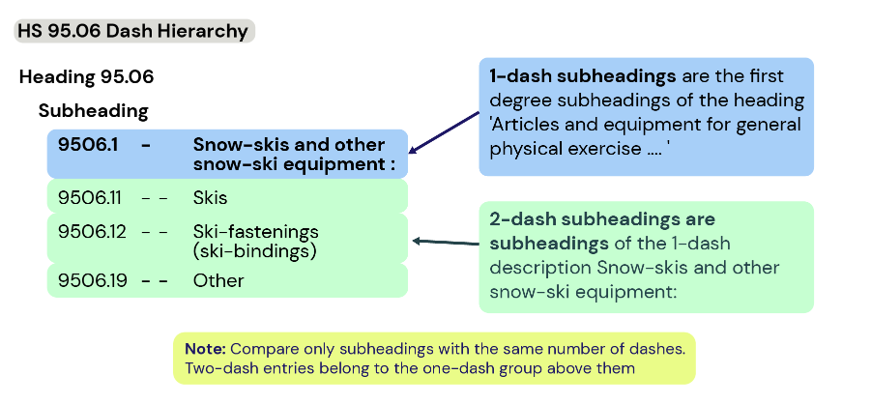
Example 1: How the dash hierarchy looks in heading 95.06
This diagram illustrates how the Harmonized System uses dashes to show the relationship between subheadings. A single dash (–) identifies a 5‑digit subheading, while two dashes (- -) identify a 6‑digit subheading that belongs only to the one‑dash group directly above it. In heading 95.06, the subheading 9506.1 is subdivided into 9506.11 and 9506.19, both shown with two dashes to indicate their dependent relationship. The separate one‑dash subheading 9506.9 forms a different group and must not be compared with the two‑dash entries under 9506.1. This hierarchical structure is essential for accurate classification. It ensures that comparisons are made only within the correct level and prevents the common error of selecting the wrong residual “other” subheading. The diagram visually reinforces this rule by grouping the two‑dash entries under their parent one‑dash subheading and separating the unrelated one‑dash “other” subheading. |
|
Example 2: Applying the dash hierarchy to classify a baseball bat HS Nomenclature - Specimen Heading 95.06
Now apply the structure shown in Example 1. A baseball bat is classified within heading 95.06 as an article or equipment for sports or outdoor games. Work down the hierarchy one dash level at a time.
A baseball bat does not fit any of the named categories, so the only option is the residual subheading 9506.9.
A baseball bat is not equipment ‘for general physical exercise, gymnastics or athletics’, so the answer is subheading 9506.99. Classification. Baseball bat → 9506.99 |
||||||||||||||||||||||||||||