
Study Guide
3. Green Customs
3.3. Multilateral Environmental Agreements (MEAs)
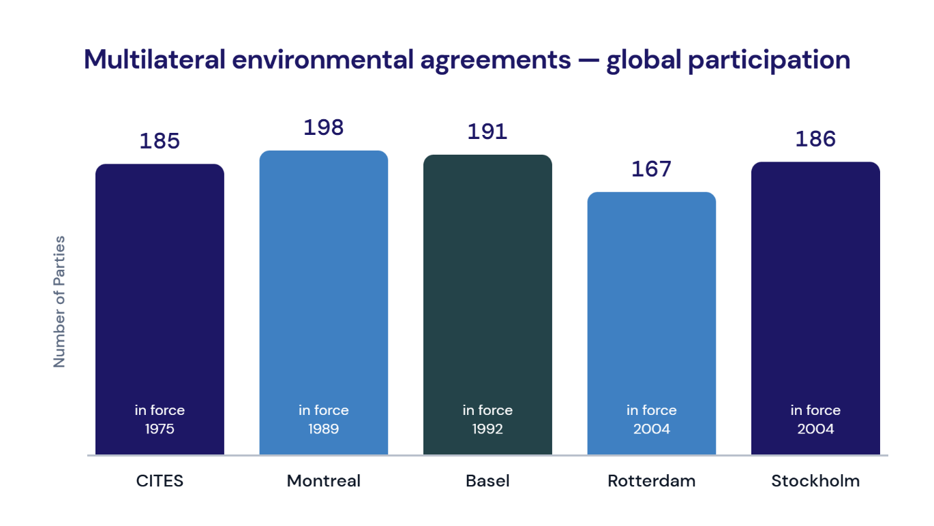
Multilateral Environmental Agreements (MEAs) regulate the international movement of environmentally sensitive goods. Customs administrations play a central role in enforcing these agreements at the border. Examples include preventing illegal trade in ozone‑depleting substances, combating wildlife trafficking, controlling hazardous waste movements, and ensuring safe handling of chemicals and persistent pollutants (Green Customs Guide).
|
Agreement |
What it controls |
Customs role |
|
Convention on International Trade in Endangered species (CITES) (1975) |
Trade in endangered wild animals and plants, and their products |
Check permits; intercept trafficked species and products |
|
Montreal Protocol (1989) |
Ozone-depleting substances and HFCs |
Control ODS/HFC trade; enforce phase-out schedules |
|
Basel Convention (1992) |
Transboundary movement of hazardous and other wastes |
Verify prior consent; prevent illegal waste dumping |
|
Rotterdam Convention (2004) |
Trade in listed hazardous chemicals and pesticides |
Confirm consent and documentation for listed chemicals |
|
Stockholm Convention (2004) |
Persistent organic pollutants (POPs) |
Enforce import/export restrictions on POPs |