
Study Guide
International Commercial Terms (Incoterms®)
|
Learning Objectives
|
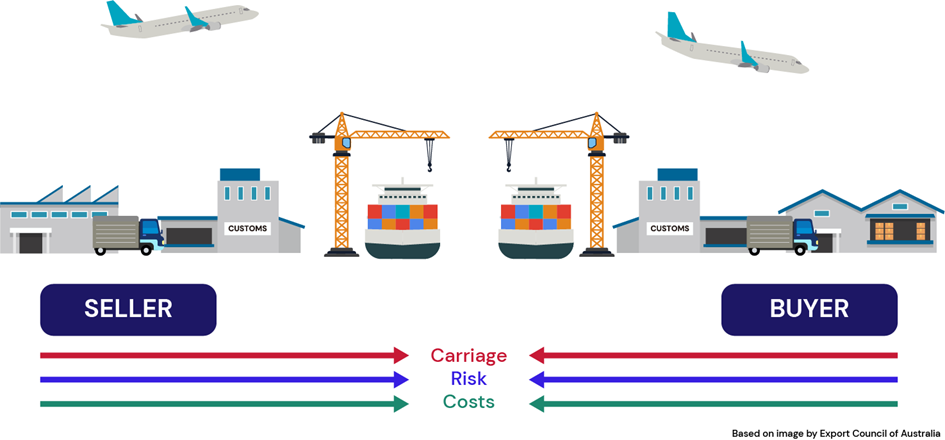
Possibly the most important clause in an international contract of sale is the one that defines the agreed trade terms between the seller and the buyer. These terms establish three things for each party:
- Which responsibilities apply to the seller, the buyer, and their respective service providers?
- How risks are divided between seller and buyer
- How costs are divided between seller and buyer
|
Note At every point in the supply chain, legal responsibility for the goods rests with either the seller or the buyer. Responsibility covers carriage, risk, and costs. |
International Supply Chain
In commodity trade, standard contract forms have developed to meet the specific requirements of different goods — oil, timber, grain — each with distinct handling, shipping, and payment conditions. These are often performed under charterparties[1], with detailed provisions for loading, unloading, inspection, and payment. Manufactured goods follow similar conventions, with parties either using industry-standard terms or negotiating bespoke contracts.
Because the CISG applies only between parties in different States, an international sale usually involves goods crossing at least one border. It is therefore necessary to clearly define how functions, costs, and risks are allocated between the buyer and the seller.
The key questions are:
- Who arranges carriage?
- Who handles customs formalities?
- Who bears the risk if goods are lost or damaged in transit?
These issues are addressed by trade terms. The most widely used are those developed by the International Chamber of Commerce, known as Incoterms® — a standardized shorthand that divides responsibility clearly between seller and buyer.
Incoterms® were first introduced in 1936. The current version, Incoterms® 2020, took effect in January 2020. There are 11 terms, organized into four Groups and two categories based on obligations, risk, and costs. The table below lists all 11 terms by Group and mode of transport.
|
Group |
Term |
Description |
Mode of Transport |
|
E |
EXW |
Ex Works – named place of delivery (e.g. factory or warehouse) |
Any |
|
F |
FCA |
Free Carrier At – named place of delivery (e.g. seller’s premises or ‘other place’) |
Any |
|
FAS |
Free Alongside Ship – named seaport of loading |
Sea or Inland Waterway |
|
|
FOB |
Free On Board – naming the seaport of loading and vessel |
Sea or Inland Waterway |
|
|
C |
CFR |
Cost and Freight – naming the seaport of discharge/destination |
Sea or Inland Waterway |
|
CIF |
Cost, Insurance and Freight – naming the seaport of discharge/destination |
Sea or Inland Waterway |
|
|
CPT |
Carriage Paid To – naming the place of handover at destination |
Any |
|
|
CIP |
Carriage & Insurance Paid to – naming the place as in CPT |
Any |
|
|
D |
DAP |
Delivered At Place – naming the place of destination |
Any |
|
DPU |
Delivered at Place Unloaded – naming the place of destination |
Any |
|
|
DDP |
Delivered Duty Paid – naming a place of handover at destination |
Any |
Source: International Chamber of Commerce 2025
|
Incoterms® are concerned with the possession of goods, not ownership, title, or property. At any given point in the supply chain, the party in possession of the goods may not be the party that owns them. Traders must understand this distinction and manage their business accordingly. |
[1] In a charter party a shipper in effect charters a ship to carry the cargo to its destination. The cargo or portions of it are sold and re-sold during transit and may be off-loaded at different ports. Parties to such transactions are trading on the basis of the sale of documents representing the goods – the bill of lading.