
Study Guide
Marine Insurance
Marine insurance covers the risk of physical loss or damage to goods and merchandise in transit by any mode of conveyance, or while in storage. Despite the name, marine insurance policies can also cover air shipments. The purpose of marine insurance is to restore the insured to the financial position they would have been in had the loss not occurred.
All marine insurance policies refer to the Institute of Cargo Clauses, the principal insurance clauses used in international trade, published by the Institute of London Underwriters (ILU). There are four variations:
|
Clause |
Cover Level |
|
C Clauses |
Minimum cover – specified risks only |
|
B Clauses |
Includes all cover provided under Clauses (C) cover plus volcanic activity and earthquakes |
|
A Clauses |
‘All Risks’ – highest level; includes all risks subject to listed exclusions (Clause B plus wilful negligence) |
|
Air Clauses |
Cover for goods transported by air freight |
The Marine Insurance Certificate
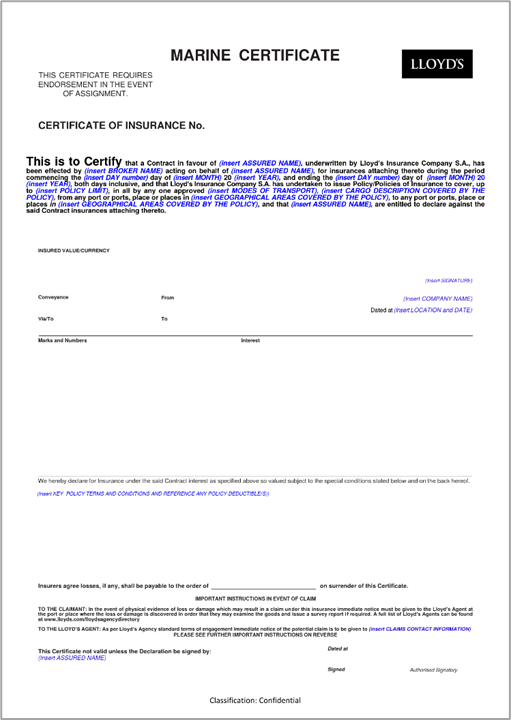
Under the British and Australian Marine Insurance Acts of 1906 and 1909, respectively, a compliant insurance certificate must contain:
- The name of the assured
- The name(s) and address(es) of the insurer(s)
- The subject matter insured and risks covered
- The voyage or period of time covered
- The sum insured (the ‘insurable value’ — normally the CIF/CIP value of the commercial invoice plus 10%)
- A signature by or on behalf of the insurer
- The place where claims are payable and the name of the agent to whom claims may be directed
A typical distribution comprises an Original and one non-negotiable copy sent by first dispatch to the buyer, followed by a Duplicate and a second non-negotiable copy. Further non-negotiable copies are sent to the broker and/or insurer as evidence of the risk under the policy. Under a documentary letter of credit, the negotiating bank will normally require both the Original and the Duplicate.
When documents must be transferred while goods are in transit, an insurance certificate can be made transferable by endorsement. This is done by signing the reverse of the original document to the order of the new owner, which transfers the right to claim under the policy to the endorsee.
Under the terms of a documentary letter of credit, the certificate is often required in negotiable form, prepared ‘To Order’ or ‘To Shipper’s Order’ and blank endorsed. In this case, the endorser does not designate a specific party as the endorsee, making the document freely negotiable by any holder. When credits require this, the accompanying bill of lading is also typically made out ‘To Order’ and blank endorsed.
The information on the insurance certificate must conform to the other documents presented under the credit.
|
Note The certificate must not be dated after the ‘on board’ or shipment date shown on the transport documents. |