
Study Guide
2. Part 1: International Trade Treaties and Conventions
2.3. WTO Valuation Agreement
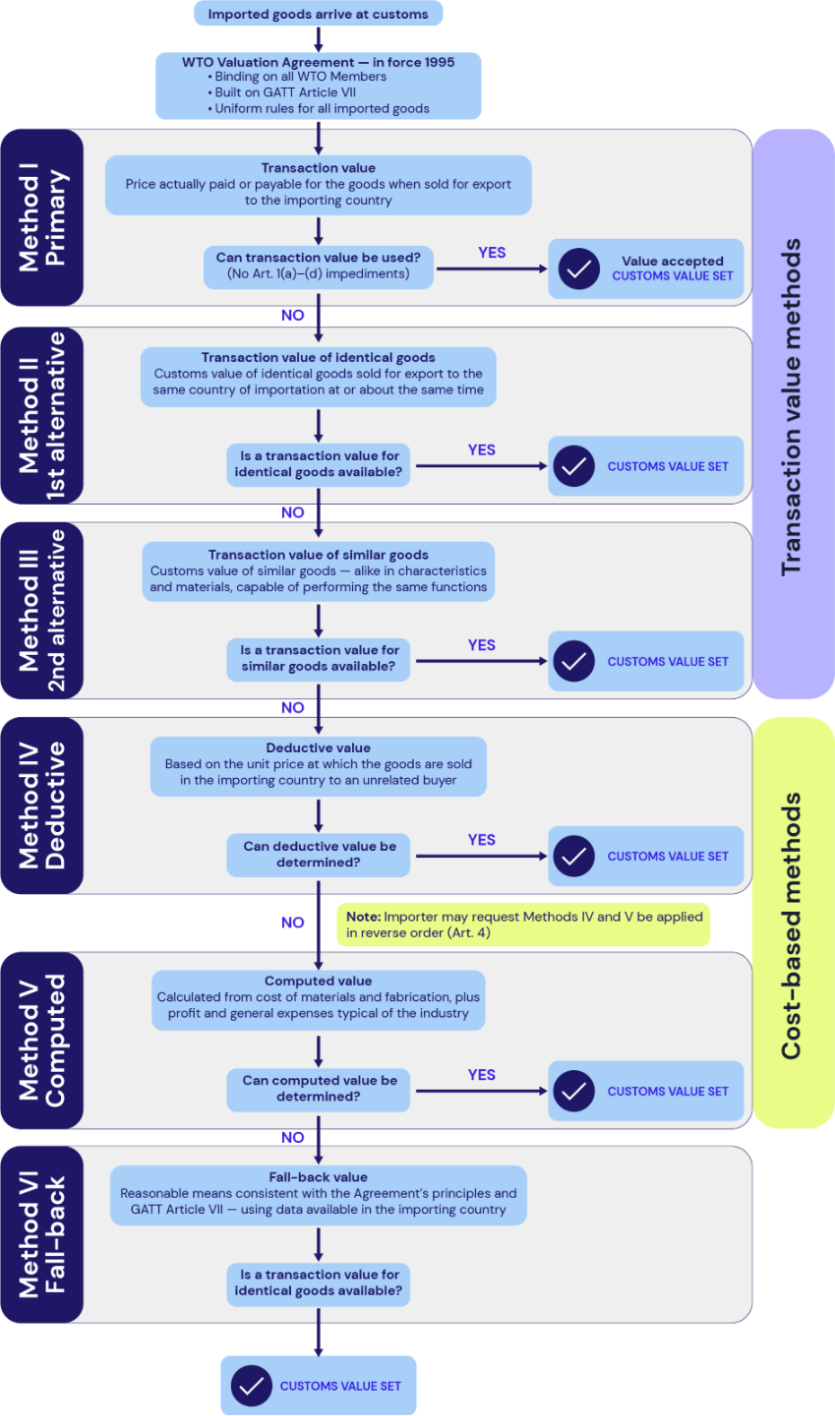
An important outcome of the Uruguay Round of multilateral trade negotiations in 1994 was the Agreement on Implementation of Article VII of GATT — the Valuation Agreement. It entered into force in 1995 and binds all WTO Members to apply uniform rules for determining the customs value of imported goods.
Building on Article VII of GATT, the Agreement provides that the primary basis for customs value is the transaction value of the imported goods. The transaction value is the price actually paid or payable for the goods when sold for export to the country of importation. The price actually paid or payable is to be adjusted where necessary to take account of certain specific elements — the various charges, costs and expenses incurred by the buyer in the importation process that are not already included in the price actually paid or payable for the imported goods.
The adjusted transaction value represents the customs value of the goods, provided that none of the four impediments to the use of "transaction value" are present in terms of sale or purchase of the imported goods (Article 1, paragraph 1 (a)-(d) of the Agreement).
Where no transaction value can be determined, or where the stipulated conditions cannot be met, the Agreement provides five alternative methods for determining the customs value of the goods, which must be applied in hierarchical order:
-
Where the customs value cannot be determined based on the transaction value method (Method I), the customs value is to be determined based on the transaction value of identical imported goods (Method II).
-
If the customs value cannot be determined using the transaction value of identical goods, then the customs value shall be determined based on the transaction value of similar imported goods (Method III).
-
If the customs value cannot be determined on the basis of the transaction value of the imported goods or of identical or similar imported goods, it shall be determined based on the deductive value method (Method IV). Under the deductive value method, the customs value is determined on the basis of a unit price at which the goods are sold in the condition as imported to an unrelated buyer in the country of importation.
-
When the customs value cannot be determined based on the deductive value method, the next method is the computed value method (Method V). Under this method, the customs value is essentially calculated using the sum of the cost of materials and fabrication and an amount for profit and general expenses. If the WTO member country chooses to base the customs value on Cost, Insurance, and Freight (CIF), then the computed value also includes the cost of transportation and its related costs and insurance for transportation.
-
If the customs value cannot be determined under any of the five methods, the customs value shall be determined using reasonable means consistent with the principles and general provisions of the Agreement and of Article VII of the GATT 1994 (Fall Back Value Method; Method VI).
The WTO text of the agreement is available at Agreement of Implementation of Article VII of GATT and contains a helpful introduction which explains these concepts further.
Implementation of the Valuation Agreement has presented challenges in many countries. The biggest difficulty — particularly for developing country Customs administrations — has been re-skilling staff to understand and correctly apply the methodology. Where invoice values cannot be trusted, there is a tendency to revert immediately to the fallback method, which often means reverting to a database of notional or actual values from past transactions. This can lead to an assessment of value which is neither accurate nor strictly lawful in accordance with the Agreement. There is also a tendency in some countries to see valuation as negotiable between the importer and Customs, when the value should be determined by an objective application of the methodology. Valuation fraud continues to be a problem, with false invoices being substituted for the true invoice, thereby ostensibly reducing the value of the goods for valuation purposes. All of these issues have made some Customs administrations cautious in their implementation of the Agreement.
Both the WTO and the WCO have a Valuation Committee — the WTO to focus on policy and law; the WCO to focus on the practical application of the Agreement and to provide guidance to Customs administrations on its proper implementation. Later in this course, we will cover valuation in much more detail in Module 7.
Both the WTO and the WCO have a Valuation Committee – the WTO to focus on policy and law; the WCO to focus on the practical application of the Agreement and to provide guidance to Customs administrations on the proper implementation of it.