
Supply Chain Security Study Guide
6. Regional responses
6.1. European Union
As an immediate reaction to 9/11, the EU implemented an "anti-terrorism action plan" (October 2001), followed by "The Framework Decision on Combating Terrorism" (June 2002). These increased cooperation between Europe's national governments within the EU, and with the rest of the world.
The attacks in Madrid and London led the EU to update its response to terrorism further. In December 2005 the EU agreed a new counter terrorism strategy. A key element of the response in 2005 was the urgent implementation of all previously agreed strategies.
Customs related security initiatives
At the end of July 2003, the European Commission presented to the Parliament and Council a series of measures to address security issues. The package brought together the basic concepts underlying the new security-management model for the EU's external borders, such as a harmonized risk assessment system. The security amendments to the Community Customs Code (Regulation (EC) n° 648/2005 of 13 April 2005) were published in the Official Journal of the European Union on 4 May 2005.
Through these amendments the EU introduced a number of measures to tighten security around goods crossing international borders. The measures aim to deliver faster and better-targeted checks.
The implementing provisions of the security amendments entered into force on 26 December 2006 and apply within the following timeframe:
|
Early 2007 |
1 January 2008 |
1 July 2009 |
|
Common risk management framework introduced (fully computerised in 2009) |
Authorized Economic Operator (AEO) programme entered into force |
Advance cargo information became mandatory for traders with advance details on goods entering or leaving the European Community (EC 2008) (full implementation 1 January 2011) |
One of the main elements of the Customs Security Program is the creation of the AEO concept. Member States are entitled to grant AEO status to any economic operator that meets common criteria relating to the operator's control systems, financial solvency, and compliance record. The EU AEO Program entered into force on 1 January 2008, but member states have been accepting applications to join the program since October 2007.
The EU has issued AEO Certificates in all member states. By April 2023, the EU had issued 18,375 AEO Certificates to companies meeting security requirements. Following Brexit, the EU announced that it would no longer recognize certificates issued by UK Customs and Border Protection.
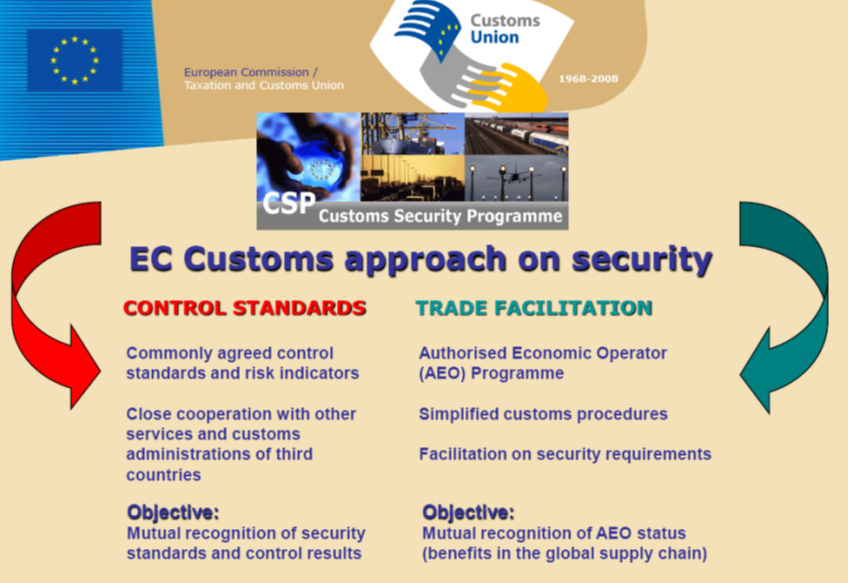
Figure 2 Source: European Commission
Air cargo security
In January 2003 the EU established common rules for civil aviation security when it brought into force Regulation (EC) No 2320/2002. The regulation prescribed the security criteria for air cargo, courier and express parcels. It covered specific security controls, the regulated agent, criteria for known consignor, and processes for all-cargo aircraft.
Commission Regulation (EC) No 831/2000, adopted on 2 June 2006 and in force from 1 January 2007, laid down more harmonized rules on air cargo security. The changes related to Regulated Agent Obligations, Security Controls, Known Consignor Qualification, Account Consignor Qualification and Transhipment Security Controls (EC 2007).
In September 2008 the EU and the United States agreed standards for air cargo screening on half of flights between their respective countries by February 2009 and on all flights by 2010. The agreement ensures that the United States and the EU use the same screening equipment, provide the same training to screeners, and impose the same security requirements for the facilities where cargo is screened (TSA 2008b). 100% screening with the United States was not achieved in 2010, although significant progress was made.
In August 2011 the EU published new rules on security measures for cargo coming from non-EU countries. The main elements of the rules, which came into effect on 1 February 2012, are:
|
1 |
Pre-flight screening Air carriers will be required to ensure that cargo either has been screened for explosives or inflammables, or comes from a trusted source, before they are allowed to fly into the EU from third countries; the carriers and trusted sources in third countries will be subject to independent validation as of 2014. |
|
2 |
Risk-based exemptions In third countries with high security standards, cargo will be exempted from these additional measures. In third countries with high risk, enhanced screening for cargo will be required by means of a combination of two or more screening measures. |
|
3 |
Transfer cargo screening Cargo being transferred from all-cargo on to passenger flights at EU airports must be screened to higher passenger flight standards before loading on to the passenger aircraft. |