
Study Guide
1. Introduction
Historically, identifying the origin of goods was simpler because most products were manufactured within one country. Today, few products are made solely in one country, or even within one enterprise. Goods are now composites of inputs, transformations, and value-added activity from producers in many nations. Multinational corporations make investment decisions based partly on minimizing input costs and securing ready access to materials and labor for components that are consolidated into a final product and shipped worldwide using just-in-time logistics.
Components are often sourced from several countries, transported to a third country for consolidation, and then exported. What is the origin of those final goods? It may not be the country of export. The decision becomes harder when components or the final goods are produced within an area governed by a regional trade agreement with its own rules of origin.
|
|
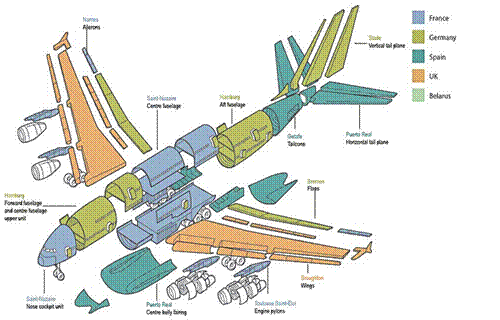
Example: Components sourced from different countries Consider the Airbus A380. Its components are sourced and partly assembled in five different countries, with final assembly in Toulouse, France.
Figure 1: Airbus A380 component sources. Source: Aviation WA |
A further difficulty has been the proliferation of regional trade agreements. These agreements often exclude non-contracting parties and limit producers in those States from competing for contracts. A framework was needed to govern the origin of goods. It also had to align with existing trade rules in the General Agreement on Tariffs and Trade (GATT) 1947 and GATT 1994. That framework became the Agreement on Rules of Origin 1995.
This Module gives you a foundation in Rules of Origin. You should supplement it with your own research and reading. The material covers both theory and practice across these areas:
|
01 Rules of Origin under GATT/WTO How rules of origin sit within the global trade rules established by GATT 1947 and GATT 1994. |
02 Meaning of origin What "origin" means in customs terms, and the difference between non-preferential and preferential rules. |
|
03 WTO Agreement on Rules of Origin The four parts and two annexes of the 1995 Agreement, including the three tests for substantial transformation. |
04 Revised Kyoto Convention, Specific Annex K |
|
05 Case study: AUSFTA |
|
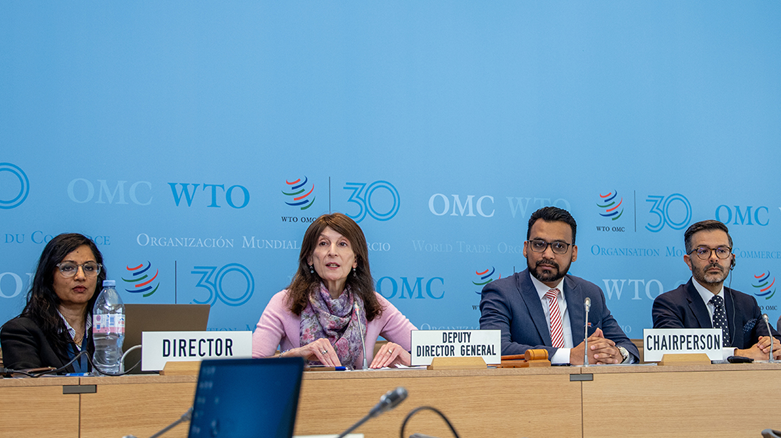
Figure 2: WTO Deputy Director-General Angela Ellard delivering her opening remarks on the 30th anniversary of the Agreement on Rules of Origin on 4 April 2025.
Source: https://www.wto.org/english/news_e/news25_e/roi_04apr25_e.htm