Study Guide
6. Administrative obligations conferring rights to the importer
6.5. Compliance Risks in Customs valuation
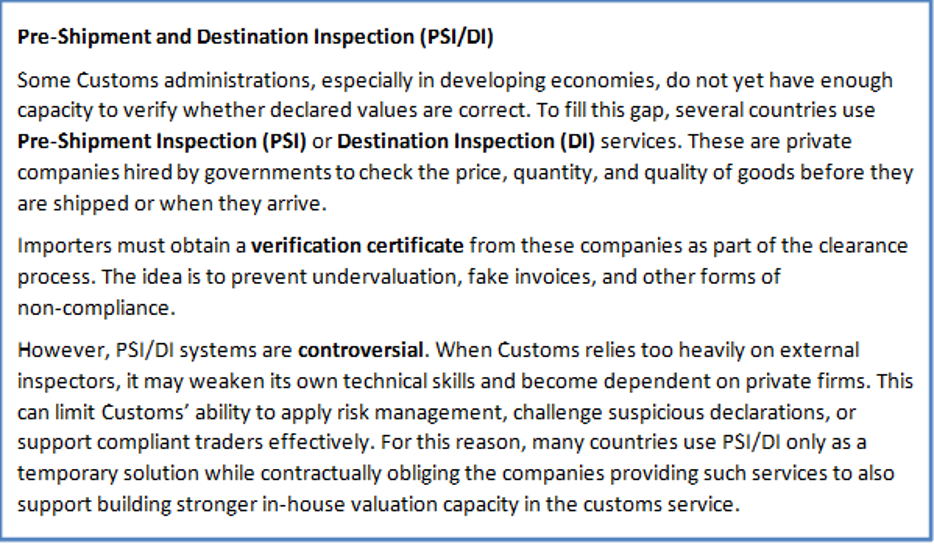
The WTO Valuation Agreement established a fair and uniform system based on transaction value, but its effective implementation depends heavily on the capacity of national Customs administrations. In many countries, limited audit powers, weak post‑clearance controls, and the sheer volume of small consignments - particularly from e‑commerce - have made the system vulnerable to abuse. These vulnerabilities do not arise from the Agreement itself, but from gaps in enforcement, data availability, and institutional capability. Where Customs cannot reliably verify the price actually paid or payable, the valuation system becomes exposed to manipulation.
Undervaluation
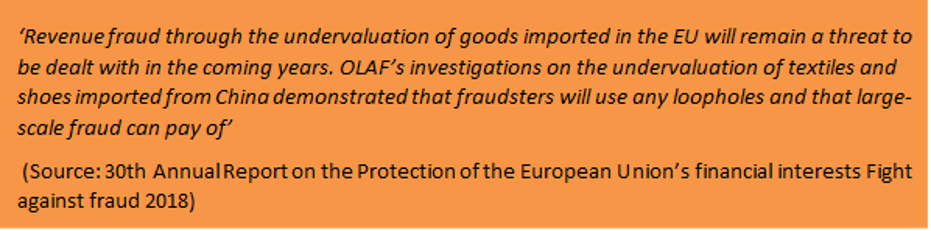
This is one of the most widespread customs offences globally and has a direct impact on government revenue. When declared values fall significantly below market norms, Customs may suspect revenue loss and initiate checks to verify the true transaction value. These checks can delay clearance, trigger physical examination of cargo, and, depending on national law, may result in administrative fines or seizure of goods. In high‑risk sectors such as apparel, electronics, and e‑commerce parcels, undervaluation is frequently linked to fake invoices, fictitious suppliers, manipulated quantities, or informal payments not reflected in documentation. Such practices undermine the integrity of the valuation system and place additional pressure on already stretched border control resources.
Customs administrations face practical challenges when verifying declared values. Many lack the resources, legal authority and procedures to obtain supplier records or conduct detailed valuation audits. As a result, they rely heavily on risk indicators such as historical import data, valuation databases and price trends through internet searches. Although valuation databases cannot be used to determine customs value under the WTO Agreement, they are routinely used to identify anomalies and establish “reason to doubt” before an enquiry is opened. Where significant discrepancies exist, Customs may suspend release until satisfactory evidence of the true transaction value is provided.
Overvaluation
While less common, remains a significant compliance concern. It occurs when the declared value is higher than the true price actually paid or payable. This practice is often used for transfer pricing manipulation, enabling multinational groups to shift profits out of high‑tax jurisdictions by inflating intra‑company prices. Overvaluation is also used in money‑laundering schemes, where inflated invoices allow illicit funds to be moved across borders under the guise of legitimate trade. In some countries, exporters inflate values to obtain higher VAT refunds, duty drawback, or subsidy payments. Although overvaluation does not reduce customs revenue, it is closely associated with tax evasion, illicit finance, and export fraud and must be recognised as a compliance red flag.
Both undervaluation and overvaluation distort trade data, undermine the effectiveness of customs controls, and complicate the administration of revenue collection. Recognising implausibly low or high declared values and understanding the systemic weaknesses that allow such practices to occur is essential for maintaining the integrity of the valuation system and supporting lawful, transparent international trade.