
Study Guide
Contract of Carriage – The Bill of Lading
The contract of carriage defines the terms for transporting goods between agreed locations. It typically includes:
- the agreed place and time of shipment and delivery
- the transport route to be used
- responsibility for payment of freight charge
- the liabilities of the parties and their agents
- the governing law and dispute resolution method (court or arbitration)
- any additional terms that affect the rights and responsibilities of the parties
The agreed route is particularly important. Some perishable goods, such as fruit, can only withstand a limited period in transit. For volatile commodity markets, prolonged carriage may expose sellers or buyers to unacceptable price risk.
The principal document governing the relationship between the shipper and the carrier is the Bill of Lading. Carriers may use standard forms or different forms for different routes. The Baltic and International Maritime Conference (BIMCO), for example, has maintained the Conline Bill — a generic liner bill of lading — for over 40 years.
A bill of lading performs three functions:
- Receipt for goods shipped: It provides evidence that the goods were shipped and were in apparent good order and condition at the time. If the carrier signs a bill without annotation, it cannot later deny the apparent condition of the goods on shipment.
|
Note A bill with an annotation noting damage is a ‘claused’ bill; one without annotation is a ‘clean’ bill. |
- Evidence of the contract of carriage: It evidences the contract between shipper and carrier. While the goods are at sea, the shipper-exporter endorses the bill of lading to the importer, either as named consignee or by endorsement, passing title in the goods and entitling the importer to receive the goods from the carrier at the port of destination. Note carefully that the bill of lading is evidence of the contract, not the contract itself.
|
Note The bill of lading is evidence of the contract, not the contract itself. |
- Document of title: The bill of lading represents title to the goods, enabling them to be sold, pledged, or mortgaged by dealing with the document rather than the goods themselves.
|
Note The bill of lading is evidence of the contract, not the contract itself. For For a bill to be negotiable, the ‘Consignee’ box must read ‘To Order’, meaning the carrier will deliver to the person to whom the shipper has endorsed the bill. The chain of endorsement typically runs: exporter → exporter’s bank → importer’s bank → importer. |
There are different categories of bill of lading. A house bill is issued by a freight forwarder or carrier’s agent, evidencing that goods have been received and will be forwarded to the vessel. A shipped or ocean bill is issued by the ship’s master, evidencing that goods have been received and loaded on board.
The following description outlines the fields of a DHL USA electronic Bill of Lading:
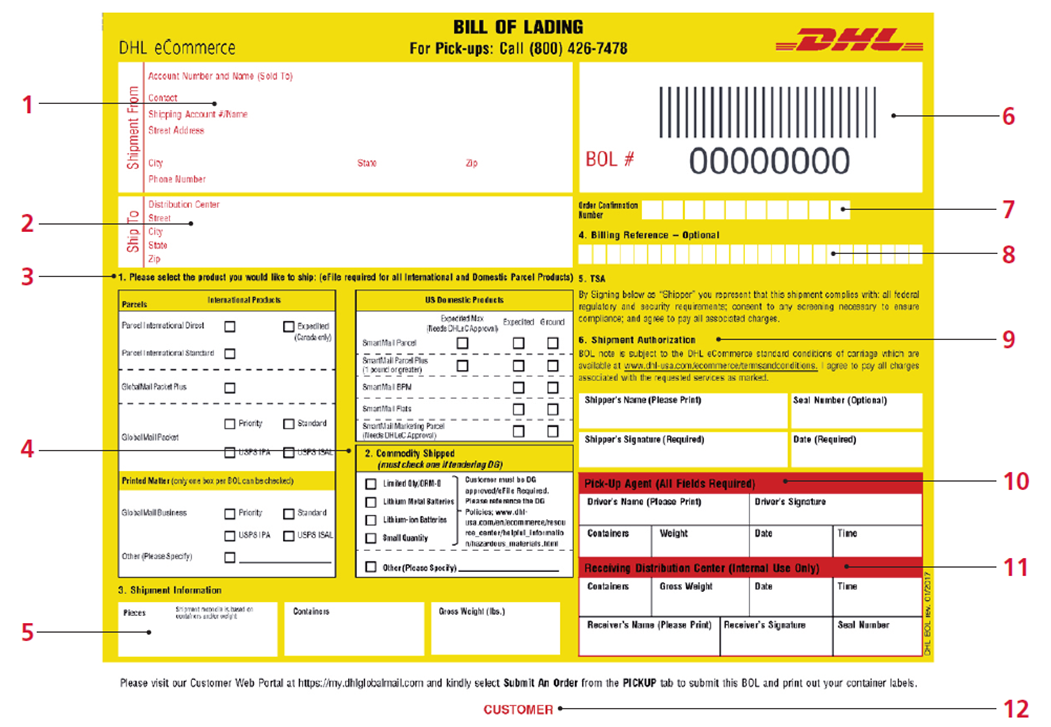
- Shipment From (required). Shipper’s contact information should be pre-entered by DHL eCommerce. If blank, contact Customer Service.
- Ship To (required). The distribution centre processing the shipment should be pre-entered by DHL eCommerce. If blank, contact Customer Service.
- Product/Service (required). Identify product and service leve
Note
Only one box can be marked for the “GM Business Mail” product or in the “US Domestic Products” section. Use a separate BOL for each product and/or service.
- Commodity Shipped (must check one if tendering DG). DHL eCommerce requires shippers to identify the type of Dangerous Goods being shipped in the eFile, as a content category code, and the BOL. Mark “Limited Qty/ORM-D” for packages tendered with content category code 08 (e.g. creams, alcohols, and perfumes). Mark “Lithium-Ion Batteries” for packages tendered with content category codes 04 – 06 (e.g. cell phone and laptop batteries). Mark “Small Quantity” for packages tendered with content category code 09. Please select “Other” if tendering “Lithium Metal Batteries” packages, content category codes 01 – 03 (e.g. watch and camera batteries).
- Pieces/Containers/Gross Weight (required). All shippers must indicate the number of containers and shipment weight (lbs.).
- BOL Number.
- Order Confirmation Number. Enter the number provided by Customer Service Representative when pick-up was scheduled.
- Billing Reference (optional). Note any internal reference.
- Shipment Authorization (required). Please complete and sign.
- Pick-Up Agent. DHL eCommerce and/or our agent will complete.
- Receiving Distribution Centre. To be completed by our distribution centre.
- BOL Sequence Copy. Note that each eBOL consists of four copies.
a) Billing – place this copy inside one of the containers.
b) Agent – provide this copy to the driver.
c) Operations – also provide this copy to the driver.
d) Customer – keep this copy for your records.