
Customs Regulatory Control Study Guide
2. Part 1: International Trade Treaties and Conventions
2.2. The Harmonized System Convention (HS Convention)
The WTO adopted the Harmonized System Convention in 1988 as the global means for determining the tariff classification of all goods. Its full title is the International Convention on the Harmonized Commodity Description and Coding System.
The aims of the Harmonized System are to:
|
01 International Uniformity Achieve uniform classification of goods across all countries, removing divergent national approaches. |
02 Trade Statistics Enable the collection, analysis, and comparison of world trade statistics on a consistent basis. |
|
03 Common Coding System Provide a single international system for coding, describing, and classifying goods, usable by freight forwarders, insurers, transport associations, importers, and exporters. |
04 Responsive to Change Maintain an up-to-date document that can be amended to reflect technological developments and shifts in international trade patterns. |
The Harmonized System (HS) is built around a standardised 6-digit code used globally to classify goods, ensuring each product is identified consistently as it is produced, traded, and transported. Its purpose is to replace multiple differing classification systems, allowing all countries and industries to use a single, common framework for identifying goods in international trade.
The Harmonized System is designed to be a multipurpose nomenclature. Some of the uses envisaged by its authors include being a basis for:
|
01 Customs tariffs Forms the basis for national tariff documents, enabling correct duty assessment, revenue collection, and the application of trade policy at the border. |
02 International trade statistics Provides a standardised framework for the collection, analysis, and comparison of trade data between countries. |
|
03 Rules of origin Supports the determination of where goods originate, critical for applying preferential tariff rates under trade agreements. |
04 Trade negotiations Used as the basis for WTO schedules of tariff concessions and other bilateral and multilateral trade agreement negotiations. |
|
05 Identifying restricted and prohibited goods Enables the consistent identification of goods that are subject to restrictions or outright prohibitions in international trade, supporting Customs enforcement at the border. |
|
The current primary function of the Harmonized System is to form the basis for national tariff documents. A large percentage of countries still depend heavily on customs duties for their national revenues, and goods need to be properly classified to ensure correct revenue collection. The Harmonized System forms the basis of the Customs tariffs of more than 200 countries, customs territories and the European Economic Union (EEU), representing approximately 98% of world trade.
HS Nomenclature
The HS Convention consists of 20 Articles and an Annex. The Articles govern the procedures for running the Convention. The Annex has more relevance for everyday use by Customs administrations. The HS Nomenclature is the Annex to the Convention. Under Article 1, it comprises:
|
Component |
Description |
|
Headings (4-digit) |
4-digit classifications and their goods descriptions, the primary level of classification. |
|
Subheadings (5- and 6-digit) |
More specific 5- and 6-digit classifications and their goods descriptions, providing greater granularity. |
|
Legal notes |
Notes applicable to headings and subheadings, legally binding interpretive rules appearing at the start of chapters and sections. |
|
Interpretative rules |
Rules for the classification of goods, providing the legal framework for determining which heading or subheading applies to any given product. |
Headings and subheadings are grouped into 97 chapters, which are further divided into 21 sections. Legal notes appear at the beginning of nearly all chapters and some sections. While it is not our intention to examine all 20 Articles, it is worth looking at a few key ones.
Article 3 specifies the obligations of Contracting Parties. It sets out three distinct points:
|
Point |
Obligation on Contracting Parties |
|
1 |
Adopt the HS as-is On signing the Convention, Contracting Parties are bound to adopt the HS as it stands, and as it is revised every five years. |
|
2 |
No changes to scope or order Texts and codes may not be amended in any way that would change the scope or order of the headings or subheadings. |
|
3 |
Only domestic implementation amendments The only permitted amendments are those necessary to give effect to the HS in domestic law, and even these must not affect the scope of headings or subheadings. |
Articles 4 and 5 permit developing countries that are signatories to participate initially in the HS at the 4-digit level only, and to receive technical assistance in adopting the Nomenclature. Partial application does not limit a country to using only the 4-digit headings; it may also elect to use only some of the 5- and 6-digit subheadings if it chooses.
Article 6 provides for the establishment of the Harmonized System Committee (HSC) and its associated sub-committees or working parties. Under this article, the HSC administers the general running of the HS, while the Review Sub-Committee conducts a systematic review of the structure of the Nomenclature on a regular basis to ensure it keeps up to date with technological developments and changes in trading patterns.
Article 7 allows for amendments to the HS documents and for the preparation and amendment of supplementary publications such as the Harmonized System Explanatory Notes and the Compendium of Classification Opinions.
Note
The six digits of an HS code are structured across three levels, Chapter, Heading, and Subheading.
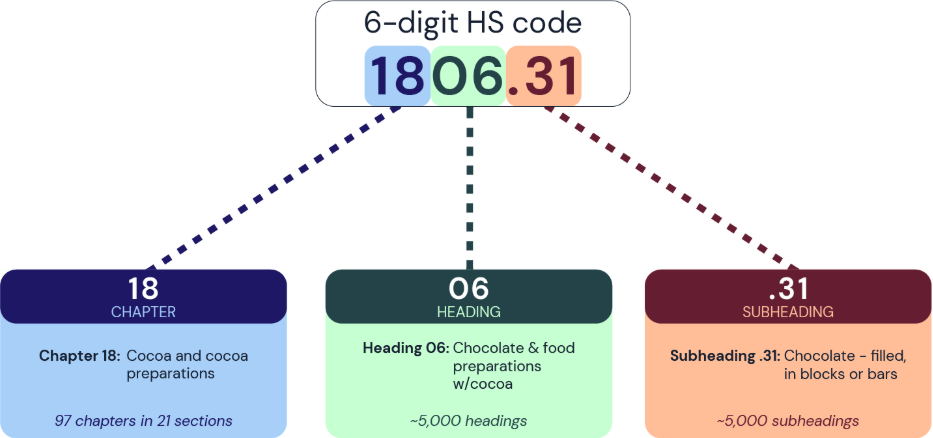
The following image shows a specimen Nomenclature page illustrating how legal notes and classification numbers/descriptions appear in practice. It shows Chapter 18 (Cocoa and cocoa preparations) as an example, with legal notes at the top followed by 4-digit headings and 6-digit subheadings.
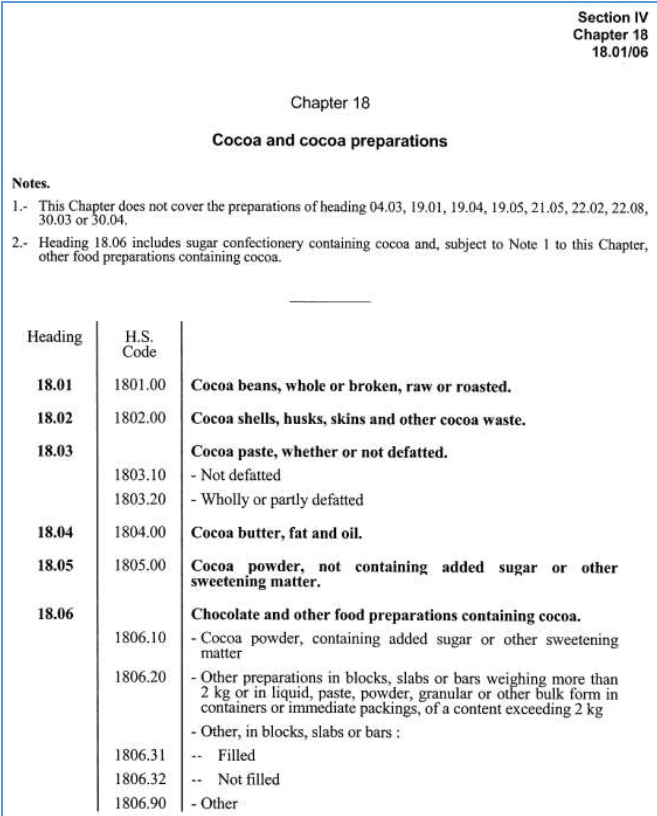
Figure 1: Specimen HS Nomenclature page showing legal notes and classification numbers/descriptions
Note
The latest version of the Nomenclature was introduced on 1 January 2022 and should now be in force in all Contracting Parties. The next review, originally scheduled for 2025, has been deferred for at least a year and is due to be implemented on 1 January 2028.
The Harmonized System Committee (HSC)
The HSC is the primary administrative body responsible for the uniform interpretation and application of the HS. Each Contracting Party has one vote. The exception is EU member states, which collectively hold one vote in the name of the European Economic Community.
|
Function |
What the HSC Does |
|
Guidance on HS interpretation |
Prepares Explanatory Notes, Classification Opinions, and individual formal advice to guide consistent interpretation of the HS across all Contracting Parties. |
|
Recommendations for uniformity |
Prepares recommendations to secure uniformity and transparency in how the HS is interpreted and applied, minimizing divergence between countries. |
|
Information collation and circulation |
Collates and circulates information on the application and maintenance of the HS, keeping all Contracting Parties informed of developments and decisions. |
The HSC is also the arbiter of classification disputes between Contracting Parties under Article 10. Where a dispute arises, the parties are first encouraged to reach agreement among themselves. Disputes that cannot be settled directly are referred to the HSC for adjudication at its bi-annual meetings. In the unlikely event that the HSC cannot settle a dispute, it may refer the matter to the WCO Council for a recommendation. Members not satisfied with the result have the right to appeal.
Continuous Updating of the HS
The HS has a built-in system of continuous amendment, essential because internationally traded goods are constantly changing — whether because of shifting demand or technological progress. The HS operates on a five-year review cycle. Each cycle may examine the Nomenclature as a whole, focus on certain sectors, or address particular areas — for example, a review period may focus on heavy machinery classifications or computer-related equipment. The review process is intensive and involves detailed submissions and consultations between the HSC and its sub-committees. Since its inception, the HS has undergone six major reviews. The sixth (current) version was implemented on 1 January 2022. The next review, originally scheduled for 2025, has been deferred for at least a year and is due on 1 January 2028.
Harmonized System Explanatory Notes (HSEN)
The HSEN are the largest and most important supplementary publication produced by the HSC. Although they do not form an integral part of the HS Nomenclature, they are the official interpretation of the HS structure and complement the legal text. The HS Convention and the HSEN will be studied in much more detail later in the course to assist you in classifying goods in accordance with the HS Tariff.