
Study Guide
3. Air Cargo
3.2. Post-Mail Handling Units
International mail arrives in all modes of transport, although increasingly the main mode is air. The Post remains one of the most widely used channels for sending personal and commercial items across borders, including gifts and other goods.
Customs is necessarily involved in international postal traffic. As with goods imported by any other means, Customs must collect the appropriate duties and taxes, enforce import and export prohibitions and restrictions, and ensure compliance with the laws it is responsible for enforcing. The international framework for postal traffic is set by the Acts of the Universal Postal Union (UPU), and the World Customs Organization and the UPU have jointly produced a guide on international postal shipments and customs matters, based on the Universal Postal Convention and the postal traffic provisions of the Revised Kyoto Convention.
|
|
Reading 3: WCO-UPU Postal Customs Guide For more on the WCO-UPU Postal Customs, go to WCO-UPU Postal Customs Guide |
Because of the very high volume of postal consignments and the largely unreported nature of postal traffic, standard cargo procedures would create unacceptable delays. Customs and postal authorities have therefore developed separate administrative arrangements and risk assessment techniques for international mail. In most countries this involves the postal authority setting up dedicated international mail handling facilities that house a permanent Customs presence.
|
Standard cargo approach |
International mail: requires a different approach |
|
• Relatively small number of consignments per shipment • Detailed commercial documentation available • Standard declaration and clearance procedures apply |
⚠️ Very high volume of individual consignments arriving simultaneously ⚠️ Largely unreported in nature; limited advance data available • Standard cargo procedures would create unacceptable delays |
When mail arrives in a country, it is in mail bags. These bags are usually sealed and the administrative arrangement requires that unsealed bags be delivered to an international mail handling facility. The mail can be divided broadly into three categories: parcels, letter class, and Express Mail Service (EMS). Generally, the postal authority and Customs have an agreement to give priority to EMS parcels. Any postal article containing goods should carry an attached customs declaration describing the contents, along with an invoice or other supporting documentation.
How customs treats the three mail categories
|
Parcels |
Letter class |
Express Mail Service (EMS) |
|
Screened manually because of the lack of documentary information on what is in each mail bag. High-risk articles are targeted for full screening; remaining parcels are subject to X-ray and/or detector dog screening. |
Generally not examined in detail. Considered low value and low risk in terms of containing prohibited items. May be screened using X-ray, customs drug and firearm detector dogs, or any other appropriate method. |
Given priority by agreement between Customs and the postal authority. Otherwise treated like parcels for screening purposes. |
Because of the lack of documentary information on what is in each mail bag, the screening process for parcels and EMS is generally manual. The type of risk assessment used for air and sea cargo cannot be carried out by examining documents or electronic reports. To make judgements about whether a parcel presents a threat, a customs officer needs to examine the details written on or attached to the parcel.
Carrying out this type of physical screening on every mail article entering the country is not practical, so Customs generally targets articles considered high risk for full screening. The remaining parcels are subject to X-ray and/or detector dog screening. This still requires physical tipping of mail bags but is a much quicker process.
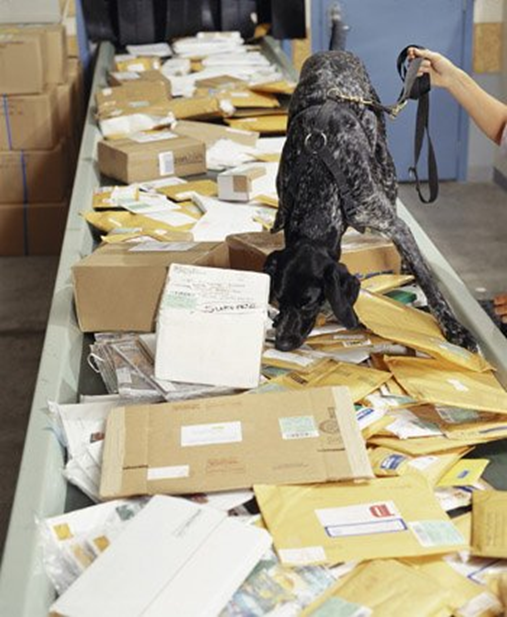
From the screening, a decision is made on whether the article needs to be further assessed. The decision for further assessment can be related to concerns that the article contains contraband or that there is duty payable.
Most countries set a threshold value for postal articles, and the rules below it, above it, and around the exceptions work as follows:
How postal article duty is treated
|
01 Below threshold No duty or tax collected. The article moves through without further customs action on duty. |
02 Above threshold Duty and tax may be payable. A full examination is often needed because the customs declaration is usually inadequate. |
03 Exceptions Some goods (typically tobacco and alcohol) attract duty regardless of value. |
In many countries, Customs is not permitted to open postal articles, and the opening must be done by a postal officer. Generally, because Customs and postal officers are co-located in the mail handling unit when international mail is being processed, this does not result in delays.
If it is determined that duty is payable on an article, the addressee is notified and asked to lodge an import declaration. If, when examining the goods, Customs is not satisfied with the declared value, additional documentation is sought to verify the value on the declaration. The import declaration and clearance procedure are generally the same as for air and sea cargo once the threshold has been reached.
These administrative arrangements and risk assessment techniques may change in some administrations as national postal services become deregulated, start to compete in new markets, and increase their efforts to develop standard electronic messages for postal traffic.
The best practice guide to Customs formalities in respect to postal traffic can be found in the Revised Kyoto Convention in Annex J, chapter 2.
|
|
Reading 4: Revised Kyoto Convention, Specific Annex J Chapter 2, Postal Traffic Revised Kyoto Convention, Specific Annex J Chapter 2, Postal Traffic. To view, please click on the following link: Text of the Revised Kyoto Agreement |